

THE HENDERSON–HASSELBALCH EQUATION
149
NH 4
NH 3
H 2 O
+
+ H 3 O
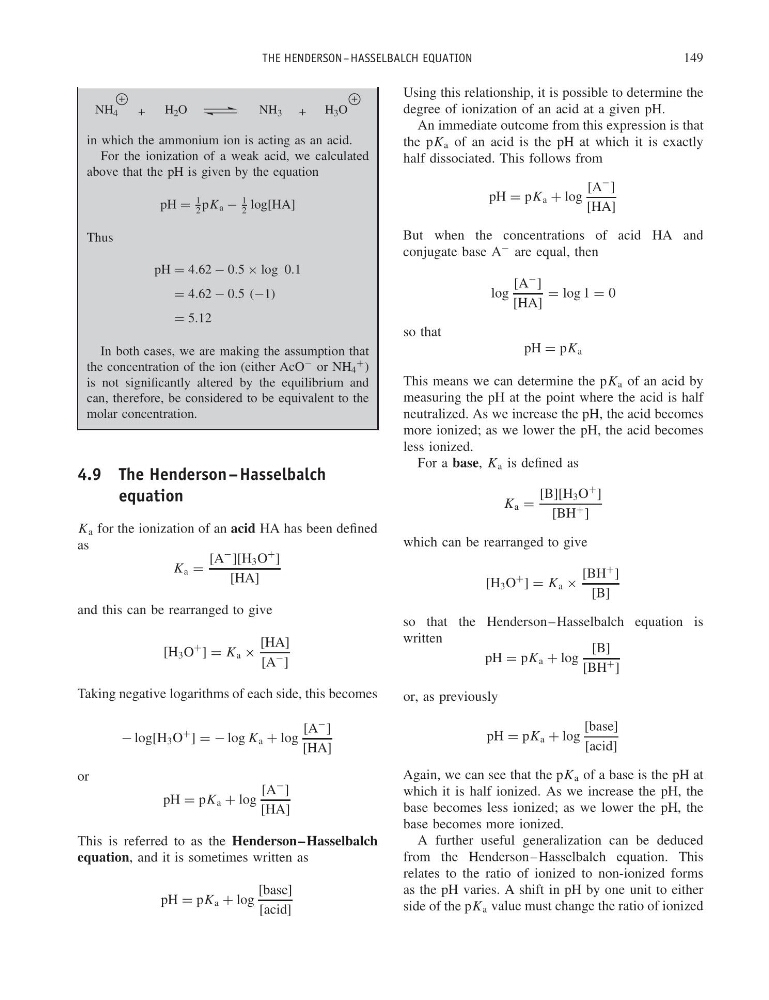
in which the ammonium ion is acting as an acid.
For the ionization of a weak acid, we calculated
above that the pH is given by the equation
pH =
1
2
pK a −
1
2
log[HA]
Thus
pH = 4.62 − 0.5 × log 0.1
= 4.62 − 0.5 (−1)
= 5.12
In both cases, we are making the assumption that
the concentration of the ion (either AcO
− or NH 4
+ )
is not significantly altered by the equilibrium and
can, therefore, be considered to be equivalent to the
molar concentration.
4.9 The Henderson–Hasselbalch
equation
K a for the ionization of an acid HA has been defined
as
K a =
[A
− ][H 3 O
+ ]
[HA]
and this can be rearranged to give
[H 3 O
+ ] = K a ×
[HA]
[A
− ]
Taking negative logarithms of each side, this becomes
− log[H 3 O
+ ] = − log K a + log
[A
− ]
[HA]
or
pH = pK a + log
[A
− ]
[HA]
This is referred to as the Henderson–Hasselbalch
equation, and it is sometimes written as
pH = pK a + log
[base]
[acid]
Using this relationship, it is possible to determine the
degree of ionization of an acid at a given pH.
An immediate outcome from this expression is that
the pK a of an acid is the pH at which it is exactly
half dissociated. This follows from
pH = pK a + log
[A
− ]
[HA]
But when the concentrations of acid HA and
conjugate base A
− are equal, then
log
[A
− ]
[HA]
= log 1 = 0
so that
pH = pK a
This means we can determine the pK a of an acid by
measuring the pH at the point where the acid is half
neutralized. As we increase the pH, the acid becomes
more ionized; as we lower the pH, the acid becomes
less ionized.
For a base, K a is defined as
K a =
[B][H 3 O
+ ]
[BH
+ ]
which can be rearranged to give
[H 3 O
+ ] = K a ×
[BH
+ ]
[B]
so that the Henderson–Hasselbalch equation is
written
pH = pK a + log
[B]
[BH
+ ]
or, as previously
pH = pK a + log
[base]
[acid]
Again, we can see that the pK a of a base is the pH at
which it is half ionized. As we increase the pH, the
base becomes less ionized; as we lower the pH, the
base becomes more ionized.
A further useful generalization can be deduced
from the Henderson–Hasselbalch equation. This
relates to the ratio of ionized to non-ionized forms
as the pH varies. A shift in pH by one unit to either
side of the pK a value must change the ratio of ionized
149
NH 4
NH 3
H 2 O
+
+ H 3 O
in which the ammonium ion is acting as an acid.
For the ionization of a weak acid, we calculated
above that the pH is given by the equation
pH =
1
2
pK a −
1
2
log[HA]
Thus
pH = 4.62 − 0.5 × log 0.1
= 4.62 − 0.5 (−1)
= 5.12
In both cases, we are making the assumption that
the concentration of the ion (either AcO
− or NH 4
+ )
is not significantly altered by the equilibrium and
can, therefore, be considered to be equivalent to the
molar concentration.
4.9 The Henderson–Hasselbalch
equation
K a for the ionization of an acid HA has been defined
as
K a =
[A
− ][H 3 O
+ ]
[HA]
and this can be rearranged to give
[H 3 O
+ ] = K a ×
[HA]
[A
− ]
Taking negative logarithms of each side, this becomes
− log[H 3 O
+ ] = − log K a + log
[A
− ]
[HA]
or
pH = pK a + log
[A
− ]
[HA]
This is referred to as the Henderson–Hasselbalch
equation, and it is sometimes written as
pH = pK a + log
[base]
[acid]
Using this relationship, it is possible to determine the
degree of ionization of an acid at a given pH.
An immediate outcome from this expression is that
the pK a of an acid is the pH at which it is exactly
half dissociated. This follows from
pH = pK a + log
[A
− ]
[HA]
But when the concentrations of acid HA and
conjugate base A
− are equal, then
log
[A
− ]
[HA]
= log 1 = 0
so that
pH = pK a
This means we can determine the pK a of an acid by
measuring the pH at the point where the acid is half
neutralized. As we increase the pH, the acid becomes
more ionized; as we lower the pH, the acid becomes
less ionized.
For a base, K a is defined as
K a =
[B][H 3 O
+ ]
[BH
+ ]
which can be rearranged to give
[H 3 O
+ ] = K a ×
[BH
+ ]
[B]
so that the Henderson–Hasselbalch equation is
written
pH = pK a + log
[B]
[BH
+ ]
or, as previously
pH = pK a + log
[base]
[acid]
Again, we can see that the pK a of a base is the pH at
which it is half ionized. As we increase the pH, the
base becomes less ionized; as we lower the pH, the
base becomes more ionized.
A further useful generalization can be deduced
from the Henderson–Hasselbalch equation. This
relates to the ratio of ionized to non-ionized forms
as the pH varies. A shift in pH by one unit to either
side of the pK a value must change the ratio of ionized