

4
Acids and bases
4.1 Acid–base equilibria
A particularly important concept in chemistry is that
associated with proton loss and gain, i.e. acidity and
basicity. Acids produce positively charged hydrogen
ions H
+ (protons) in aqueous solution; the more
acidic a compound is, the greater the concentration of
protons it produces. In water, protons do not have an
independent existence, but become strongly attached
to a water molecule to give the stable hydronium
ion H 3 O
+ . In the Brønsted–Lowry definition:
• an acid is a substance that will donate a proton;
• a base is a substance that will accept a proton.
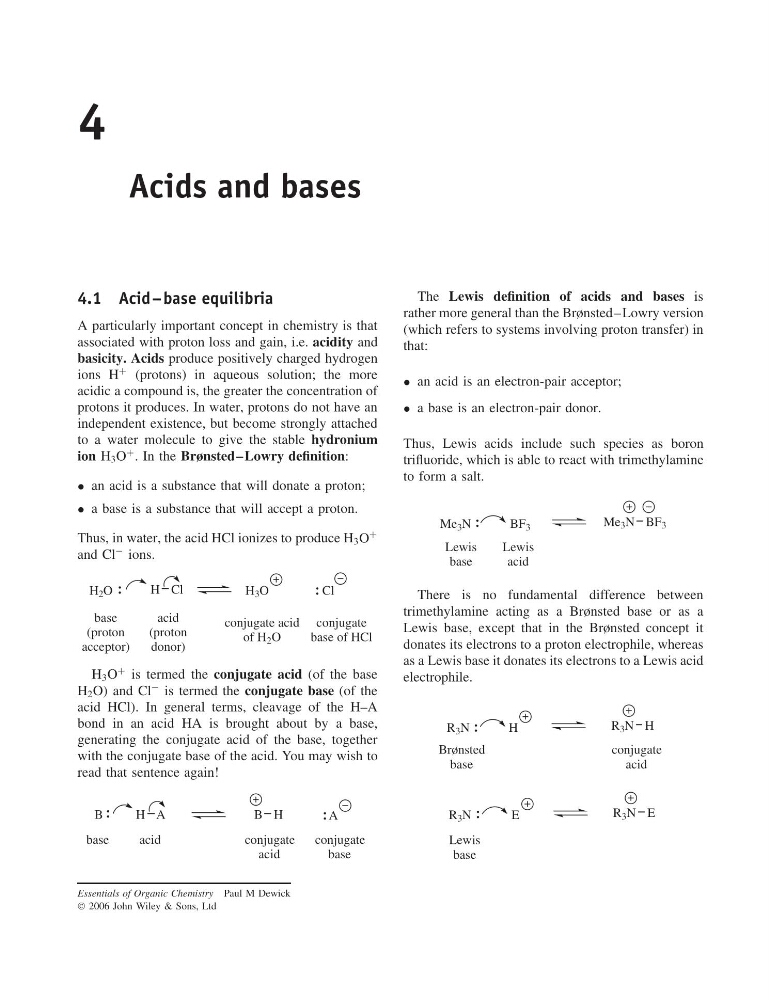
Thus, in water, the acid HCl ionizes to produce H 3 O
+
and Cl
− ions.
H 2 O
H Cl
Cl
H 3 O
base
(proton
acceptor)
acid
(proton
donor)
conjugate acid
of H 2 O
conjugate
base of HCl
H 3 O
+ is termed the conjugate acid (of the base
H 2 O) and Cl
− is termed the conjugate base (of the
acid HCl). In general terms, cleavage of the H–A
bond in an acid HA is brought about by a base,
generating the conjugate acid of the base, together
with the conjugate base of the acid. You may wish to
read that sentence again!
H A
B
B H
A
base
acid
conjugate
acid
conjugate
base
The Lewis definition of acids and bases is
rather more general than the Brønsted–Lowry version
(which refers to systems involving proton transfer) in
that:
• an acid is an electron-pair acceptor;
• a base is an electron-pair donor.
Thus, Lewis acids include such species as boron
trifluoride, which is able to react with trimethylamine
to form a salt.
Me 3 N
BF 3
Me 3 N BF 3
Lewis
base
Lewis
acid
There is no fundamental difference between
trimethylamine acting as a Brønsted base or as a
Lewis base, except that in the Brønsted concept it
donates its electrons to a proton electrophile, whereas
as a Lewis base it donates its electrons to a Lewis acid
electrophile.
R 3 N
H
R 3 N H
R 3 N
E
R 3 N E
Brønsted
base
conjugate
acid
Lewis
base
Essentials of Organic Chemistry Paul M Dewick
2006 John Wiley & Sons, Ltd
Acids and bases
4.1 Acid–base equilibria
A particularly important concept in chemistry is that
associated with proton loss and gain, i.e. acidity and
basicity. Acids produce positively charged hydrogen
ions H
+ (protons) in aqueous solution; the more
acidic a compound is, the greater the concentration of
protons it produces. In water, protons do not have an
independent existence, but become strongly attached
to a water molecule to give the stable hydronium
ion H 3 O
+ . In the Brønsted–Lowry definition:
• an acid is a substance that will donate a proton;
• a base is a substance that will accept a proton.
Thus, in water, the acid HCl ionizes to produce H 3 O
+
and Cl
− ions.
H 2 O
H Cl
Cl
H 3 O
base
(proton
acceptor)
acid
(proton
donor)
conjugate acid
of H 2 O
conjugate
base of HCl
H 3 O
+ is termed the conjugate acid (of the base
H 2 O) and Cl
− is termed the conjugate base (of the
acid HCl). In general terms, cleavage of the H–A
bond in an acid HA is brought about by a base,
generating the conjugate acid of the base, together
with the conjugate base of the acid. You may wish to
read that sentence again!
H A
B
B H
A
base
acid
conjugate
acid
conjugate
base
The Lewis definition of acids and bases is
rather more general than the Brønsted–Lowry version
(which refers to systems involving proton transfer) in
that:
• an acid is an electron-pair acceptor;
• a base is an electron-pair donor.
Thus, Lewis acids include such species as boron
trifluoride, which is able to react with trimethylamine
to form a salt.
Me 3 N
BF 3
Me 3 N BF 3
Lewis
base
Lewis
acid
There is no fundamental difference between
trimethylamine acting as a Brønsted base or as a
Lewis base, except that in the Brønsted concept it
donates its electrons to a proton electrophile, whereas
as a Lewis base it donates its electrons to a Lewis acid
electrophile.
R 3 N
H
R 3 N H
R 3 N
E
R 3 N E
Brønsted
base
conjugate
acid
Lewis
base
Essentials of Organic Chemistry Paul M Dewick
2006 John Wiley & Sons, Ltd