

118
STEREOCHEMISTRY
Box 3.21 (continued)
N
Me
O
O
N
Me
OH
(–)-hyoscyamine
H CH 2 OH
NMe
tropine
OH
N
O
O
H CH 2 OH
Me
O
(–)-hyoscine
(scopolamine)
N
OH
Me
O
scopine
≡
*
*
*
*
*
*
*
*
* chiral centres
tropine
N-methyl-8-azabicyclo[3,2,1]octane
NMe
tropane
1
3
5
8
7
2
6
4
plane of
symmetry
plane of
symmetry
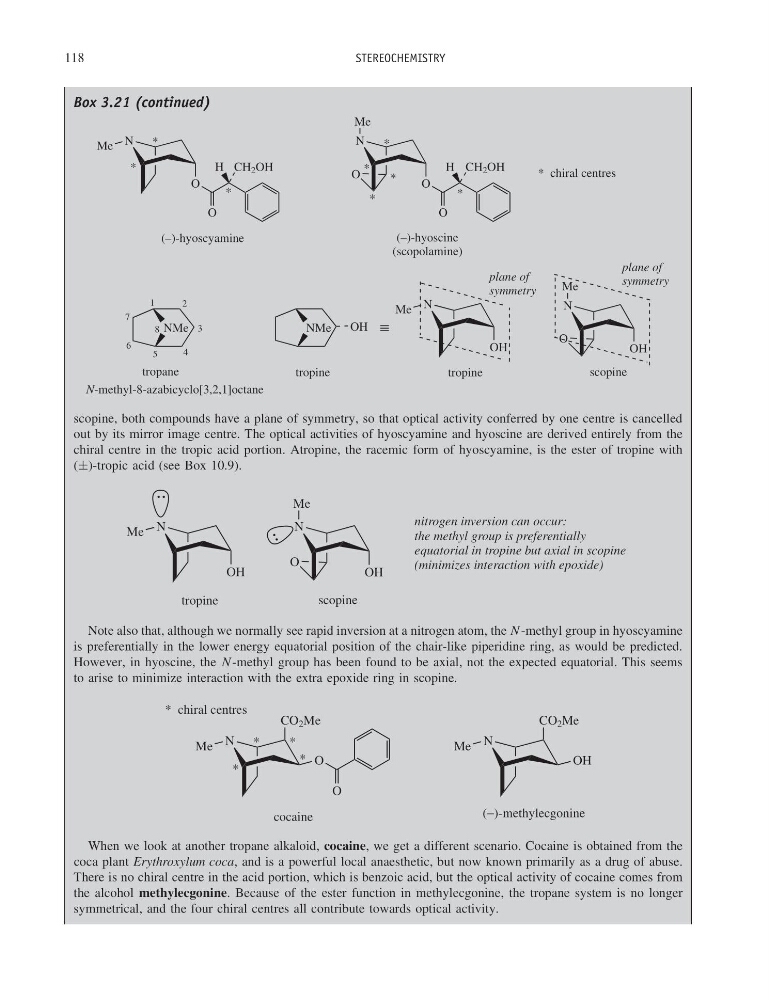
scopine, both compounds have a plane of symmetry, so that optical activity conferred by one centre is cancelled
out by its mirror image centre. The optical activities of hyoscyamine and hyoscine are derived entirely from the
chiral centre in the tropic acid portion. Atropine, the racemic form of hyoscyamine, is the ester of tropine with
(±)-tropic acid (see Box 10.9).
nitrogen inversion can occur:
the methyl group is preferentially
equatorial in tropine but axial in scopine
(minimizes interaction with epoxide)
N
Me
OH
N
OH
Me
O
scopine
tropine
Note also that, although we normally see rapid inversion at a nitrogen atom, the N-methyl group in hyoscyamine
is preferentially in the lower energy equatorial position of the chair-like piperidine ring, as would be predicted.
However, in hyoscine, the N-methyl group has been found to be axial, not the expected equatorial. This seems
to arise to minimize interaction with the extra epoxide ring in scopine.
N
Me
CO 2 Me
O
O
cocaine
N
Me
CO 2 Me
OH
(−)-methylecgonine
*
*
*
*
* chiral centres
When we look at another tropane alkaloid, cocaine, we get a different scenario. Cocaine is obtained from the
coca plant Erythroxylum coca, and is a powerful local anaesthetic, but now known primarily as a drug of abuse.
There is no chiral centre in the acid portion, which is benzoic acid, but the optical activity of cocaine comes from
the alcohol methylecgonine. Because of the ester function in methylecgonine, the tropane system is no longer
symmetrical, and the four chiral centres all contribute towards optical activity.
STEREOCHEMISTRY
Box 3.21 (continued)
N
Me
O
O
N
Me
OH
(–)-hyoscyamine
H CH 2 OH
NMe
tropine
OH
N
O
O
H CH 2 OH
Me
O
(–)-hyoscine
(scopolamine)
N
OH
Me
O
scopine
≡
*
*
*
*
*
*
*
*
* chiral centres
tropine
N-methyl-8-azabicyclo[3,2,1]octane
NMe
tropane
1
3
5
8
7
2
6
4
plane of
symmetry
plane of
symmetry
scopine, both compounds have a plane of symmetry, so that optical activity conferred by one centre is cancelled
out by its mirror image centre. The optical activities of hyoscyamine and hyoscine are derived entirely from the
chiral centre in the tropic acid portion. Atropine, the racemic form of hyoscyamine, is the ester of tropine with
(±)-tropic acid (see Box 10.9).
nitrogen inversion can occur:
the methyl group is preferentially
equatorial in tropine but axial in scopine
(minimizes interaction with epoxide)
N
Me
OH
N
OH
Me
O
scopine
tropine
Note also that, although we normally see rapid inversion at a nitrogen atom, the N-methyl group in hyoscyamine
is preferentially in the lower energy equatorial position of the chair-like piperidine ring, as would be predicted.
However, in hyoscine, the N-methyl group has been found to be axial, not the expected equatorial. This seems
to arise to minimize interaction with the extra epoxide ring in scopine.
N
Me
CO 2 Me
O
O
cocaine
N
Me
CO 2 Me
OH
(−)-methylecgonine
*
*
*
*
* chiral centres
When we look at another tropane alkaloid, cocaine, we get a different scenario. Cocaine is obtained from the
coca plant Erythroxylum coca, and is a powerful local anaesthetic, but now known primarily as a drug of abuse.
There is no chiral centre in the acid portion, which is benzoic acid, but the optical activity of cocaine comes from
the alcohol methylecgonine. Because of the ester function in methylecgonine, the tropane system is no longer
symmetrical, and the four chiral centres all contribute towards optical activity.