

98
STEREOCHEMISTRY
Box 3.14
NADH delivers hydride from a prochiral centre; NAD
+ has enantiotopic faces
NADH (reduced nicotinamide adenine dinucleotide) is utilized in biological reductions to deliver hydride to an
aldehyde or ketone carbonyl group (see Box 7.6). A proton from water is used to complete the process, and the
product is thus an alcohol. The reaction is catalysed by an enzyme called a dehydrogenase. The reverse reaction
may also be catalysed by the enzyme, namely the oxidation of an alcohol to an aldehyde or ketone. It is this
reverse reaction that provides the dehydrogenase nomenclature.
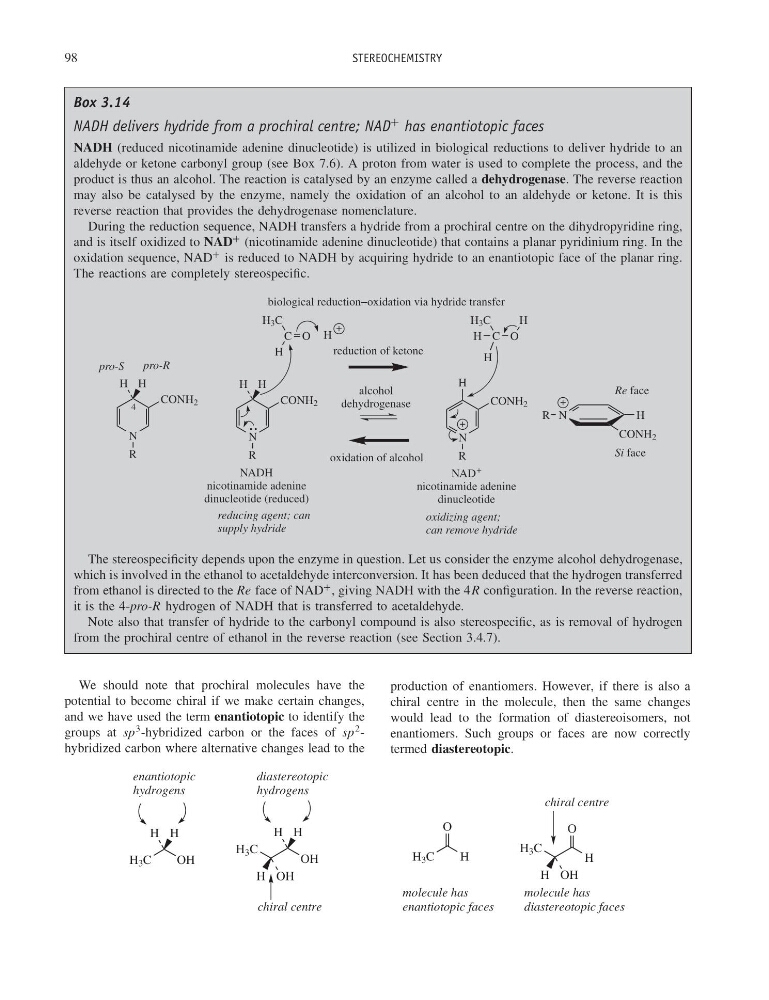
During the reduction sequence, NADH transfers a hydride from a prochiral centre on the dihydropyridine ring,
and is itself oxidized to NAD
+ (nicotinamide adenine dinucleotide) that contains a planar pyridinium ring. In the
oxidation sequence, NAD
+ is reduced to NADH by acquiring hydride to an enantiotopic face of the planar ring.
The reactions are completely stereospecific.
N
R
CONH 2
H
H
C O
H
H 3 C
N
R
CONH 2
C
H
H 3 C
H
NADH
nicotinamide adenine
dinucleotide (reduced)
alcohol
dehydrogenase
biological reduction−oxidation via hydride transfer
NAD
+
nicotinamide adenine
dinucleotide
reducing agent; can
supply hydride
oxidizing agent;
can remove hydride
N
R
CONH 2
H
H
pro-R
pro-S
N
H
CONH 2
R
Re face
Si face
reduction of ketone
oxidation of alcohol
O
H
H
4
H
The stereospecificity depends upon the enzyme in question. Let us consider the enzyme alcohol dehydrogenase,
which is involved in the ethanol to acetaldehyde interconversion. It has been deduced that the hydrogen transferred
from ethanol is directed to the Re face of NAD
+ , giving NADH with the 4R configuration. In the reverse reaction,
it is the 4-pro-R hydrogen of NADH that is transferred to acetaldehyde.
Note also that transfer of hydride to the carbonyl compound is also stereospecific, as is removal of hydrogen
from the prochiral centre of ethanol in the reverse reaction (see Section 3.4.7).
We should note that prochiral molecules have the
potential to become chiral if we make certain changes,
and we have used the term enantiotopic to identify the
groups at sp
3 -hybridized carbon or the faces of sp
2 -
hybridized carbon where alternative changes lead to the
production of enantiomers. However, if there is also a
chiral centre in the molecule, then the same changes
would lead to the formation of diastereoisomers, not
enantiomers. Such groups or faces are now correctly
termed diastereotopic.
H 3 C
OH
H
H
OH
H
H
H 3 C
OH
H
enantiotopic
hydrogens
diastereotopic
hydrogens
chiral centre
O
H 3 C
H
O
H
H 3 C
OH
H
molecule has
enantiotopic faces
molecule has
diastereotopic faces
chiral centre
STEREOCHEMISTRY
Box 3.14
NADH delivers hydride from a prochiral centre; NAD
+ has enantiotopic faces
NADH (reduced nicotinamide adenine dinucleotide) is utilized in biological reductions to deliver hydride to an
aldehyde or ketone carbonyl group (see Box 7.6). A proton from water is used to complete the process, and the
product is thus an alcohol. The reaction is catalysed by an enzyme called a dehydrogenase. The reverse reaction
may also be catalysed by the enzyme, namely the oxidation of an alcohol to an aldehyde or ketone. It is this
reverse reaction that provides the dehydrogenase nomenclature.
During the reduction sequence, NADH transfers a hydride from a prochiral centre on the dihydropyridine ring,
and is itself oxidized to NAD
+ (nicotinamide adenine dinucleotide) that contains a planar pyridinium ring. In the
oxidation sequence, NAD
+ is reduced to NADH by acquiring hydride to an enantiotopic face of the planar ring.
The reactions are completely stereospecific.
N
R
CONH 2
H
H
C O
H
H 3 C
N
R
CONH 2
C
H
H 3 C
H
NADH
nicotinamide adenine
dinucleotide (reduced)
alcohol
dehydrogenase
biological reduction−oxidation via hydride transfer
NAD
+
nicotinamide adenine
dinucleotide
reducing agent; can
supply hydride
oxidizing agent;
can remove hydride
N
R
CONH 2
H
H
pro-R
pro-S
N
H
CONH 2
R
Re face
Si face
reduction of ketone
oxidation of alcohol
O
H
H
4
H
The stereospecificity depends upon the enzyme in question. Let us consider the enzyme alcohol dehydrogenase,
which is involved in the ethanol to acetaldehyde interconversion. It has been deduced that the hydrogen transferred
from ethanol is directed to the Re face of NAD
+ , giving NADH with the 4R configuration. In the reverse reaction,
it is the 4-pro-R hydrogen of NADH that is transferred to acetaldehyde.
Note also that transfer of hydride to the carbonyl compound is also stereospecific, as is removal of hydrogen
from the prochiral centre of ethanol in the reverse reaction (see Section 3.4.7).
We should note that prochiral molecules have the
potential to become chiral if we make certain changes,
and we have used the term enantiotopic to identify the
groups at sp
3 -hybridized carbon or the faces of sp
2 -
hybridized carbon where alternative changes lead to the
production of enantiomers. However, if there is also a
chiral centre in the molecule, then the same changes
would lead to the formation of diastereoisomers, not
enantiomers. Such groups or faces are now correctly
termed diastereotopic.
H 3 C
OH
H
H
OH
H
H
H 3 C
OH
H
enantiotopic
hydrogens
diastereotopic
hydrogens
chiral centre
O
H 3 C
H
O
H
H 3 C
OH
H
molecule has
enantiotopic faces
molecule has
diastereotopic faces
chiral centre