

90
STEREOCHEMISTRY
3.4.5 Meso compounds
Now for a rather unexpected twist. We have seen
that if there are n chiral centres there should be 2
n
configurational isomers, and we have considered each
of these for n = 2 (e.g. ephedrine, pseudoephedrine). It
transpires that if the groups around chiral centres are the
same, then the number of stereoisomers is less than 2
n .
Thus, when n = 2, there are only three stereoisomers,
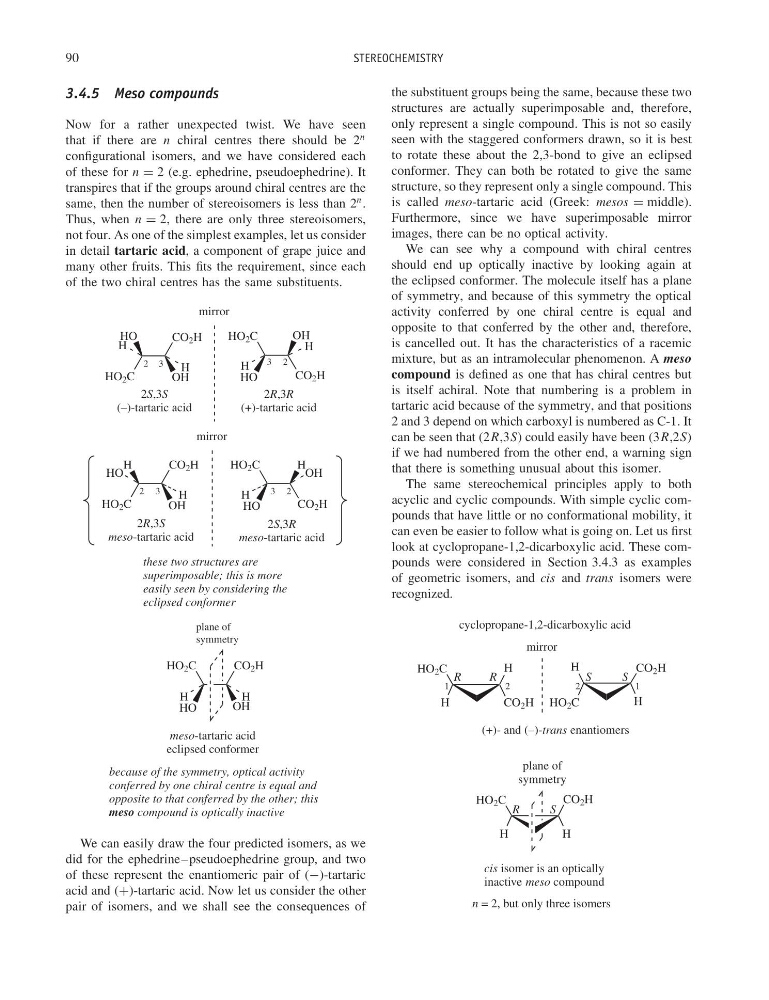
not four. As one of the simplest examples, let us consider
in detail tartaric acid, a component of grape juice and
many other fruits. This fits the requirement, since each
of the two chiral centres has the same substituents.
CO 2 H
HO 2 C
OH
HO
H
H
CO 2 H
HO 2 C
OH
H
H
HO
HO 2 C
CO 2 H
HO
H
H
OH
HO 2 C
CO 2 H
HO
OH
H
H
2S,3S
(–)-tartaric acid
2
2R,3R
(+)-tartaric acid
3
2
3
2 3
2R,3S
meso-tartaric acid
2
3
2S,3R
meso-tartaric acid
mirror
CO 2 H
HO 2 C
OH
HO
H
H
these two structures are
superimposable; this is more
easily seen by considering the
eclipsed conformer
because of the symmetry, optical activity
conferred by one chiral centre is equal and
opposite to that conferred by the other; this
meso compound is optically inactive
plane of
symmetry
meso-tartaric acid
eclipsed conformer
mirror
We can easily draw the four predicted isomers, as we
did for the ephedrine–pseudoephedrine group, and two
of these represent the enantiomeric pair of (−)-tartaric
acid and (+)-tartaric acid. Now let us consider the other
pair of isomers, and we shall see the consequences of
the substituent groups being the same, because these two
structures are actually superimposable and, therefore,
only represent a single compound. This is not so easily
seen with the staggered conformers drawn, so it is best
to rotate these about the 2,3-bond to give an eclipsed
conformer. They can both be rotated to give the same
structure, so they represent only a single compound. This
is called meso-tartaric acid (Greek: mesos = middle).
Furthermore, since we have superimposable mirror
images, there can be no optical activity.
We can see why a compound with chiral centres
should end up optically inactive by looking again at
the eclipsed conformer. The molecule itself has a plane
of symmetry, and because of this symmetry the optical
activity conferred by one chiral centre is equal and
opposite to that conferred by the other and, therefore,
is cancelled out. It has the characteristics of a racemic
mixture, but as an intramolecular phenomenon. A meso
compound is defined as one that has chiral centres but
is itself achiral. Note that numbering is a problem in
tartaric acid because of the symmetry, and that positions
2 and 3 depend on which carboxyl is numbered as C-1. It
can be seen that (2R,3S) could easily have been (3R,2S)
if we had numbered from the other end, a warning sign
that there is something unusual about this isomer.
The same stereochemical principles apply to both
acyclic and cyclic compounds. With simple cyclic compounds that have little or no conformational mobility, it
can even be easier to follow what is going on. Let us first
look at cyclopropane-1,2-dicarboxylic acid. These compounds were considered in Section 3.4.3 as examples
of geometric isomers, and cis and trans isomers were
recognized.
HO 2 C
H
CO 2 H
H
HO 2 C
H
H
CO 2 H
CO 2 H
H
H
HO 2 C
mirror
cis isomer is an optically
inactive meso compound
(+)- and (–)-trans enantiomers
plane of
symmetry
n = 2, but only three isomers
R
S
R
R
S
S
cyclopropane-1,2-dicarboxylic acid
2
1
1
2
STEREOCHEMISTRY
3.4.5 Meso compounds
Now for a rather unexpected twist. We have seen
that if there are n chiral centres there should be 2
n
configurational isomers, and we have considered each
of these for n = 2 (e.g. ephedrine, pseudoephedrine). It
transpires that if the groups around chiral centres are the
same, then the number of stereoisomers is less than 2
n .
Thus, when n = 2, there are only three stereoisomers,
not four. As one of the simplest examples, let us consider
in detail tartaric acid, a component of grape juice and
many other fruits. This fits the requirement, since each
of the two chiral centres has the same substituents.
CO 2 H
HO 2 C
OH
HO
H
H
CO 2 H
HO 2 C
OH
H
H
HO
HO 2 C
CO 2 H
HO
H
H
OH
HO 2 C
CO 2 H
HO
OH
H
H
2S,3S
(–)-tartaric acid
2
2R,3R
(+)-tartaric acid
3
2
3
2 3
2R,3S
meso-tartaric acid
2
3
2S,3R
meso-tartaric acid
mirror
CO 2 H
HO 2 C
OH
HO
H
H
these two structures are
superimposable; this is more
easily seen by considering the
eclipsed conformer
because of the symmetry, optical activity
conferred by one chiral centre is equal and
opposite to that conferred by the other; this
meso compound is optically inactive
plane of
symmetry
meso-tartaric acid
eclipsed conformer
mirror
We can easily draw the four predicted isomers, as we
did for the ephedrine–pseudoephedrine group, and two
of these represent the enantiomeric pair of (−)-tartaric
acid and (+)-tartaric acid. Now let us consider the other
pair of isomers, and we shall see the consequences of
the substituent groups being the same, because these two
structures are actually superimposable and, therefore,
only represent a single compound. This is not so easily
seen with the staggered conformers drawn, so it is best
to rotate these about the 2,3-bond to give an eclipsed
conformer. They can both be rotated to give the same
structure, so they represent only a single compound. This
is called meso-tartaric acid (Greek: mesos = middle).
Furthermore, since we have superimposable mirror
images, there can be no optical activity.
We can see why a compound with chiral centres
should end up optically inactive by looking again at
the eclipsed conformer. The molecule itself has a plane
of symmetry, and because of this symmetry the optical
activity conferred by one chiral centre is equal and
opposite to that conferred by the other and, therefore,
is cancelled out. It has the characteristics of a racemic
mixture, but as an intramolecular phenomenon. A meso
compound is defined as one that has chiral centres but
is itself achiral. Note that numbering is a problem in
tartaric acid because of the symmetry, and that positions
2 and 3 depend on which carboxyl is numbered as C-1. It
can be seen that (2R,3S) could easily have been (3R,2S)
if we had numbered from the other end, a warning sign
that there is something unusual about this isomer.
The same stereochemical principles apply to both
acyclic and cyclic compounds. With simple cyclic compounds that have little or no conformational mobility, it
can even be easier to follow what is going on. Let us first
look at cyclopropane-1,2-dicarboxylic acid. These compounds were considered in Section 3.4.3 as examples
of geometric isomers, and cis and trans isomers were
recognized.
HO 2 C
H
CO 2 H
H
HO 2 C
H
H
CO 2 H
CO 2 H
H
H
HO 2 C
mirror
cis isomer is an optically
inactive meso compound
(+)- and (–)-trans enantiomers
plane of
symmetry
n = 2, but only three isomers
R
S
R
R
S
S
cyclopropane-1,2-dicarboxylic acid
2
1
1
2