

dipole moments, dipole–dipole interactions are frequent. A carbonyl (C=O) functional
group, for example, constitutes a dipole since the carbon is electropositive and the
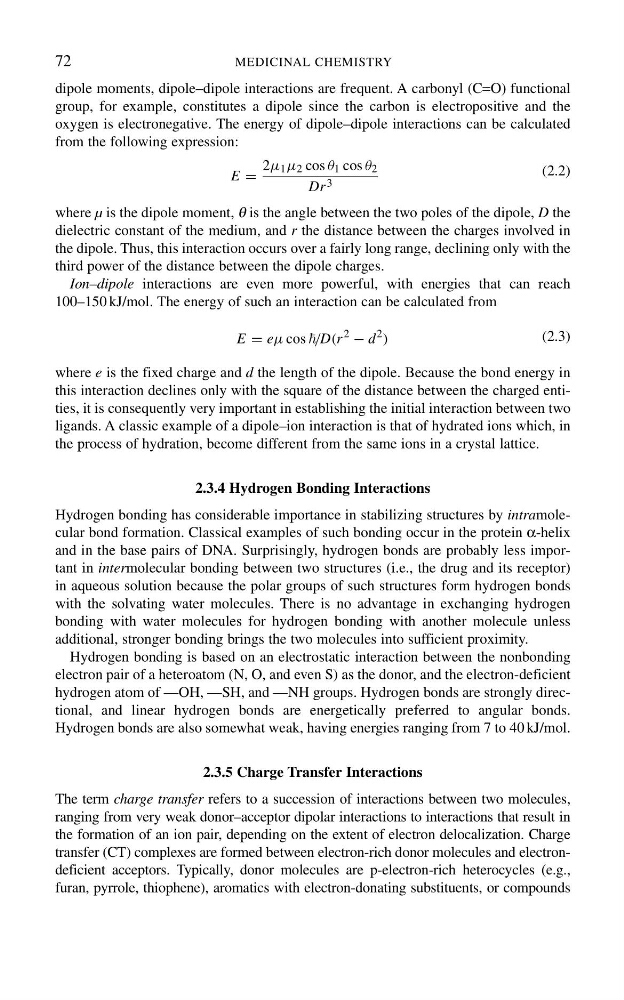
oxygen is electronegative. The energy of dipole–dipole interactions can be calculated
from the following expression:
where µ is the dipole moment, θ is the angle between the two poles of the dipole, D the
dielectric constant of the medium, and r the distance between the charges involved in
the dipole. Thus, this interaction occurs over a fairly long range, declining only with the
third power of the distance between the dipole charges.
Ion–dipole interactions are even more powerful, with energies that can reach
100–150 kJ/mol. The energy of such an interaction can be calculated from
where e is the fixed charge and d the length of the dipole. Because the bond energy in
this interaction declines only with the square of the distance between the charged entities, it is consequently very important in establishing the initial interaction between two
ligands. A classic example of a dipole–ion interaction is that of hydrated ions which, in
the process of hydration, become different from the same ions in a crystal lattice.
2.3.4 Hydrogen Bonding Interactions
Hydrogen bonding has considerable importance in stabilizing structures by intramolecular bond formation. Classical examples of such bonding occur in the protein α-helix
and in the base pairs of DNA. Surprisingly, hydrogen bonds are probably less important in intermolecular bonding between two structures (i.e., the drug and its receptor)
in aqueous solution because the polar groups of such structures form hydrogen bonds
with the solvating water molecules. There is no advantage in exchanging hydrogen
bonding with water molecules for hydrogen bonding with another molecule unless
additional, stronger bonding brings the two molecules into sufficient proximity.
Hydrogen bonding is based on an electrostatic interaction between the nonbonding
electron pair of a heteroatom (N, O, and even S) as the donor, and the electron-deficient
hydrogen atom of —OH, —SH, and —NH groups. Hydrogen bonds are strongly directional, and linear hydrogen bonds are energetically preferred to angular bonds.
Hydrogen bonds are also somewhat weak, having energies ranging from 7 to 40 kJ/mol.
2.3.5 Charge Transfer Interactions
The term charge transfer refers to a succession of interactions between two molecules,
ranging from very weak donor–acceptor dipolar interactions to interactions that result in
the formation of an ion pair, depending on the extent of electron delocalization. Charge
transfer (CT) complexes are formed between electron-rich donor molecules and electrondeficient acceptors. Typically, donor molecules are p-electron-rich heterocycles (e.g.,
furan, pyrrole, thiophene), aromatics with electron-donating substituents, or compounds
72
MEDICINAL CHEMISTRY
E =
2µ 1 µ 2 cos θ 1 cos θ 2
Dr 3
(2.2)
E = eµ cos /D(r
2
− d
2 )
(2.3)
group, for example, constitutes a dipole since the carbon is electropositive and the
oxygen is electronegative. The energy of dipole–dipole interactions can be calculated
from the following expression:
where µ is the dipole moment, θ is the angle between the two poles of the dipole, D the
dielectric constant of the medium, and r the distance between the charges involved in
the dipole. Thus, this interaction occurs over a fairly long range, declining only with the
third power of the distance between the dipole charges.
Ion–dipole interactions are even more powerful, with energies that can reach
100–150 kJ/mol. The energy of such an interaction can be calculated from
where e is the fixed charge and d the length of the dipole. Because the bond energy in
this interaction declines only with the square of the distance between the charged entities, it is consequently very important in establishing the initial interaction between two
ligands. A classic example of a dipole–ion interaction is that of hydrated ions which, in
the process of hydration, become different from the same ions in a crystal lattice.
2.3.4 Hydrogen Bonding Interactions
Hydrogen bonding has considerable importance in stabilizing structures by intramolecular bond formation. Classical examples of such bonding occur in the protein α-helix
and in the base pairs of DNA. Surprisingly, hydrogen bonds are probably less important in intermolecular bonding between two structures (i.e., the drug and its receptor)
in aqueous solution because the polar groups of such structures form hydrogen bonds
with the solvating water molecules. There is no advantage in exchanging hydrogen
bonding with water molecules for hydrogen bonding with another molecule unless
additional, stronger bonding brings the two molecules into sufficient proximity.
Hydrogen bonding is based on an electrostatic interaction between the nonbonding
electron pair of a heteroatom (N, O, and even S) as the donor, and the electron-deficient
hydrogen atom of —OH, —SH, and —NH groups. Hydrogen bonds are strongly directional, and linear hydrogen bonds are energetically preferred to angular bonds.
Hydrogen bonds are also somewhat weak, having energies ranging from 7 to 40 kJ/mol.
2.3.5 Charge Transfer Interactions
The term charge transfer refers to a succession of interactions between two molecules,
ranging from very weak donor–acceptor dipolar interactions to interactions that result in
the formation of an ion pair, depending on the extent of electron delocalization. Charge
transfer (CT) complexes are formed between electron-rich donor molecules and electrondeficient acceptors. Typically, donor molecules are p-electron-rich heterocycles (e.g.,
furan, pyrrole, thiophene), aromatics with electron-donating substituents, or compounds
72
MEDICINAL CHEMISTRY
E =
2µ 1 µ 2 cos θ 1 cos θ 2
Dr 3
(2.2)
E = eµ cos /D(r
2
− d
2 )
(2.3)