

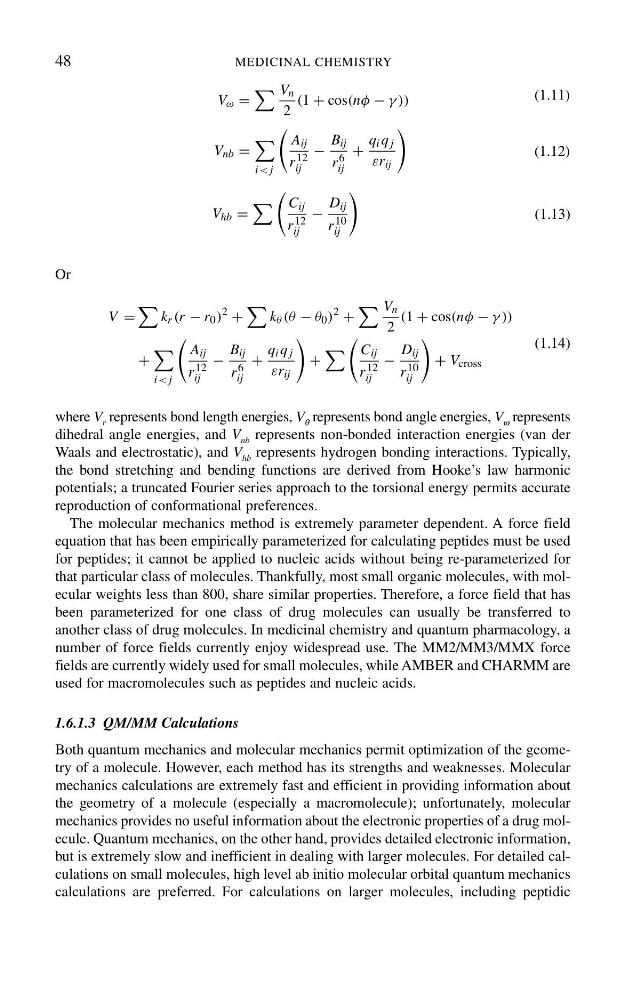
Or
where V r represents bond length energies, V θ represents bond angle energies, V ω represents
dihedral angle energies, and V nb represents non-bonded interaction energies (van der
Waals and electrostatic), and V hb represents hydrogen bonding interactions. Typically,
the bond stretching and bending functions are derived from Hooke’s law harmonic
potentials; a truncated Fourier series approach to the torsional energy permits accurate
reproduction of conformational preferences.
The molecular mechanics method is extremely parameter dependent. A force field
equation that has been empirically parameterized for calculating peptides must be used
for peptides; it cannot be applied to nucleic acids without being re-parameterized for
that particular class of molecules. Thankfully, most small organic molecules, with molecular weights less than 800, share similar properties. Therefore, a force field that has
been parameterized for one class of drug molecules can usually be transferred to
another class of drug molecules. In medicinal chemistry and quantum pharmacology, a
number of force fields currently enjoy widespread use. The MM2/MM3/MMX force
fields are currently widely used for small molecules, while AMBER and CHARMM are
used for macromolecules such as peptides and nucleic acids.
1.6.1.3 QM/MM Calculations
Both quantum mechanics and molecular mechanics permit optimization of the geometry of a molecule. However, each method has its strengths and weaknesses. Molecular
mechanics calculations are extremely fast and efficient in providing information about
the geometry of a molecule (especially a macromolecule); unfortunately, molecular
mechanics provides no useful information about the electronic properties of a drug molecule. Quantum mechanics, on the other hand, provides detailed electronic information,
but is extremely slow and inefficient in dealing with larger molecules. For detailed calculations on small molecules, high level ab initio molecular orbital quantum mechanics
calculations are preferred. For calculations on larger molecules, including peptidic
48
MEDICINAL CHEMISTRY
V ω =
V n
2
(1 + cos(nφ − γ ))
(1.11)
V nb =
i
r 12
ij
−
B ij
r 6
ij
+
q i q j
εr ij
(1.12)
V hb =
C ij
r 12
ij
−
D ij
r 10
ij
(1.13)
V =
k r (r − r 0 )
2
+
k θ (θ − θ 0 )
2
+
V n
2
(1 + cos(nφ − γ ))
+
i
r 12
ij
−
B ij
r 6
ij
+
q i q j
εr ij
+
C ij
r 12
ij
−
D ij
r 10
ij
+ V cross
(1.14)
where V r represents bond length energies, V θ represents bond angle energies, V ω represents
dihedral angle energies, and V nb represents non-bonded interaction energies (van der
Waals and electrostatic), and V hb represents hydrogen bonding interactions. Typically,
the bond stretching and bending functions are derived from Hooke’s law harmonic
potentials; a truncated Fourier series approach to the torsional energy permits accurate
reproduction of conformational preferences.
The molecular mechanics method is extremely parameter dependent. A force field
equation that has been empirically parameterized for calculating peptides must be used
for peptides; it cannot be applied to nucleic acids without being re-parameterized for
that particular class of molecules. Thankfully, most small organic molecules, with molecular weights less than 800, share similar properties. Therefore, a force field that has
been parameterized for one class of drug molecules can usually be transferred to
another class of drug molecules. In medicinal chemistry and quantum pharmacology, a
number of force fields currently enjoy widespread use. The MM2/MM3/MMX force
fields are currently widely used for small molecules, while AMBER and CHARMM are
used for macromolecules such as peptides and nucleic acids.
1.6.1.3 QM/MM Calculations
Both quantum mechanics and molecular mechanics permit optimization of the geometry of a molecule. However, each method has its strengths and weaknesses. Molecular
mechanics calculations are extremely fast and efficient in providing information about
the geometry of a molecule (especially a macromolecule); unfortunately, molecular
mechanics provides no useful information about the electronic properties of a drug molecule. Quantum mechanics, on the other hand, provides detailed electronic information,
but is extremely slow and inefficient in dealing with larger molecules. For detailed calculations on small molecules, high level ab initio molecular orbital quantum mechanics
calculations are preferred. For calculations on larger molecules, including peptidic
48
MEDICINAL CHEMISTRY
V ω =
V n
2
(1 + cos(nφ − γ ))
(1.11)
V nb =
i
r 12
ij
−
B ij
r 6
ij
+
q i q j
εr ij
(1.12)
V hb =
C ij
r 12
ij
−
D ij
r 10
ij
(1.13)
V =
k r (r − r 0 )
2
+
k θ (θ − θ 0 )
2
+
V n
2
(1 + cos(nφ − γ ))
+
i
r 12
ij
−
B ij
r 6
ij
+
q i q j
εr ij
+
C ij
r 12
ij
−
D ij
r 10
ij
+ V cross
(1.14)