

9.6.1 Antiparasitic Drugs Targeting Protozoans
Although there is a variety of protozoan infestations, malaria is probably the most
important on a world-wide scale. Four species of the plasmodium parasite cause malaria
in humans: Plasmodium falciparum, Plasmodium vivax, Plasmodium malariae, and
Plasmodium ovale; P. falciparum is responsible for most of the deaths. Malaria parasites
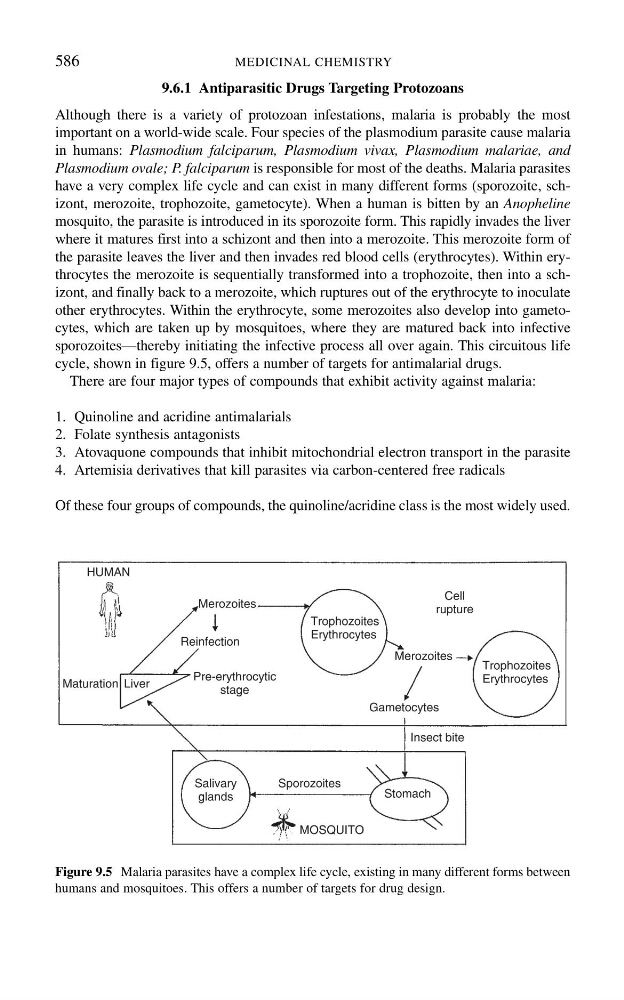
have a very complex life cycle and can exist in many different forms (sporozoite, schizont, merozoite, trophozoite, gametocyte). When a human is bitten by an Anopheline
mosquito, the parasite is introduced in its sporozoite form. This rapidly invades the liver
where it matures first into a schizont and then into a merozoite. This merozoite form of
the parasite leaves the liver and then invades red blood cells (erythrocytes). Within erythrocytes the merozoite is sequentially transformed into a trophozoite, then into a schizont, and finally back to a merozoite, which ruptures out of the erythrocyte to inoculate
other erythrocytes. Within the erythrocyte, some merozoites also develop into gametocytes, which are taken up by mosquitoes, where they are matured back into infective
sporozoites—thereby initiating the infective process all over again. This circuitous life
cycle, shown in figure 9.5, offers a number of targets for antimalarial drugs.
There are four major types of compounds that exhibit activity against malaria:
1. Quinoline and acridine antimalarials
2. Folate synthesis antagonists
3. Atovaquone compounds that inhibit mitochondrial electron transport in the parasite
4. Artemisia derivatives that kill parasites via carbon-centered free radicals
Of these four groups of compounds, the quinoline/acridine class is the most widely used.
586
MEDICINAL CHEMISTRY
Figure 9.5 Malaria parasites have a complex life cycle, existing in many different forms between
humans and mosquitoes. This offers a number of targets for drug design.