

Correlations between physicochemical parameters and the antibacterial activity of
sulfa drugs have been explored for a long time. The value of the acid dissociation constant of the sulfonamide group (pK a ) is essential, the optimum being between 6.0 and 7.4.
This pK a depends on the electronegativity of the -SO 2 - group, but the degree of dissociation is also greatly influenced by the intracellular pH. For the optimal balance
between intrinsic activity and penetration of the bacterial cell membrane, a 50% ionization is desirable. The hydrophobicity of the drug molecule also plays a role in its activity,
as Hansch correlations have shown.
9.4.4.2 Antibacterials Targeting RNA Polymerase: Rifamycins
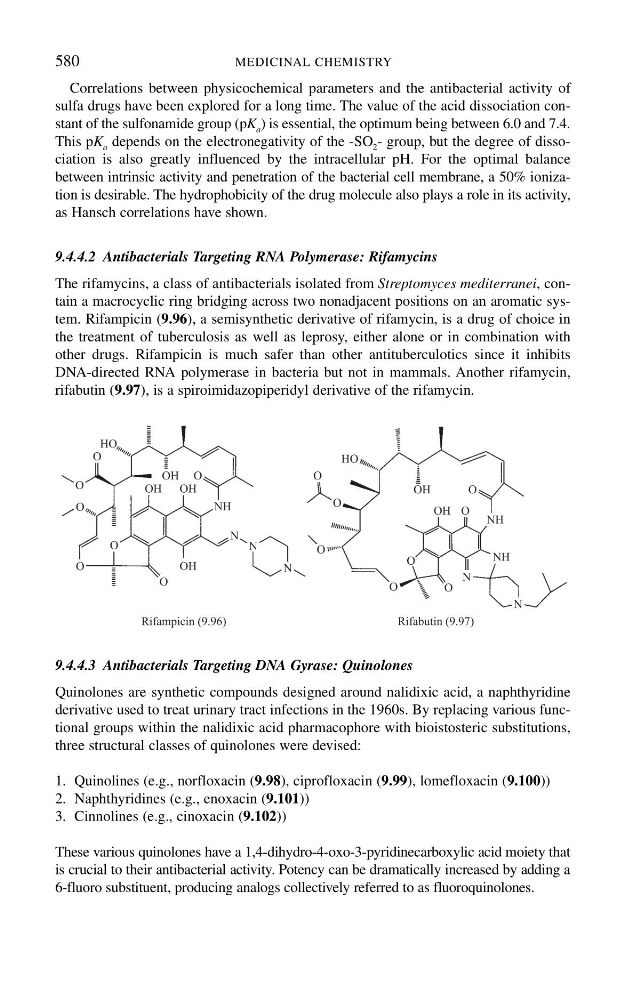
The rifamycins, a class of antibacterials isolated from Streptomyces mediterranei, contain a macrocyclic ring bridging across two nonadjacent positions on an aromatic system. Rifampicin (9.96), a semisynthetic derivative of rifamycin, is a drug of choice in
the treatment of tuberculosis as well as leprosy, either alone or in combination with
other drugs. Rifampicin is much safer than other antituberculotics since it inhibits
DNA-directed RNA polymerase in bacteria but not in mammals. Another rifamycin,
rifabutin (9.97), is a spiroimidazopiperidyl derivative of the rifamycin.
9.4.4.3 Antibacterials Targeting DNA Gyrase: Quinolones
Quinolones are synthetic compounds designed around nalidixic acid, a naphthyridine
derivative used to treat urinary tract infections in the 1960s. By replacing various functional groups within the nalidixic acid pharmacophore with bioistosteric substitutions,
three structural classes of quinolones were devised:
1. Quinolines (e.g., norfloxacin (9.98), ciprofloxacin (9.99), lomefloxacin (9.100))
2. Naphthyridines (e.g., enoxacin (9.101))
3. Cinnolines (e.g., cinoxacin (9.102))
These various quinolones have a 1,4-dihydro-4-oxo-3-pyridinecarboxylic acid moiety that
is crucial to their antibacterial activity. Potency can be dramatically increased by adding a
6-fluoro substituent, producing analogs collectively referred to as fluoroquinolones.
580
MEDICINAL CHEMISTRY