

This chapter focuses primarily on endogenous molecules as nonmessenger targets for
drug design. There are many such molecules. As discussed earlier, amino acid derivatives, lipids (eicosanoids), nucleoside/nucleotide derivatives, and carbohydrates all
afford heterocyclic leads for drug design. The discussion will not be repeated here.
In addition to endogenous heterocycles, there are also medically important exogenous heterocycles. Nature is a great source of molecular diversity, especially for bioactive molecules. Nature provides a rich source of peptidic (penicillin), lipid (terpenes),
and other (alkaloid) heterocyclic natural products. These compounds are produced in
plants or nonhuman animals, but may exert profound biological effects when administered to humans.
Heterocycles which are not biosynthesized in humans, but which are natural products
produced by other life forms, are very important in the history of drug design. This is
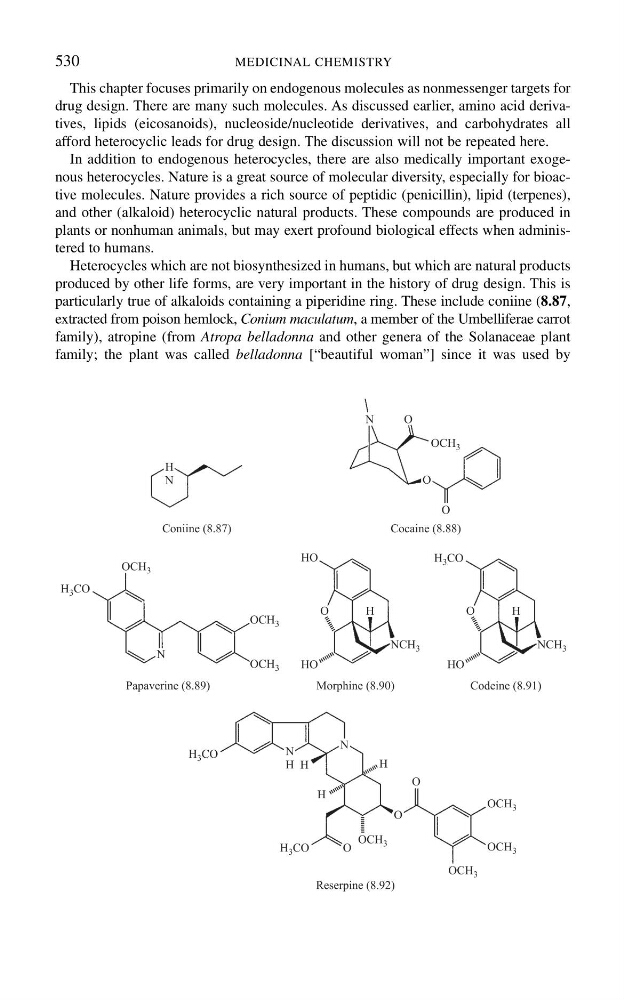
particularly true of alkaloids containing a piperidine ring. These include coniine (8.87,
extracted from poison hemlock, Conium maculatum, a member of the Umbelliferae carrot
family), atropine (from Atropa belladonna and other genera of the Solanaceae plant
family; the plant was called belladonna [“beautiful woman”] since it was used by
530
MEDICINAL CHEMISTRY