

milk, and eggs contain vitamin A itself, a cleavage product of β-carotene. It is necessary
for the growth of young animals since it regulates bone-cell formation and the shape of
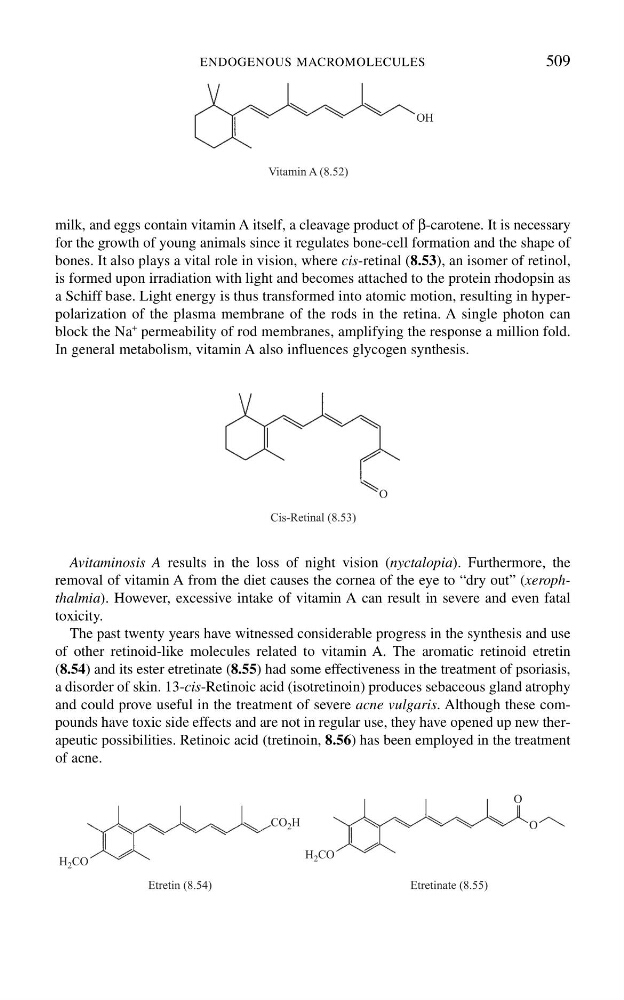
bones. It also plays a vital role in vision, where cis-retinal (8.53), an isomer of retinol,
is formed upon irradiation with light and becomes attached to the protein rhodopsin as
a Schiff base. Light energy is thus transformed into atomic motion, resulting in hyperpolarization of the plasma membrane of the rods in the retina. A single photon can
block the Na
+ permeability of rod membranes, amplifying the response a million fold.
In general metabolism, vitamin A also influences glycogen synthesis.
Avitaminosis A results in the loss of night vision (nyctalopia). Furthermore, the
removal of vitamin A from the diet causes the cornea of the eye to “dry out” (xerophthalmia). However, excessive intake of vitamin A can result in severe and even fatal
toxicity.
The past twenty years have witnessed considerable progress in the synthesis and use
of other retinoid-like molecules related to vitamin A. The aromatic retinoid etretin
(8.54) and its ester etretinate (8.55) had some effectiveness in the treatment of psoriasis,
a disorder of skin. 13-cis-Retinoic acid (isotretinoin) produces sebaceous gland atrophy
and could prove useful in the treatment of severe acne vulgaris. Although these compounds have toxic side effects and are not in regular use, they have opened up new therapeutic possibilities. Retinoic acid (tretinoin, 8.56) has been employed in the treatment
of acne.
ENDOGENOUS MACROMOLECULES
509
for the growth of young animals since it regulates bone-cell formation and the shape of
bones. It also plays a vital role in vision, where cis-retinal (8.53), an isomer of retinol,
is formed upon irradiation with light and becomes attached to the protein rhodopsin as
a Schiff base. Light energy is thus transformed into atomic motion, resulting in hyperpolarization of the plasma membrane of the rods in the retina. A single photon can
block the Na
+ permeability of rod membranes, amplifying the response a million fold.
In general metabolism, vitamin A also influences glycogen synthesis.
Avitaminosis A results in the loss of night vision (nyctalopia). Furthermore, the
removal of vitamin A from the diet causes the cornea of the eye to “dry out” (xerophthalmia). However, excessive intake of vitamin A can result in severe and even fatal
toxicity.
The past twenty years have witnessed considerable progress in the synthesis and use
of other retinoid-like molecules related to vitamin A. The aromatic retinoid etretin
(8.54) and its ester etretinate (8.55) had some effectiveness in the treatment of psoriasis,
a disorder of skin. 13-cis-Retinoic acid (isotretinoin) produces sebaceous gland atrophy
and could prove useful in the treatment of severe acne vulgaris. Although these compounds have toxic side effects and are not in regular use, they have opened up new therapeutic possibilities. Retinoic acid (tretinoin, 8.56) has been employed in the treatment
of acne.
ENDOGENOUS MACROMOLECULES
509