

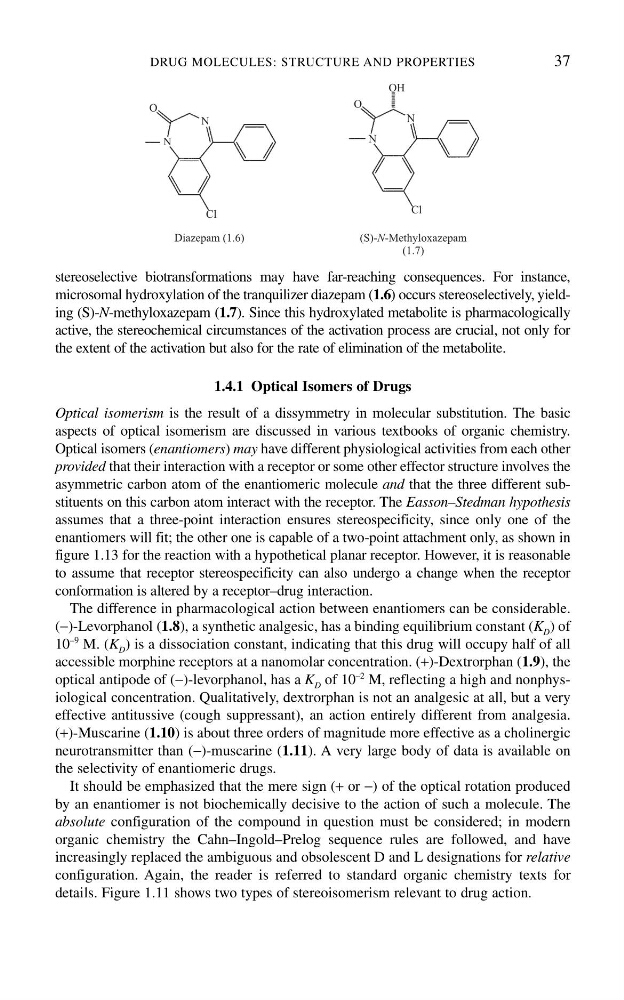
stereoselective biotransformations may have far-reaching consequences. For instance,
microsomal hydroxylation of the tranquilizer diazepam (1.6) occurs stereoselectively, yielding (S)-N-methyloxazepam (1.7). Since this hydroxylated metabolite is pharmacologically
active, the stereochemical circumstances of the activation process are crucial, not only for
the extent of the activation but also for the rate of elimination of the metabolite.
1.4.1 Optical Isomers of Drugs
Optical isomerism is the result of a dissymmetry in molecular substitution. The basic
aspects of optical isomerism are discussed in various textbooks of organic chemistry.
Optical isomers (enantiomers) may have different physiological activities from each other
provided that their interaction with a receptor or some other effector structure involves the
asymmetric carbon atom of the enantiomeric molecule and that the three different substituents on this carbon atom interact with the receptor. The Easson–Stedman hypothesis
assumes that a three-point interaction ensures stereospecificity, since only one of the
enantiomers will fit; the other one is capable of a two-point attachment only, as shown in
figure 1.13 for the reaction with a hypothetical planar receptor. However, it is reasonable
to assume that receptor stereospecificity can also undergo a change when the receptor
conformation is altered by a receptor–drug interaction.
The difference in pharmacological action between enantiomers can be considerable.
(−)-Levorphanol (1.8), a synthetic analgesic, has a binding equilibrium constant (K D ) of
10
–9 M. (K D ) is a dissociation constant, indicating that this drug will occupy half of all
accessible morphine receptors at a nanomolar concentration. (+)-Dextrorphan (1.9), the
optical antipode of (−)-levorphanol, has a K D of 10
–2 M, reflecting a high and nonphysiological concentration. Qualitatively, dextrorphan is not an analgesic at all, but a very
effective antitussive (cough suppressant), an action entirely different from analgesia.
(+)-Muscarine (1.10) is about three orders of magnitude more effective as a cholinergic
neurotransmitter than (−)-muscarine (1.11). A very large body of data is available on
the selectivity of enantiomeric drugs.
It should be emphasized that the mere sign (+ or −) of the optical rotation produced
by an enantiomer is not biochemically decisive to the action of such a molecule. The
absolute configuration of the compound in question must be considered; in modern
organic chemistry the Cahn–Ingold–Prelog sequence rules are followed, and have
increasingly replaced the ambiguous and obsolescent D and L designations for relative
configuration. Again, the reader is referred to standard organic chemistry texts for
details. Figure 1.11 shows two types of stereoisomerism relevant to drug action.
DRUG MOLECULES: STRUCTURE AND PROPERTIES
37
O
O
Cl
OH
Cl
Diazepam (1.6)
(S)- -Methyloxazepam
(1.7)
N
N
N
N
N
microsomal hydroxylation of the tranquilizer diazepam (1.6) occurs stereoselectively, yielding (S)-N-methyloxazepam (1.7). Since this hydroxylated metabolite is pharmacologically
active, the stereochemical circumstances of the activation process are crucial, not only for
the extent of the activation but also for the rate of elimination of the metabolite.
1.4.1 Optical Isomers of Drugs
Optical isomerism is the result of a dissymmetry in molecular substitution. The basic
aspects of optical isomerism are discussed in various textbooks of organic chemistry.
Optical isomers (enantiomers) may have different physiological activities from each other
provided that their interaction with a receptor or some other effector structure involves the
asymmetric carbon atom of the enantiomeric molecule and that the three different substituents on this carbon atom interact with the receptor. The Easson–Stedman hypothesis
assumes that a three-point interaction ensures stereospecificity, since only one of the
enantiomers will fit; the other one is capable of a two-point attachment only, as shown in
figure 1.13 for the reaction with a hypothetical planar receptor. However, it is reasonable
to assume that receptor stereospecificity can also undergo a change when the receptor
conformation is altered by a receptor–drug interaction.
The difference in pharmacological action between enantiomers can be considerable.
(−)-Levorphanol (1.8), a synthetic analgesic, has a binding equilibrium constant (K D ) of
10
–9 M. (K D ) is a dissociation constant, indicating that this drug will occupy half of all
accessible morphine receptors at a nanomolar concentration. (+)-Dextrorphan (1.9), the
optical antipode of (−)-levorphanol, has a K D of 10
–2 M, reflecting a high and nonphysiological concentration. Qualitatively, dextrorphan is not an analgesic at all, but a very
effective antitussive (cough suppressant), an action entirely different from analgesia.
(+)-Muscarine (1.10) is about three orders of magnitude more effective as a cholinergic
neurotransmitter than (−)-muscarine (1.11). A very large body of data is available on
the selectivity of enantiomeric drugs.
It should be emphasized that the mere sign (+ or −) of the optical rotation produced
by an enantiomer is not biochemically decisive to the action of such a molecule. The
absolute configuration of the compound in question must be considered; in modern
organic chemistry the Cahn–Ingold–Prelog sequence rules are followed, and have
increasingly replaced the ambiguous and obsolescent D and L designations for relative
configuration. Again, the reader is referred to standard organic chemistry texts for
details. Figure 1.11 shows two types of stereoisomerism relevant to drug action.
DRUG MOLECULES: STRUCTURE AND PROPERTIES
37
O
O
Cl
OH
Cl
Diazepam (1.6)
(S)- -Methyloxazepam
(1.7)
N
N
N
N
N