

5. The activity of a compound depends to a very great extent on the position of the
23-carbonyl oxygen, which is held quite rigidly by ring D and the double bond. The
standard is the position of the carbonyl relative to the rigid backbone of digitoxigenin. In synthetic analogs, every 0.22 nm deviation from this position causes a loss
of activity by one order of magnitude from a maximum IC 50 of 49 nM. This correlation is highly significant, as the regression coefficient of r
2
= 0.993 indicates.
6. Removal of the sugar portion allows epimerization of the 3β-OH group, with a
decrease in activity and an increase in toxicity due to changes in polarity.
More recently, a polypeptide of 49 amino acids was isolated from a sea anemone. This
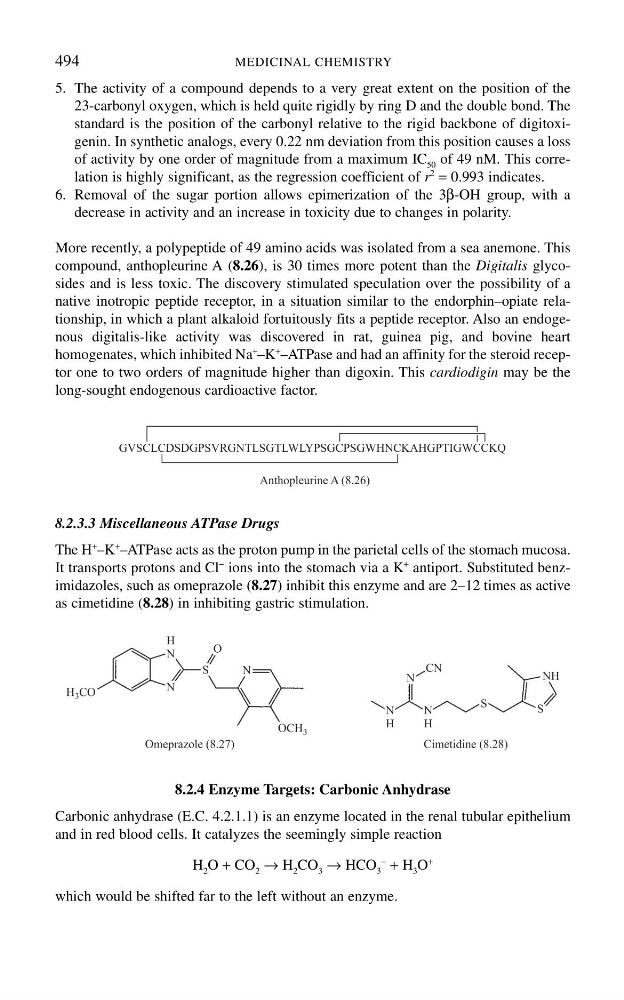
compound, anthopleurine A (8.26), is 30 times more potent than the Digitalis glycosides and is less toxic. The discovery stimulated speculation over the possibility of a
native inotropic peptide receptor, in a situation similar to the endorphin–opiate relationship, in which a plant alkaloid fortuitously fits a peptide receptor. Also an endogenous digitalis-like activity was discovered in rat, guinea pig, and bovine heart
homogenates, which inhibited Na
+
–K
+
–ATPase and had an affinity for the steroid receptor one to two orders of magnitude higher than digoxin. This cardiodigin may be the
long-sought endogenous cardioactive factor.
8.2.3.3 Miscellaneous ATPase Drugs
The H
+
–K
+
–ATPase acts as the proton pump in the parietal cells of the stomach mucosa.
It transports protons and Cl
− ions into the stomach via a K
+ antiport. Substituted benzimidazoles, such as omeprazole (8.27) inhibit this enzyme and are 2–12 times as active
as cimetidine (8.28) in inhibiting gastric stimulation.
8.2.4 Enzyme Targets: Carbonic Anhydrase
Carbonic anhydrase (E.C. 4.2.1.1) is an enzyme located in the renal tubular epithelium
and in red blood cells. It catalyzes the seemingly simple reaction
H 2 O + CO 2 → H 2 CO 3 → HCO 3
−
+ H 3 O
+
which would be shifted far to the left without an enzyme.
494
MEDICINAL CHEMISTRY
23-carbonyl oxygen, which is held quite rigidly by ring D and the double bond. The
standard is the position of the carbonyl relative to the rigid backbone of digitoxigenin. In synthetic analogs, every 0.22 nm deviation from this position causes a loss
of activity by one order of magnitude from a maximum IC 50 of 49 nM. This correlation is highly significant, as the regression coefficient of r
2
= 0.993 indicates.
6. Removal of the sugar portion allows epimerization of the 3β-OH group, with a
decrease in activity and an increase in toxicity due to changes in polarity.
More recently, a polypeptide of 49 amino acids was isolated from a sea anemone. This
compound, anthopleurine A (8.26), is 30 times more potent than the Digitalis glycosides and is less toxic. The discovery stimulated speculation over the possibility of a
native inotropic peptide receptor, in a situation similar to the endorphin–opiate relationship, in which a plant alkaloid fortuitously fits a peptide receptor. Also an endogenous digitalis-like activity was discovered in rat, guinea pig, and bovine heart
homogenates, which inhibited Na
+
–K
+
–ATPase and had an affinity for the steroid receptor one to two orders of magnitude higher than digoxin. This cardiodigin may be the
long-sought endogenous cardioactive factor.
8.2.3.3 Miscellaneous ATPase Drugs
The H
+
–K
+
–ATPase acts as the proton pump in the parietal cells of the stomach mucosa.
It transports protons and Cl
− ions into the stomach via a K
+ antiport. Substituted benzimidazoles, such as omeprazole (8.27) inhibit this enzyme and are 2–12 times as active
as cimetidine (8.28) in inhibiting gastric stimulation.
8.2.4 Enzyme Targets: Carbonic Anhydrase
Carbonic anhydrase (E.C. 4.2.1.1) is an enzyme located in the renal tubular epithelium
and in red blood cells. It catalyzes the seemingly simple reaction
H 2 O + CO 2 → H 2 CO 3 → HCO 3
−
+ H 3 O
+
which would be shifted far to the left without an enzyme.
494
MEDICINAL CHEMISTRY