

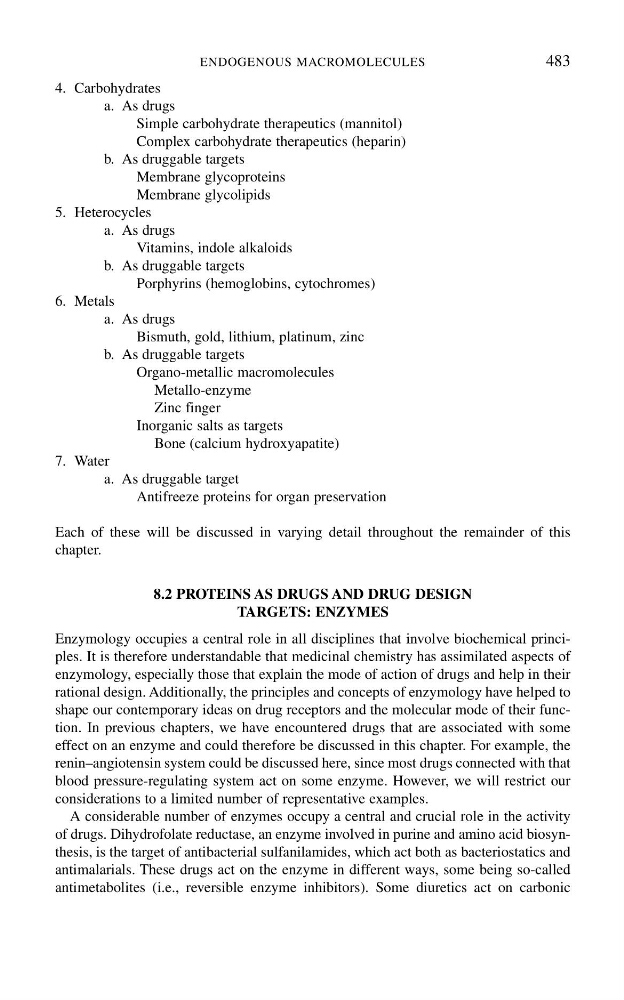
4. Carbohydrates
a. As drugs
Simple carbohydrate therapeutics (mannitol)
Complex carbohydrate therapeutics (heparin)
b. As druggable targets
Membrane glycoproteins
Membrane glycolipids
5. Heterocycles
a. As drugs
Vitamins, indole alkaloids
b. As druggable targets
Porphyrins (hemoglobins, cytochromes)
6. Metals
a. As drugs
Bismuth, gold, lithium, platinum, zinc
b. As druggable targets
Organo-metallic macromolecules
Metallo-enzyme
Zinc finger
Inorganic salts as targets
Bone (calcium hydroxyapatite)
7. Water
a. As druggable target
Antifreeze proteins for organ preservation
Each of these will be discussed in varying detail throughout the remainder of this
chapter.
8.2 PROTEINS AS DRUGS AND DRUG DESIGN
TARGETS: ENZYMES
Enzymology occupies a central role in all disciplines that involve biochemical principles. It is therefore understandable that medicinal chemistry has assimilated aspects of
enzymology, especially those that explain the mode of action of drugs and help in their
rational design. Additionally, the principles and concepts of enzymology have helped to
shape our contemporary ideas on drug receptors and the molecular mode of their function. In previous chapters, we have encountered drugs that are associated with some
effect on an enzyme and could therefore be discussed in this chapter. For example, the
renin–angiotensin system could be discussed here, since most drugs connected with that
blood pressure-regulating system act on some enzyme. However, we will restrict our
considerations to a limited number of representative examples.
A considerable number of enzymes occupy a central and crucial role in the activity
of drugs. Dihydrofolate reductase, an enzyme involved in purine and amino acid biosynthesis, is the target of antibacterial sulfanilamides, which act both as bacteriostatics and
antimalarials. These drugs act on the enzyme in different ways, some being so-called
antimetabolites (i.e., reversible enzyme inhibitors). Some diuretics act on carbonic
ENDOGENOUS MACROMOLECULES
483
a. As drugs
Simple carbohydrate therapeutics (mannitol)
Complex carbohydrate therapeutics (heparin)
b. As druggable targets
Membrane glycoproteins
Membrane glycolipids
5. Heterocycles
a. As drugs
Vitamins, indole alkaloids
b. As druggable targets
Porphyrins (hemoglobins, cytochromes)
6. Metals
a. As drugs
Bismuth, gold, lithium, platinum, zinc
b. As druggable targets
Organo-metallic macromolecules
Metallo-enzyme
Zinc finger
Inorganic salts as targets
Bone (calcium hydroxyapatite)
7. Water
a. As druggable target
Antifreeze proteins for organ preservation
Each of these will be discussed in varying detail throughout the remainder of this
chapter.
8.2 PROTEINS AS DRUGS AND DRUG DESIGN
TARGETS: ENZYMES
Enzymology occupies a central role in all disciplines that involve biochemical principles. It is therefore understandable that medicinal chemistry has assimilated aspects of
enzymology, especially those that explain the mode of action of drugs and help in their
rational design. Additionally, the principles and concepts of enzymology have helped to
shape our contemporary ideas on drug receptors and the molecular mode of their function. In previous chapters, we have encountered drugs that are associated with some
effect on an enzyme and could therefore be discussed in this chapter. For example, the
renin–angiotensin system could be discussed here, since most drugs connected with that
blood pressure-regulating system act on some enzyme. However, we will restrict our
considerations to a limited number of representative examples.
A considerable number of enzymes occupy a central and crucial role in the activity
of drugs. Dihydrofolate reductase, an enzyme involved in purine and amino acid biosynthesis, is the target of antibacterial sulfanilamides, which act both as bacteriostatics and
antimalarials. These drugs act on the enzyme in different ways, some being so-called
antimetabolites (i.e., reversible enzyme inhibitors). Some diuretics act on carbonic
ENDOGENOUS MACROMOLECULES
483