

in their importance in drug design. Prostaglandins affect blood pressure, blood clotting,
gastric secretion, kidney function, inflammation, and uterine contractility. One of the
prostaglandins (PGE 1 ) is a potent pyrogen (fever-inducing agent), involved in the symptoms of many pathological processes.
Prostaglandin biosynthesis is also relevant to drug design. In nature, prostaglandins
are biosynthesized from arachidonic acid, a C20 unsaturated fatty acid. The synthetic
conversion of arachidonic acid to a prostaglandin is catalyzed by the cyclooxygenase
(COX) enzyme, which is itself an important target in the design of anti-inflammatory
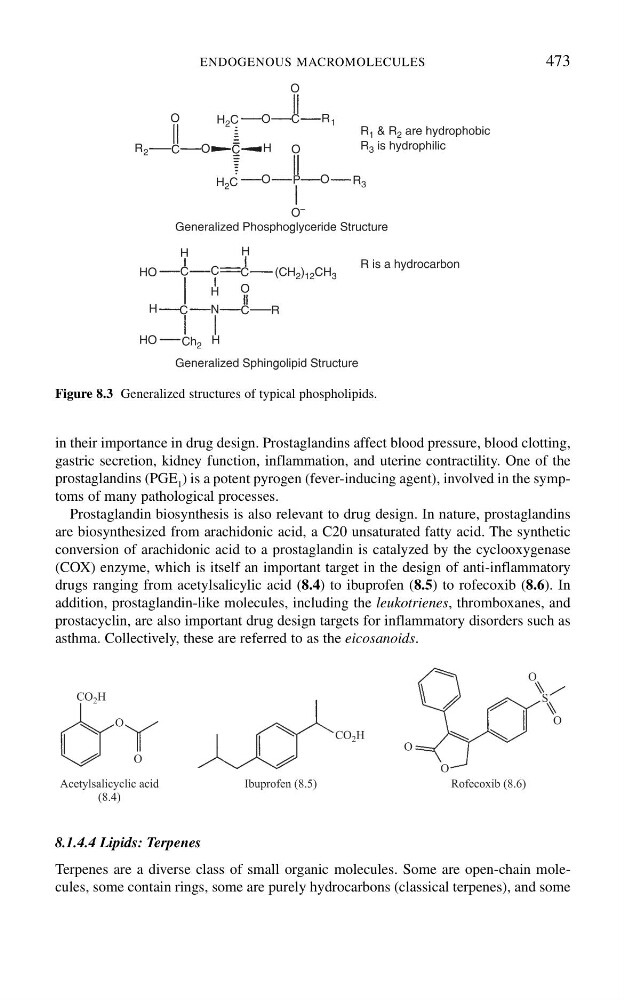
drugs ranging from acetylsalicylic acid (8.4) to ibuprofen (8.5) to rofecoxib (8.6). In
addition, prostaglandin-like molecules, including the leukotrienes, thromboxanes, and
prostacyclin, are also important drug design targets for inflammatory disorders such as
asthma. Collectively, these are referred to as the eicosanoids.
8.1.4.4 Lipids: Terpenes
Terpenes are a diverse class of small organic molecules. Some are open-chain molecules, some contain rings, some are purely hydrocarbons (classical terpenes), and some
ENDOGENOUS MACROMOLECULES
473
Figure 8.3 Generalized structures of typical phospholipids.
gastric secretion, kidney function, inflammation, and uterine contractility. One of the
prostaglandins (PGE 1 ) is a potent pyrogen (fever-inducing agent), involved in the symptoms of many pathological processes.
Prostaglandin biosynthesis is also relevant to drug design. In nature, prostaglandins
are biosynthesized from arachidonic acid, a C20 unsaturated fatty acid. The synthetic
conversion of arachidonic acid to a prostaglandin is catalyzed by the cyclooxygenase
(COX) enzyme, which is itself an important target in the design of anti-inflammatory
drugs ranging from acetylsalicylic acid (8.4) to ibuprofen (8.5) to rofecoxib (8.6). In
addition, prostaglandin-like molecules, including the leukotrienes, thromboxanes, and
prostacyclin, are also important drug design targets for inflammatory disorders such as
asthma. Collectively, these are referred to as the eicosanoids.
8.1.4.4 Lipids: Terpenes
Terpenes are a diverse class of small organic molecules. Some are open-chain molecules, some contain rings, some are purely hydrocarbons (classical terpenes), and some
ENDOGENOUS MACROMOLECULES
473
Figure 8.3 Generalized structures of typical phospholipids.