

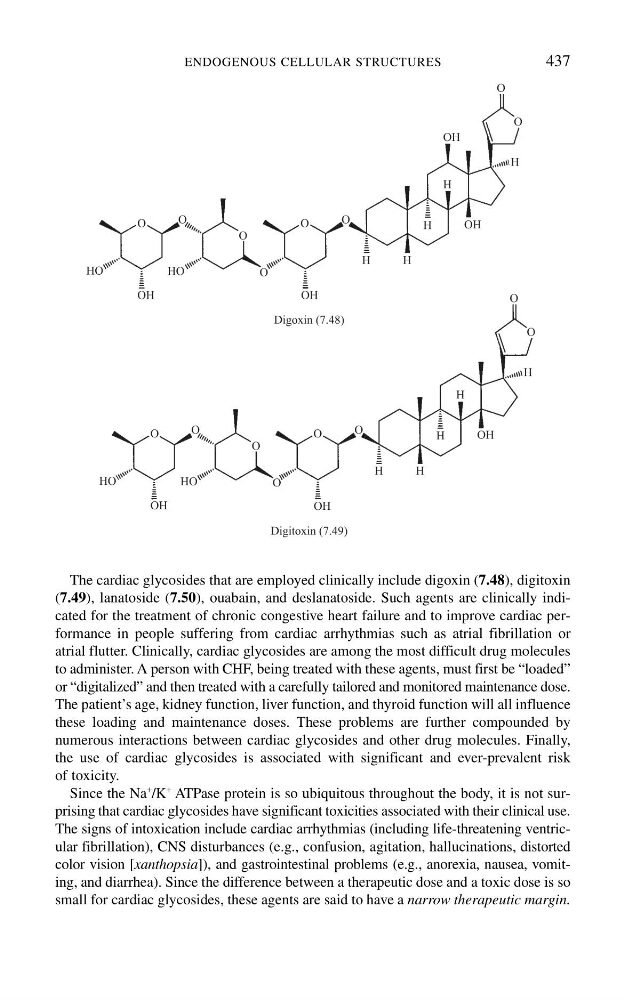
The cardiac glycosides that are employed clinically include digoxin (7.48), digitoxin
(7.49), lanatoside (7.50), ouabain, and deslanatoside. Such agents are clinically indicated for the treatment of chronic congestive heart failure and to improve cardiac performance in people suffering from cardiac arrhythmias such as atrial fibrillation or
atrial flutter. Clinically, cardiac glycosides are among the most difficult drug molecules
to administer. A person with CHF, being treated with these agents, must first be “loaded”
or “digitalized” and then treated with a carefully tailored and monitored maintenance dose.
The patient’s age, kidney function, liver function, and thyroid function will all influence
these loading and maintenance doses. These problems are further compounded by
numerous interactions between cardiac glycosides and other drug molecules. Finally,
the use of cardiac glycosides is associated with significant and ever-prevalent risk
of toxicity.
Since the Na
+
/K
+ ATPase protein is so ubiquitous throughout the body, it is not surprising that cardiac glycosides have significant toxicities associated with their clinical use.
The signs of intoxication include cardiac arrhythmias (including life-threatening ventricular fibrillation), CNS disturbances (e.g., confusion, agitation, hallucinations, distorted
color vision [xanthopsia]), and gastrointestinal problems (e.g., anorexia, nausea, vomiting, and diarrhea). Since the difference between a therapeutic dose and a toxic dose is so
small for cardiac glycosides, these agents are said to have a narrow therapeutic margin.
ENDOGENOUS CELLULAR STRUCTURES
437
(7.49), lanatoside (7.50), ouabain, and deslanatoside. Such agents are clinically indicated for the treatment of chronic congestive heart failure and to improve cardiac performance in people suffering from cardiac arrhythmias such as atrial fibrillation or
atrial flutter. Clinically, cardiac glycosides are among the most difficult drug molecules
to administer. A person with CHF, being treated with these agents, must first be “loaded”
or “digitalized” and then treated with a carefully tailored and monitored maintenance dose.
The patient’s age, kidney function, liver function, and thyroid function will all influence
these loading and maintenance doses. These problems are further compounded by
numerous interactions between cardiac glycosides and other drug molecules. Finally,
the use of cardiac glycosides is associated with significant and ever-prevalent risk
of toxicity.
Since the Na
+
/K
+ ATPase protein is so ubiquitous throughout the body, it is not surprising that cardiac glycosides have significant toxicities associated with their clinical use.
The signs of intoxication include cardiac arrhythmias (including life-threatening ventricular fibrillation), CNS disturbances (e.g., confusion, agitation, hallucinations, distorted
color vision [xanthopsia]), and gastrointestinal problems (e.g., anorexia, nausea, vomiting, and diarrhea). Since the difference between a therapeutic dose and a toxic dose is so
small for cardiac glycosides, these agents are said to have a narrow therapeutic margin.
ENDOGENOUS CELLULAR STRUCTURES
437