

IMMUNOMODULATORS AND THEIR RECEPTORS
395
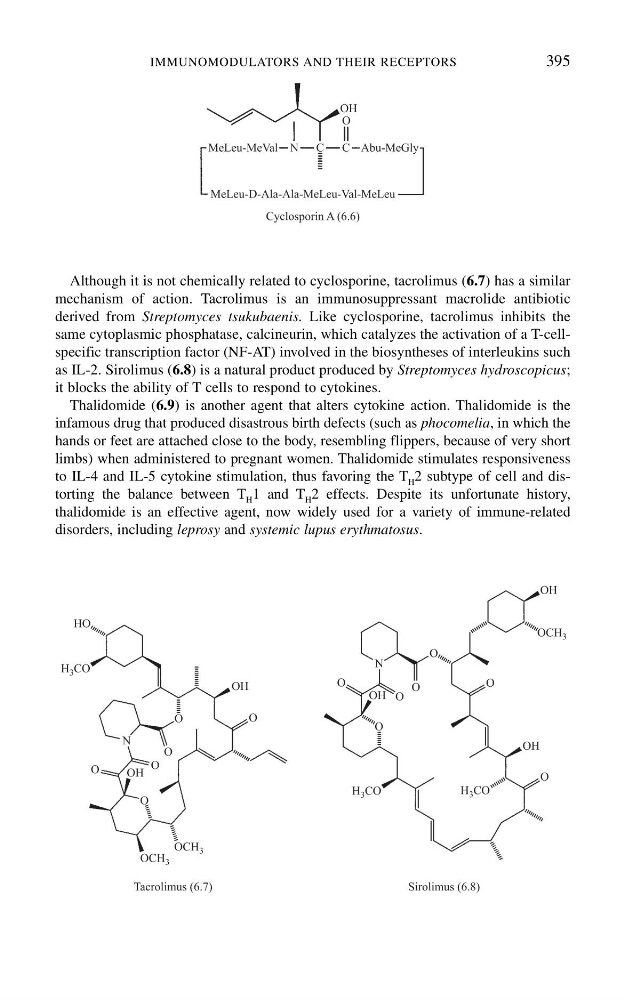
Although it is not chemically related to cyclosporine, tacrolimus (6.7) has a similar
mechanism of action. Tacrolimus is an immunosuppressant macrolide antibiotic
derived from Streptomyces tsukubaenis. Like cyclosporine, tacrolimus inhibits the
same cytoplasmic phosphatase, calcineurin, which catalyzes the activation of a T-cellspecific transcription factor (NF-AT) involved in the biosyntheses of interleukins such
as IL-2. Sirolimus (6.8) is a natural product produced by Streptomyces hydroscopicus;
it blocks the ability of T cells to respond to cytokines.
Thalidomide (6.9) is another agent that alters cytokine action. Thalidomide is the
infamous drug that produced disastrous birth defects (such as phocomelia, in which the
hands or feet are attached close to the body, resembling flippers, because of very short
limbs) when administered to pregnant women. Thalidomide stimulates responsiveness
to IL-4 and IL-5 cytokine stimulation, thus favoring the T H 2 subtype of cell and distorting the balance between T H 1 and T H 2 effects. Despite its unfortunate history,
thalidomide is an effective agent, now widely used for a variety of immune-related
disorders, including leprosy and systemic lupus erythmatosus.
395
Although it is not chemically related to cyclosporine, tacrolimus (6.7) has a similar
mechanism of action. Tacrolimus is an immunosuppressant macrolide antibiotic
derived from Streptomyces tsukubaenis. Like cyclosporine, tacrolimus inhibits the
same cytoplasmic phosphatase, calcineurin, which catalyzes the activation of a T-cellspecific transcription factor (NF-AT) involved in the biosyntheses of interleukins such
as IL-2. Sirolimus (6.8) is a natural product produced by Streptomyces hydroscopicus;
it blocks the ability of T cells to respond to cytokines.
Thalidomide (6.9) is another agent that alters cytokine action. Thalidomide is the
infamous drug that produced disastrous birth defects (such as phocomelia, in which the
hands or feet are attached close to the body, resembling flippers, because of very short
limbs) when administered to pregnant women. Thalidomide stimulates responsiveness
to IL-4 and IL-5 cytokine stimulation, thus favoring the T H 2 subtype of cell and distorting the balance between T H 1 and T H 2 effects. Despite its unfortunate history,
thalidomide is an effective agent, now widely used for a variety of immune-related
disorders, including leprosy and systemic lupus erythmatosus.