

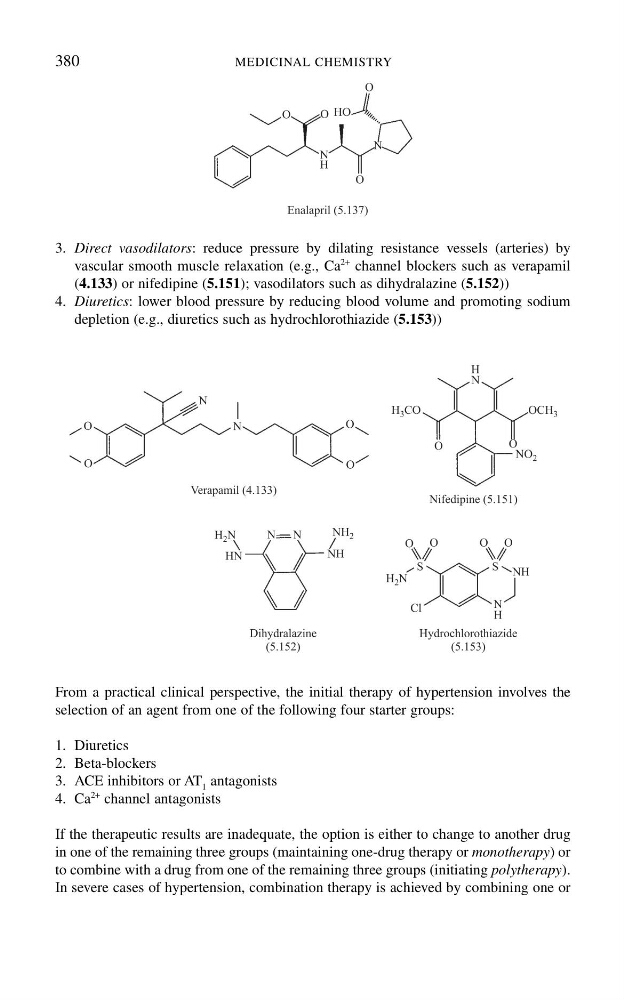
3. Direct vasodilators: reduce pressure by dilating resistance vessels (arteries) by
vascular smooth muscle relaxation (e.g., Ca
2+ channel blockers such as verapamil
(4.133) or nifedipine (5.151); vasodilators such as dihydralazine (5.152))
4. Diuretics: lower blood pressure by reducing blood volume and promoting sodium
depletion (e.g., diuretics such as hydrochlorothiazide (5.153))
From a practical clinical perspective, the initial therapy of hypertension involves the
selection of an agent from one of the following four starter groups:
1. Diuretics
2. Beta-blockers
3. ACE inhibitors or AT 1 antagonists
4. Ca
2+ channel antagonists
If the therapeutic results are inadequate, the option is either to change to another drug
in one of the remaining three groups (maintaining one-drug therapy or monotherapy) or
to combine with a drug from one of the remaining three groups (initiating polytherapy).
In severe cases of hypertension, combination therapy is achieved by combining one or
380
MEDICINAL CHEMISTRY
vascular smooth muscle relaxation (e.g., Ca
2+ channel blockers such as verapamil
(4.133) or nifedipine (5.151); vasodilators such as dihydralazine (5.152))
4. Diuretics: lower blood pressure by reducing blood volume and promoting sodium
depletion (e.g., diuretics such as hydrochlorothiazide (5.153))
From a practical clinical perspective, the initial therapy of hypertension involves the
selection of an agent from one of the following four starter groups:
1. Diuretics
2. Beta-blockers
3. ACE inhibitors or AT 1 antagonists
4. Ca
2+ channel antagonists
If the therapeutic results are inadequate, the option is either to change to another drug
in one of the remaining three groups (maintaining one-drug therapy or monotherapy) or
to combine with a drug from one of the remaining three groups (initiating polytherapy).
In severe cases of hypertension, combination therapy is achieved by combining one or
380
MEDICINAL CHEMISTRY