

Even though pure morphine has been available since 1803, its structure was finally
elucidated only in 1925, by Sir Robert Robinson. Detailed structure–activity relationships
have been worked out during the many years of study of morphine and its derivatives.
The phenolic hydroxyl on C-3 is a very important functional group on an essential
ring. There are very few active opiates without the aromatic ring or the phenolic
hydroxyl group. The latter probably amplifies the van der Waals binding to the receptor of the aromatic ring through hydrogen bonding. Masking this hydroxyl by acetylation or methylation, as in heroin or codeine, changes the analgesic effect. Codeine,
which is a natural alkaloid, has only about one-tenth the effect of morphine if given parenterally, because it must be partially demethylated in the liver and thus transformed to
morphine; thus, when given intracerebrally, it is totally inactive as an analgesic. It is
widely used as an antitussive (cough suppressant) drug. Weakening of the electron density at the 3-OH position by the introduction of electron-attracting substituents (e.g.,
-NO 2 ) in position 1 also has an inactivating effect.
Heroin (diacetylmorphine) is a highly addictive drug, being twice as active as morphine. The reason may be that its increased lipophilic character results in better transport characteristics, and the increased activity due to esterification of the 6-OH group
compensates for the loss of potency due to masking of the 3-OH by the acetyl group.
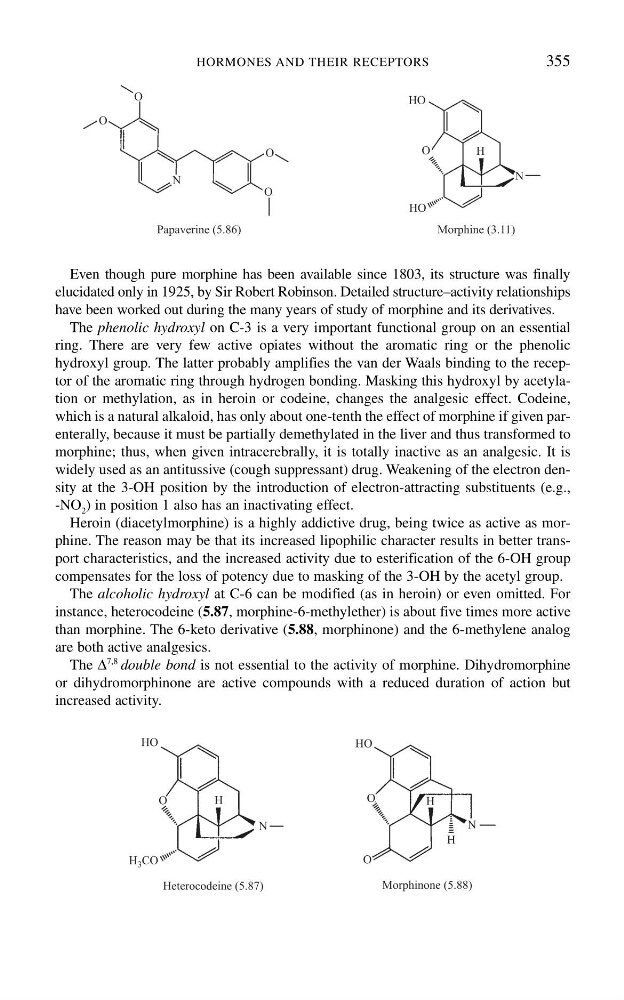
The alcoholic hydroxyl at C-6 can be modified (as in heroin) or even omitted. For
instance, heterocodeine (5.87, morphine-6-methylether) is about five times more active
than morphine. The 6-keto derivative (5.88, morphinone) and the 6-methylene analog
are both active analgesics.
The ∆
7,8 double bond is not essential to the activity of morphine. Dihydromorphine
or dihydromorphinone are active compounds with a reduced duration of action but
increased activity.
HORMONES AND THEIR RECEPTORS
355
elucidated only in 1925, by Sir Robert Robinson. Detailed structure–activity relationships
have been worked out during the many years of study of morphine and its derivatives.
The phenolic hydroxyl on C-3 is a very important functional group on an essential
ring. There are very few active opiates without the aromatic ring or the phenolic
hydroxyl group. The latter probably amplifies the van der Waals binding to the receptor of the aromatic ring through hydrogen bonding. Masking this hydroxyl by acetylation or methylation, as in heroin or codeine, changes the analgesic effect. Codeine,
which is a natural alkaloid, has only about one-tenth the effect of morphine if given parenterally, because it must be partially demethylated in the liver and thus transformed to
morphine; thus, when given intracerebrally, it is totally inactive as an analgesic. It is
widely used as an antitussive (cough suppressant) drug. Weakening of the electron density at the 3-OH position by the introduction of electron-attracting substituents (e.g.,
-NO 2 ) in position 1 also has an inactivating effect.
Heroin (diacetylmorphine) is a highly addictive drug, being twice as active as morphine. The reason may be that its increased lipophilic character results in better transport characteristics, and the increased activity due to esterification of the 6-OH group
compensates for the loss of potency due to masking of the 3-OH by the acetyl group.
The alcoholic hydroxyl at C-6 can be modified (as in heroin) or even omitted. For
instance, heterocodeine (5.87, morphine-6-methylether) is about five times more active
than morphine. The 6-keto derivative (5.88, morphinone) and the 6-methylene analog
are both active analgesics.
The ∆
7,8 double bond is not essential to the activity of morphine. Dihydromorphine
or dihydromorphinone are active compounds with a reduced duration of action but
increased activity.
HORMONES AND THEIR RECEPTORS
355