

The gonadotropins are released in a pulsed manner. Lutropin and follitropin act
together to regulate ovarian functions, egg maturation, and follicular transformation to
the corpus luteum in females. In the male, spermatogenesis depends on these hormones.
Ovarian and testicular steroids are also produced as a result of gonadotropin action, and
these in turn have a feedback regulatory effect on the hypothalamus and pituitary. Human
chorionic gonadotropin, produced by the placenta, shows LH activity and is more stable
than the other gonadotropins.
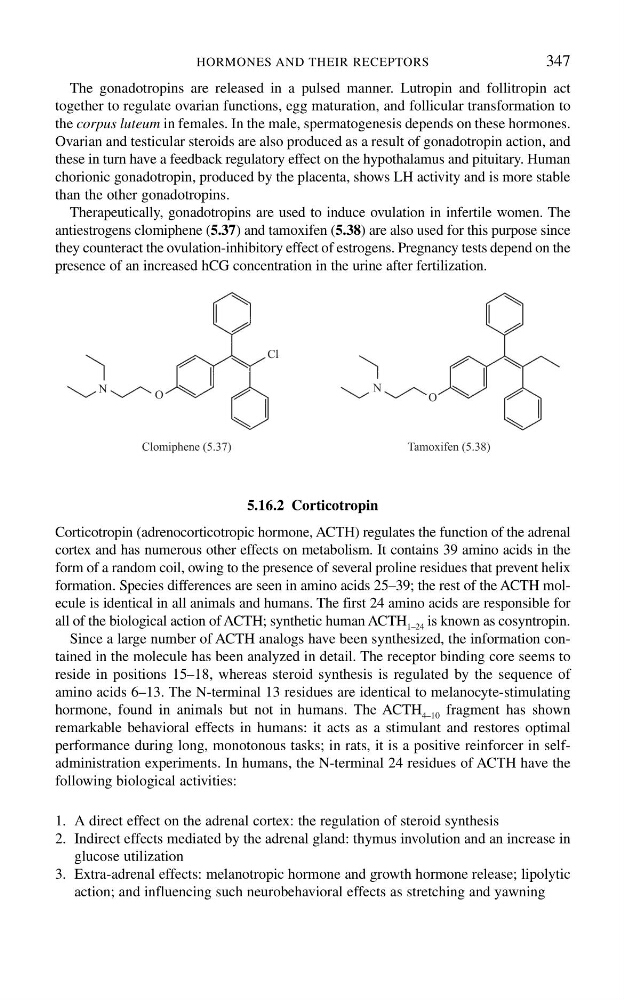
Therapeutically, gonadotropins are used to induce ovulation in infertile women. The
antiestrogens clomiphene (5.37) and tamoxifen (5.38) are also used for this purpose since
they counteract the ovulation-inhibitory effect of estrogens. Pregnancy tests depend on the
presence of an increased hCG concentration in the urine after fertilization.
5.16.2 Corticotropin
Corticotropin (adrenocorticotropic hormone, ACTH) regulates the function of the adrenal
cortex and has numerous other effects on metabolism. It contains 39 amino acids in the
form of a random coil, owing to the presence of several proline residues that prevent helix
formation. Species differences are seen in amino acids 25–39; the rest of the ACTH molecule is identical in all animals and humans. The first 24 amino acids are responsible for
all of the biological action of ACTH; synthetic human ACTH 1–24 is known as cosyntropin.
Since a large number of ACTH analogs have been synthesized, the information contained in the molecule has been analyzed in detail. The receptor binding core seems to
reside in positions 15–18, whereas steroid synthesis is regulated by the sequence of
amino acids 6–13. The N-terminal 13 residues are identical to melanocyte-stimulating
hormone, found in animals but not in humans. The ACTH 4–10 fragment has shown
remarkable behavioral effects in humans: it acts as a stimulant and restores optimal
performance during long, monotonous tasks; in rats, it is a positive reinforcer in selfadministration experiments. In humans, the N-terminal 24 residues of ACTH have the
following biological activities:
1. A direct effect on the adrenal cortex: the regulation of steroid synthesis
2. Indirect effects mediated by the adrenal gland: thymus involution and an increase in
glucose utilization
3. Extra-adrenal effects: melanotropic hormone and growth hormone release; lipolytic
action; and influencing such neurobehavioral effects as stretching and yawning
HORMONES AND THEIR RECEPTORS
347
together to regulate ovarian functions, egg maturation, and follicular transformation to
the corpus luteum in females. In the male, spermatogenesis depends on these hormones.
Ovarian and testicular steroids are also produced as a result of gonadotropin action, and
these in turn have a feedback regulatory effect on the hypothalamus and pituitary. Human
chorionic gonadotropin, produced by the placenta, shows LH activity and is more stable
than the other gonadotropins.
Therapeutically, gonadotropins are used to induce ovulation in infertile women. The
antiestrogens clomiphene (5.37) and tamoxifen (5.38) are also used for this purpose since
they counteract the ovulation-inhibitory effect of estrogens. Pregnancy tests depend on the
presence of an increased hCG concentration in the urine after fertilization.
5.16.2 Corticotropin
Corticotropin (adrenocorticotropic hormone, ACTH) regulates the function of the adrenal
cortex and has numerous other effects on metabolism. It contains 39 amino acids in the
form of a random coil, owing to the presence of several proline residues that prevent helix
formation. Species differences are seen in amino acids 25–39; the rest of the ACTH molecule is identical in all animals and humans. The first 24 amino acids are responsible for
all of the biological action of ACTH; synthetic human ACTH 1–24 is known as cosyntropin.
Since a large number of ACTH analogs have been synthesized, the information contained in the molecule has been analyzed in detail. The receptor binding core seems to
reside in positions 15–18, whereas steroid synthesis is regulated by the sequence of
amino acids 6–13. The N-terminal 13 residues are identical to melanocyte-stimulating
hormone, found in animals but not in humans. The ACTH 4–10 fragment has shown
remarkable behavioral effects in humans: it acts as a stimulant and restores optimal
performance during long, monotonous tasks; in rats, it is a positive reinforcer in selfadministration experiments. In humans, the N-terminal 24 residues of ACTH have the
following biological activities:
1. A direct effect on the adrenal cortex: the regulation of steroid synthesis
2. Indirect effects mediated by the adrenal gland: thymus involution and an increase in
glucose utilization
3. Extra-adrenal effects: melanotropic hormone and growth hormone release; lipolytic
action; and influencing such neurobehavioral effects as stretching and yawning
HORMONES AND THEIR RECEPTORS
347