

postjunctional membrane-potential modulators in ganglia. It appears that NE and ATP
are cotransmitters in sympathetic synapses, where ATP mediates the fast phasic contraction of smooth muscle through P 2 receptors. Because of this diverse biochemical
involvement, purinergic receptors, especially those binding adenosine, are implicated in
various pathologies and therapeutics. Adenosine is probably best known for its ability
to protect organs, including the heart and brain, from ischemic injury during an acute
heart attack or stroke. Multiple adenosine receptors are implicated in asthma since
adenosine causes bronchoconstriction. A 1 receptor agonism influences intraocular pressure within the eye; thus, agents active at this receptor may have a therapeutic role in
glaucoma. There exists strong evidence that adenosine possesses strong antinociceptive
properties and may accordingly be useful in the treatment of neuropathic pain within
the peripheral nervous system. Adenosine receptors are also widely distributed in the
CNS, where they depress neuronal activity. Adenosine is considered to be an endogenous anticonvulsant/neuroprotectant following head injury. Not surprisingly, adenosine
antagonists are CNS stimulants.
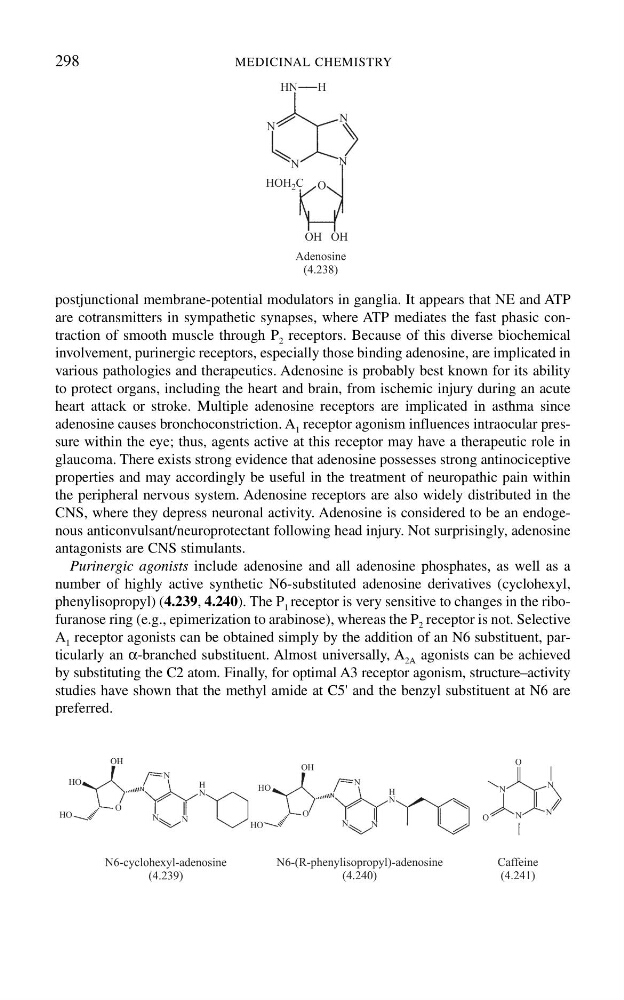
Purinergic agonists include adenosine and all adenosine phosphates, as well as a
number of highly active synthetic N6-substituted adenosine derivatives (cyclohexyl,
phenylisopropyl) (4.239, 4.240). The P 1 receptor is very sensitive to changes in the ribofuranose ring (e.g., epimerization to arabinose), whereas the P 2 receptor is not. Selective
A 1 receptor agonists can be obtained simply by the addition of an N6 substituent, particularly an α-branched substituent. Almost universally, A 2A agonists can be achieved
by substituting the C2 atom. Finally, for optimal A3 receptor agonism, structure–activity
studies have shown that the methyl amide at C5' and the benzyl substituent at N6 are
preferred.
298
MEDICINAL CHEMISTRY
are cotransmitters in sympathetic synapses, where ATP mediates the fast phasic contraction of smooth muscle through P 2 receptors. Because of this diverse biochemical
involvement, purinergic receptors, especially those binding adenosine, are implicated in
various pathologies and therapeutics. Adenosine is probably best known for its ability
to protect organs, including the heart and brain, from ischemic injury during an acute
heart attack or stroke. Multiple adenosine receptors are implicated in asthma since
adenosine causes bronchoconstriction. A 1 receptor agonism influences intraocular pressure within the eye; thus, agents active at this receptor may have a therapeutic role in
glaucoma. There exists strong evidence that adenosine possesses strong antinociceptive
properties and may accordingly be useful in the treatment of neuropathic pain within
the peripheral nervous system. Adenosine receptors are also widely distributed in the
CNS, where they depress neuronal activity. Adenosine is considered to be an endogenous anticonvulsant/neuroprotectant following head injury. Not surprisingly, adenosine
antagonists are CNS stimulants.
Purinergic agonists include adenosine and all adenosine phosphates, as well as a
number of highly active synthetic N6-substituted adenosine derivatives (cyclohexyl,
phenylisopropyl) (4.239, 4.240). The P 1 receptor is very sensitive to changes in the ribofuranose ring (e.g., epimerization to arabinose), whereas the P 2 receptor is not. Selective
A 1 receptor agonists can be obtained simply by the addition of an N6 substituent, particularly an α-branched substituent. Almost universally, A 2A agonists can be achieved
by substituting the C2 atom. Finally, for optimal A3 receptor agonism, structure–activity
studies have shown that the methyl amide at C5' and the benzyl substituent at N6 are
preferred.
298
MEDICINAL CHEMISTRY