

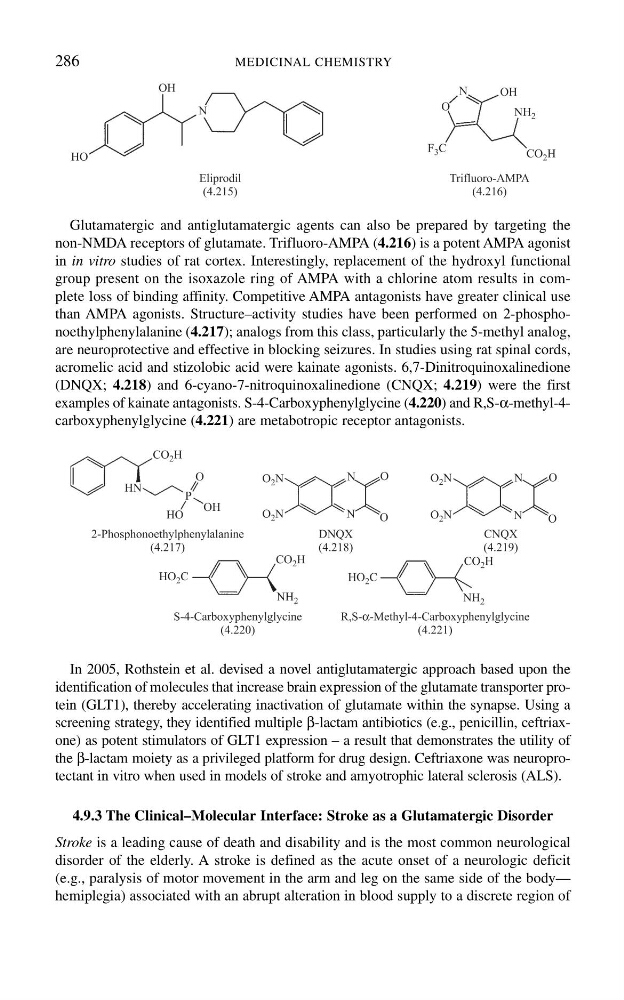
Glutamatergic and antiglutamatergic agents can also be prepared by targeting the
non-NMDA receptors of glutamate. Trifluoro-AMPA (4.216) is a potent AMPA agonist
in in vitro studies of rat cortex. Interestingly, replacement of the hydroxyl functional
group present on the isoxazole ring of AMPA with a chlorine atom results in complete loss of binding affinity. Competitive AMPA antagonists have greater clinical use
than AMPA agonists. Structure–activity studies have been performed on 2-phosphonoethylphenylalanine (4.217); analogs from this class, particularly the 5-methyl analog,
are neuroprotective and effective in blocking seizures. In studies using rat spinal cords,
acromelic acid and stizolobic acid were kainate agonists. 6,7-Dinitroquinoxalinedione
(DNQX; 4.218) and 6-cyano-7-nitroquinoxalinedione (CNQX; 4.219) were the first
examples of kainate antagonists. S-4-Carboxyphenylglycine (4.220) and R,S-α-methyl-4carboxyphenylglycine (4.221) are metabotropic receptor antagonists.
In 2005, Rothstein et al. devised a novel antiglutamatergic approach based upon the
identification of molecules that increase brain expression of the glutamate transporter protein (GLT1), thereby accelerating inactivation of glutamate within the synapse. Using a
screening strategy, they identified multiple β-lactam antibiotics (e.g., penicillin, ceftriaxone) as potent stimulators of GLT1 expression – a result that demonstrates the utility of
the β-lactam moiety as a privileged platform for drug design. Ceftriaxone was neuroprotectant in vitro when used in models of stroke and amyotrophic lateral sclerosis (ALS).
4.9.3 The Clinical–Molecular Interface: Stroke as a Glutamatergic Disorder
Stroke is a leading cause of death and disability and is the most common neurological
disorder of the elderly. A stroke is defined as the acute onset of a neurologic deficit
(e.g., paralysis of motor movement in the arm and leg on the same side of the body—
hemiplegia) associated with an abrupt alteration in blood supply to a discrete region of
286
MEDICINAL CHEMISTRY
non-NMDA receptors of glutamate. Trifluoro-AMPA (4.216) is a potent AMPA agonist
in in vitro studies of rat cortex. Interestingly, replacement of the hydroxyl functional
group present on the isoxazole ring of AMPA with a chlorine atom results in complete loss of binding affinity. Competitive AMPA antagonists have greater clinical use
than AMPA agonists. Structure–activity studies have been performed on 2-phosphonoethylphenylalanine (4.217); analogs from this class, particularly the 5-methyl analog,
are neuroprotective and effective in blocking seizures. In studies using rat spinal cords,
acromelic acid and stizolobic acid were kainate agonists. 6,7-Dinitroquinoxalinedione
(DNQX; 4.218) and 6-cyano-7-nitroquinoxalinedione (CNQX; 4.219) were the first
examples of kainate antagonists. S-4-Carboxyphenylglycine (4.220) and R,S-α-methyl-4carboxyphenylglycine (4.221) are metabotropic receptor antagonists.
In 2005, Rothstein et al. devised a novel antiglutamatergic approach based upon the
identification of molecules that increase brain expression of the glutamate transporter protein (GLT1), thereby accelerating inactivation of glutamate within the synapse. Using a
screening strategy, they identified multiple β-lactam antibiotics (e.g., penicillin, ceftriaxone) as potent stimulators of GLT1 expression – a result that demonstrates the utility of
the β-lactam moiety as a privileged platform for drug design. Ceftriaxone was neuroprotectant in vitro when used in models of stroke and amyotrophic lateral sclerosis (ALS).
4.9.3 The Clinical–Molecular Interface: Stroke as a Glutamatergic Disorder
Stroke is a leading cause of death and disability and is the most common neurological
disorder of the elderly. A stroke is defined as the acute onset of a neurologic deficit
(e.g., paralysis of motor movement in the arm and leg on the same side of the body—
hemiplegia) associated with an abrupt alteration in blood supply to a discrete region of
286
MEDICINAL CHEMISTRY