

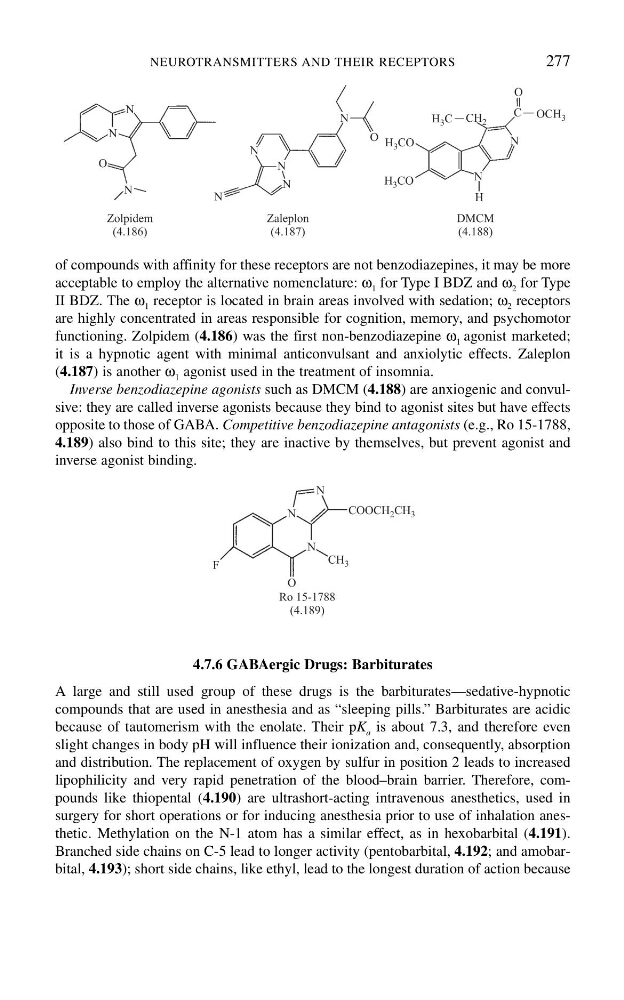
of compounds with affinity for these receptors are not benzodiazepines, it may be more
acceptable to employ the alternative nomenclature: ω 1 for Type I BDZ and ω 2 for Type
II BDZ. The ω 1 receptor is located in brain areas involved with sedation; ω 2 receptors
are highly concentrated in areas responsible for cognition, memory, and psychomotor
functioning. Zolpidem (4.186) was the first non-benzodiazepine ω 1 agonist marketed;
it is a hypnotic agent with minimal anticonvulsant and anxiolytic effects. Zaleplon
(4.187) is another ω 1 agonist used in the treatment of insomnia.
Inverse benzodiazepine agonists such as DMCM (4.188) are anxiogenic and convulsive: they are called inverse agonists because they bind to agonist sites but have effects
opposite to those of GABA. Competitive benzodiazepine antagonists (e.g., Ro 15-1788,
4.189) also bind to this site; they are inactive by themselves, but prevent agonist and
inverse agonist binding.
4.7.6 GABAergic Drugs: Barbiturates
A large and still used group of these drugs is the barbiturates—sedative-hypnotic
compounds that are used in anesthesia and as “sleeping pills.” Barbiturates are acidic
because of tautomerism with the enolate. Their pK a is about 7.3, and therefore even
slight changes in body pH will influence their ionization and, consequently, absorption
and distribution. The replacement of oxygen by sulfur in position 2 leads to increased
lipophilicity and very rapid penetration of the blood–brain barrier. Therefore, compounds like thiopental (4.190) are ultrashort-acting intravenous anesthetics, used in
surgery for short operations or for inducing anesthesia prior to use of inhalation anesthetic. Methylation on the N-1 atom has a similar effect, as in hexobarbital (4.191).
Branched side chains on C-5 lead to longer activity (pentobarbital, 4.192; and amobarbital, 4.193); short side chains, like ethyl, lead to the longest duration of action because
NEUROTRANSMITTERS AND THEIR RECEPTORS
277
acceptable to employ the alternative nomenclature: ω 1 for Type I BDZ and ω 2 for Type
II BDZ. The ω 1 receptor is located in brain areas involved with sedation; ω 2 receptors
are highly concentrated in areas responsible for cognition, memory, and psychomotor
functioning. Zolpidem (4.186) was the first non-benzodiazepine ω 1 agonist marketed;
it is a hypnotic agent with minimal anticonvulsant and anxiolytic effects. Zaleplon
(4.187) is another ω 1 agonist used in the treatment of insomnia.
Inverse benzodiazepine agonists such as DMCM (4.188) are anxiogenic and convulsive: they are called inverse agonists because they bind to agonist sites but have effects
opposite to those of GABA. Competitive benzodiazepine antagonists (e.g., Ro 15-1788,
4.189) also bind to this site; they are inactive by themselves, but prevent agonist and
inverse agonist binding.
4.7.6 GABAergic Drugs: Barbiturates
A large and still used group of these drugs is the barbiturates—sedative-hypnotic
compounds that are used in anesthesia and as “sleeping pills.” Barbiturates are acidic
because of tautomerism with the enolate. Their pK a is about 7.3, and therefore even
slight changes in body pH will influence their ionization and, consequently, absorption
and distribution. The replacement of oxygen by sulfur in position 2 leads to increased
lipophilicity and very rapid penetration of the blood–brain barrier. Therefore, compounds like thiopental (4.190) are ultrashort-acting intravenous anesthetics, used in
surgery for short operations or for inducing anesthesia prior to use of inhalation anesthetic. Methylation on the N-1 atom has a similar effect, as in hexobarbital (4.191).
Branched side chains on C-5 lead to longer activity (pentobarbital, 4.192; and amobarbital, 4.193); short side chains, like ethyl, lead to the longest duration of action because
NEUROTRANSMITTERS AND THEIR RECEPTORS
277