

as toad-skin secretion (hence the name; Bufo = toad), bufotenin methyl ether, and a
piperazine derivative called quipazine (4.118). Based upon these molecular prototypes
and other molecular platforms, an increasing number of analogs have been prepared
and tested over the years. The majority of work has focused on 5-HT 1A agonists. In the
early 1990s, a structure–activity relationship study of substituted 8-OH-DPAT analogs
demonstrated the highest 5-HT 1A agonist activity for the cis C-1 substituted derivatives,
with allyl being the optimal substituent whereas cis C-3 substitution destroyed activity.
By the mid 1990s, quantum pharmacology calculations had been used to generate a
binding site model of the 5-HT 1A receptor based on 20 agonists of two chemotypes. Now,
a decade later, 5-HT 1A agonists are still being studied as potential anxiolytic/antidepressant
molecules; agents that have been evaluated include alnespirone, sunepitron, and ebalzotan.
Using quantum pharmacology calculations as a guide, progress has also been made in
the identification of potential agonists for the 5-HT 1B receptor. The past decade has
witnessed the development of multiple 5-HT 1B/1D receptor agonists, termed triptans, as
potential therapeutics for migraine. A potent 5-HT 1F agonist has been described and
developed as a potential therapy for migraine. Unfortunately, its clinical development
has been sidelined by nonmechanism-based liver toxicity. For the remainder of the
5-HT receptor subtypes, antagonists are, in general, more therapeutically valuable
than agonists.
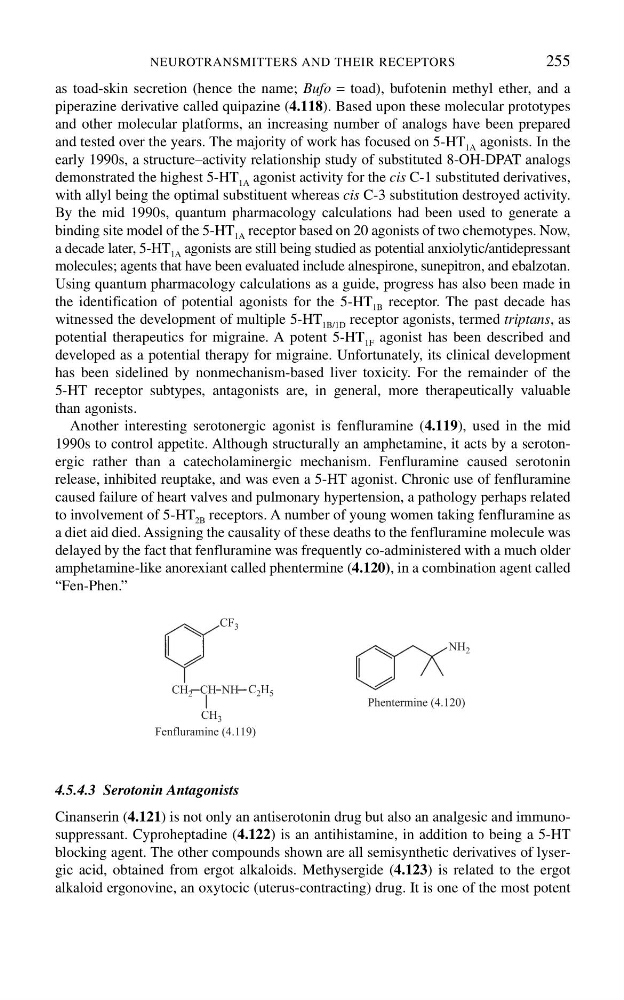
Another interesting serotonergic agonist is fenfluramine (4.119), used in the mid
1990s to control appetite. Although structurally an amphetamine, it acts by a serotonergic rather than a catecholaminergic mechanism. Fenfluramine caused serotonin
release, inhibited reuptake, and was even a 5-HT agonist. Chronic use of fenfluramine
caused failure of heart valves and pulmonary hypertension, a pathology perhaps related
to involvement of 5-HT 2B receptors. A number of young women taking fenfluramine as
a diet aid died. Assigning the causality of these deaths to the fenfluramine molecule was
delayed by the fact that fenfluramine was frequently co-administered with a much older
amphetamine-like anorexiant called phentermine (4.120), in a combination agent called
“Fen-Phen.”
4.5.4.3 Serotonin Antagonists
Cinanserin (4.121) is not only an antiserotonin drug but also an analgesic and immunosuppressant. Cyproheptadine (4.122) is an antihistamine, in addition to being a 5-HT
blocking agent. The other compounds shown are all semisynthetic derivatives of lysergic acid, obtained from ergot alkaloids. Methysergide (4.123) is related to the ergot
alkaloid ergonovine, an oxytocic (uterus-contracting) drug. It is one of the most potent
NEUROTRANSMITTERS AND THEIR RECEPTORS
255
piperazine derivative called quipazine (4.118). Based upon these molecular prototypes
and other molecular platforms, an increasing number of analogs have been prepared
and tested over the years. The majority of work has focused on 5-HT 1A agonists. In the
early 1990s, a structure–activity relationship study of substituted 8-OH-DPAT analogs
demonstrated the highest 5-HT 1A agonist activity for the cis C-1 substituted derivatives,
with allyl being the optimal substituent whereas cis C-3 substitution destroyed activity.
By the mid 1990s, quantum pharmacology calculations had been used to generate a
binding site model of the 5-HT 1A receptor based on 20 agonists of two chemotypes. Now,
a decade later, 5-HT 1A agonists are still being studied as potential anxiolytic/antidepressant
molecules; agents that have been evaluated include alnespirone, sunepitron, and ebalzotan.
Using quantum pharmacology calculations as a guide, progress has also been made in
the identification of potential agonists for the 5-HT 1B receptor. The past decade has
witnessed the development of multiple 5-HT 1B/1D receptor agonists, termed triptans, as
potential therapeutics for migraine. A potent 5-HT 1F agonist has been described and
developed as a potential therapy for migraine. Unfortunately, its clinical development
has been sidelined by nonmechanism-based liver toxicity. For the remainder of the
5-HT receptor subtypes, antagonists are, in general, more therapeutically valuable
than agonists.
Another interesting serotonergic agonist is fenfluramine (4.119), used in the mid
1990s to control appetite. Although structurally an amphetamine, it acts by a serotonergic rather than a catecholaminergic mechanism. Fenfluramine caused serotonin
release, inhibited reuptake, and was even a 5-HT agonist. Chronic use of fenfluramine
caused failure of heart valves and pulmonary hypertension, a pathology perhaps related
to involvement of 5-HT 2B receptors. A number of young women taking fenfluramine as
a diet aid died. Assigning the causality of these deaths to the fenfluramine molecule was
delayed by the fact that fenfluramine was frequently co-administered with a much older
amphetamine-like anorexiant called phentermine (4.120), in a combination agent called
“Fen-Phen.”
4.5.4.3 Serotonin Antagonists
Cinanserin (4.121) is not only an antiserotonin drug but also an analgesic and immunosuppressant. Cyproheptadine (4.122) is an antihistamine, in addition to being a 5-HT
blocking agent. The other compounds shown are all semisynthetic derivatives of lysergic acid, obtained from ergot alkaloids. Methysergide (4.123) is related to the ergot
alkaloid ergonovine, an oxytocic (uterus-contracting) drug. It is one of the most potent
NEUROTRANSMITTERS AND THEIR RECEPTORS
255