

the past decade, receptor cloning and sequencing has greatly facilitated clarification of
this confusing picture. The large number of 5-HT receptors may be divided into five
subtype families. The 5-HT 1 family contains receptors that are negatively coupled to
adenyl cyclase through a G-protein and includes the 5-HT 1A , 5-HT 1B , 5-HT 1D , 5-HT 1E ,
and 5-HT 1F receptors. Biochemical and pharmacological data suggest that the 5-HT 1B
receptor, found in rats and mice, and the 5-HT 1D receptor, found in humans and other
species, are functionally equivalent species homologs. This story is made even more
confusing by the discovery of two genes that encode the human 5-HT 1D receptor, designated 5-HT 1Dα and 5-HT 1Dβ . The 5-HT 2 family stimulates phosphoinositide-specific
phospholipase C (PI-PLC) and includes the 5-HT 2A , 5-HT 2B , and 5-HT 2C (formerly designated the 5-HT 1C ) receptors. Activation of 5-HT 2A receptors also mediates neuronal
depolarization, a result of the closing of potassium channels. To date, the 5-HT 3 family
is homomeric, consisting of only one subtype protein. This receptor belongs to a
ligand-gated ion channel superfamily; subunits of the 5-HT 3 receptor exhibit sequence
similarity to the nicotinic acetylcholine and GABA A receptors. The 5-HT 3 receptor is a
serotonin-gated cation channel that causes rapid depolarization of neurons by a transient inward ion current that is mediated by the opening of a transmembrane ion channel protein for cations. The 5-HT 3 receptor, like other proteins in the ligand-gated ion
channel superfamily, possesses pharmacological binding sites for alcohols and anesthetic agents. The 5-HT 4 , 5-HT 6 , and 5-HT 7 family includes receptors coupled to the
stimulation of adenylyl cyclase—an effect opposite to that of the 5-HT 1 family. Two rat
5-HT 7 receptor clones, differing only in the C-terminus amino acid sequence, have been
NEUROTRANSMITTERS AND THEIR RECEPTORS
251
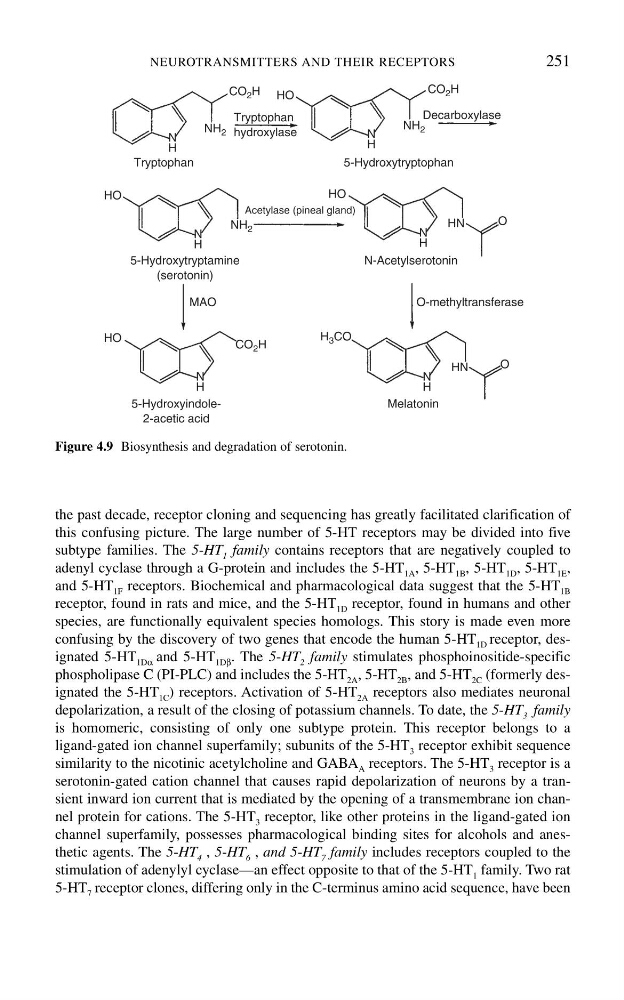
Figure 4.9 Biosynthesis and degradation of serotonin.
this confusing picture. The large number of 5-HT receptors may be divided into five
subtype families. The 5-HT 1 family contains receptors that are negatively coupled to
adenyl cyclase through a G-protein and includes the 5-HT 1A , 5-HT 1B , 5-HT 1D , 5-HT 1E ,
and 5-HT 1F receptors. Biochemical and pharmacological data suggest that the 5-HT 1B
receptor, found in rats and mice, and the 5-HT 1D receptor, found in humans and other
species, are functionally equivalent species homologs. This story is made even more
confusing by the discovery of two genes that encode the human 5-HT 1D receptor, designated 5-HT 1Dα and 5-HT 1Dβ . The 5-HT 2 family stimulates phosphoinositide-specific
phospholipase C (PI-PLC) and includes the 5-HT 2A , 5-HT 2B , and 5-HT 2C (formerly designated the 5-HT 1C ) receptors. Activation of 5-HT 2A receptors also mediates neuronal
depolarization, a result of the closing of potassium channels. To date, the 5-HT 3 family
is homomeric, consisting of only one subtype protein. This receptor belongs to a
ligand-gated ion channel superfamily; subunits of the 5-HT 3 receptor exhibit sequence
similarity to the nicotinic acetylcholine and GABA A receptors. The 5-HT 3 receptor is a
serotonin-gated cation channel that causes rapid depolarization of neurons by a transient inward ion current that is mediated by the opening of a transmembrane ion channel protein for cations. The 5-HT 3 receptor, like other proteins in the ligand-gated ion
channel superfamily, possesses pharmacological binding sites for alcohols and anesthetic agents. The 5-HT 4 , 5-HT 6 , and 5-HT 7 family includes receptors coupled to the
stimulation of adenylyl cyclase—an effect opposite to that of the 5-HT 1 family. Two rat
5-HT 7 receptor clones, differing only in the C-terminus amino acid sequence, have been
NEUROTRANSMITTERS AND THEIR RECEPTORS
251
Figure 4.9 Biosynthesis and degradation of serotonin.