

The pharmacology of all these neuroleptics is extremely complex. Briefly, phenothiazines and related drugs have a calming effect on psychotic patients, without producing excessive sedation. Other central effects include the important antiemetic effect
in disease-, drug-, or radiation-induced nausea, but not so much in motion sickness.
Butyrophenones are more effective antiemetics than phenothiazines and also potentiate
the activity of anesthetics.
Much of current medicinal chemistry concerning antipsychotics is exploring the various subtypes of DA receptors, and how specific or mixed antagonists at the various
receptors can influence the natural history and course of major psychiatric illnesses.
The mode of action of antipsychotic neuroleptics is that of postsynaptic dopamine,
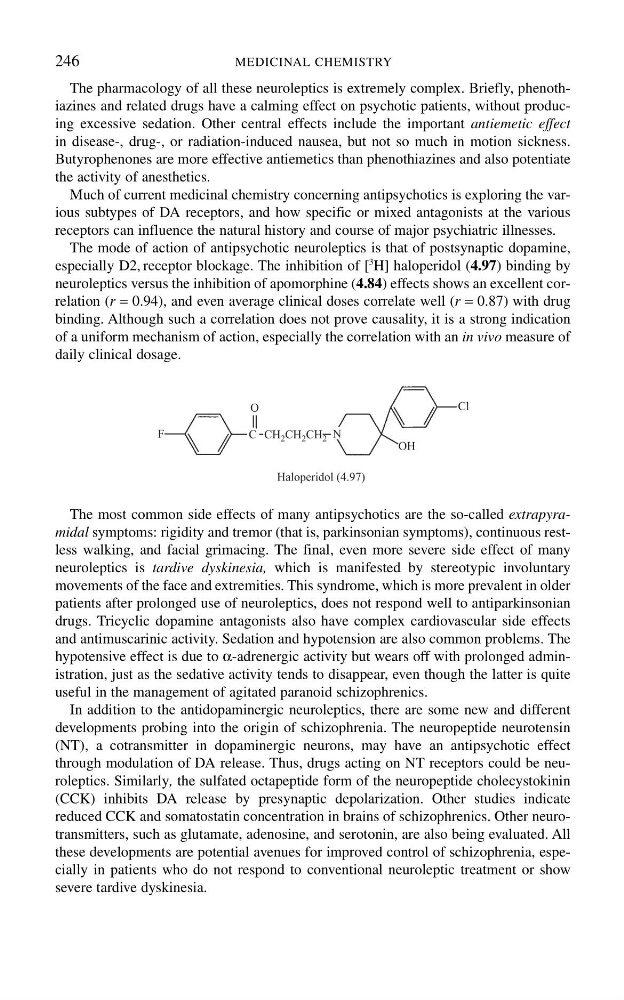
especially D2, receptor blockage. The inhibition of [
3 H] haloperidol (4.97) binding by
neuroleptics versus the inhibition of apomorphine (4.84) effects shows an excellent correlation (r = 0.94), and even average clinical doses correlate well (r = 0.87) with drug
binding. Although such a correlation does not prove causality, it is a strong indication
of a uniform mechanism of action, especially the correlation with an in vivo measure of
daily clinical dosage.
The most common side effects of many antipsychotics are the so-called extrapyramidal symptoms: rigidity and tremor (that is, parkinsonian symptoms), continuous restless walking, and facial grimacing. The final, even more severe side effect of many
neuroleptics is tardive dyskinesia, which is manifested by stereotypic involuntary
movements of the face and extremities. This syndrome, which is more prevalent in older
patients after prolonged use of neuroleptics, does not respond well to antiparkinsonian
drugs. Tricyclic dopamine antagonists also have complex cardiovascular side effects
and antimuscarinic activity. Sedation and hypotension are also common problems. The
hypotensive effect is due to α-adrenergic activity but wears off with prolonged administration, just as the sedative activity tends to disappear, even though the latter is quite
useful in the management of agitated paranoid schizophrenics.
In addition to the antidopaminergic neuroleptics, there are some new and different
developments probing into the origin of schizophrenia. The neuropeptide neurotensin
(NT), a cotransmitter in dopaminergic neurons, may have an antipsychotic effect
through modulation of DA release. Thus, drugs acting on NT receptors could be neuroleptics. Similarly, the sulfated octapeptide form of the neuropeptide cholecystokinin
(CCK) inhibits DA release by presynaptic depolarization. Other studies indicate
reduced CCK and somatostatin concentration in brains of schizophrenics. Other neurotransmitters, such as glutamate, adenosine, and serotonin, are also being evaluated. All
these developments are potential avenues for improved control of schizophrenia, especially in patients who do not respond to conventional neuroleptic treatment or show
severe tardive dyskinesia.
246
MEDICINAL CHEMISTRY
in disease-, drug-, or radiation-induced nausea, but not so much in motion sickness.
Butyrophenones are more effective antiemetics than phenothiazines and also potentiate
the activity of anesthetics.
Much of current medicinal chemistry concerning antipsychotics is exploring the various subtypes of DA receptors, and how specific or mixed antagonists at the various
receptors can influence the natural history and course of major psychiatric illnesses.
The mode of action of antipsychotic neuroleptics is that of postsynaptic dopamine,
especially D2, receptor blockage. The inhibition of [
3 H] haloperidol (4.97) binding by
neuroleptics versus the inhibition of apomorphine (4.84) effects shows an excellent correlation (r = 0.94), and even average clinical doses correlate well (r = 0.87) with drug
binding. Although such a correlation does not prove causality, it is a strong indication
of a uniform mechanism of action, especially the correlation with an in vivo measure of
daily clinical dosage.
The most common side effects of many antipsychotics are the so-called extrapyramidal symptoms: rigidity and tremor (that is, parkinsonian symptoms), continuous restless walking, and facial grimacing. The final, even more severe side effect of many
neuroleptics is tardive dyskinesia, which is manifested by stereotypic involuntary
movements of the face and extremities. This syndrome, which is more prevalent in older
patients after prolonged use of neuroleptics, does not respond well to antiparkinsonian
drugs. Tricyclic dopamine antagonists also have complex cardiovascular side effects
and antimuscarinic activity. Sedation and hypotension are also common problems. The
hypotensive effect is due to α-adrenergic activity but wears off with prolonged administration, just as the sedative activity tends to disappear, even though the latter is quite
useful in the management of agitated paranoid schizophrenics.
In addition to the antidopaminergic neuroleptics, there are some new and different
developments probing into the origin of schizophrenia. The neuropeptide neurotensin
(NT), a cotransmitter in dopaminergic neurons, may have an antipsychotic effect
through modulation of DA release. Thus, drugs acting on NT receptors could be neuroleptics. Similarly, the sulfated octapeptide form of the neuropeptide cholecystokinin
(CCK) inhibits DA release by presynaptic depolarization. Other studies indicate
reduced CCK and somatostatin concentration in brains of schizophrenics. Other neurotransmitters, such as glutamate, adenosine, and serotonin, are also being evaluated. All
these developments are potential avenues for improved control of schizophrenia, especially in patients who do not respond to conventional neuroleptic treatment or show
severe tardive dyskinesia.
246
MEDICINAL CHEMISTRY