

epinephrine and norepinephrine, producing hypertension, accelerated heart rate, and
cardiac arrhythmias in the patient. α-receptor antagonists may be of value in people
with this tumor to prevent acute cardiac and hypertensive episodes; α-receptor blockade
may also have use in the treatment of benign prostatic hyperplasia (BPH). This disorder
of older men involves progressive urinary symptoms as the enlarging prostate slowly
pinches the urethra closed. Multiple well-controlled clinical studies have shown the
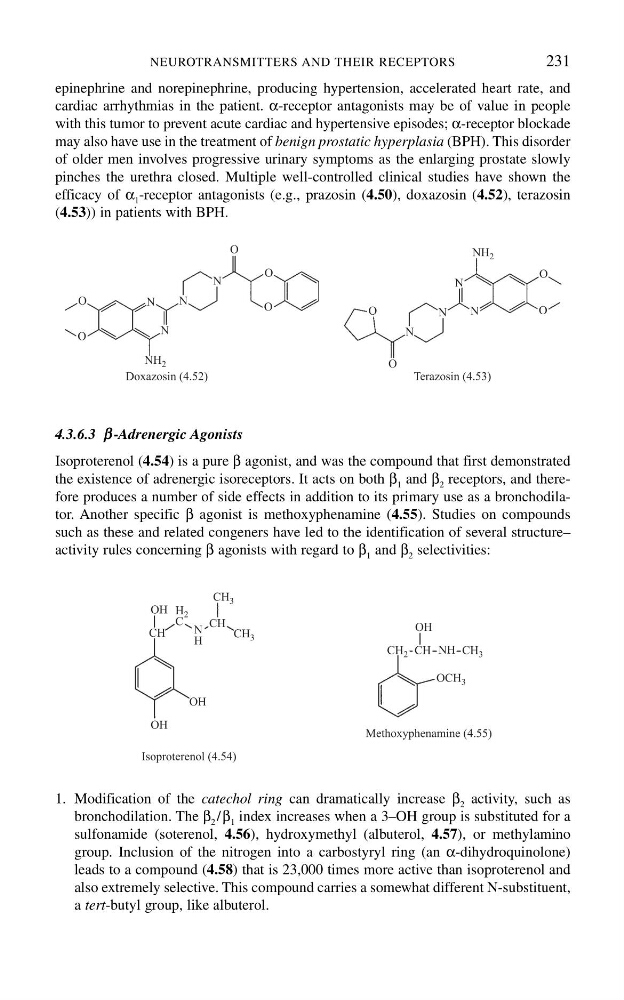
efficacy of α 1 -receptor antagonists (e.g., prazosin (4.50), doxazosin (4.52), terazosin
(4.53)) in patients with BPH.
4.3.6.3 β -Adrenergic Agonists
Isoproterenol (4.54) is a pure β agonist, and was the compound that first demonstrated
the existence of adrenergic isoreceptors. It acts on both β 1 and β 2 receptors, and therefore produces a number of side effects in addition to its primary use as a bronchodilator. Another specific β agonist is methoxyphenamine (4.55). Studies on compounds
such as these and related congeners have led to the identification of several structure–
activity rules concerning β agonists with regard to β 1 and β 2 selectivities:
1. Modification of the catechol ring can dramatically increase β 2 activity, such as
bronchodilation. The β 2 /β 1 index increases when a 3–OH group is substituted for a
sulfonamide (soterenol, 4.56), hydroxymethyl (albuterol, 4.57), or methylamino
group. Inclusion of the nitrogen into a carbostyryl ring (an α-dihydroquinolone)
leads to a compound (4.58) that is 23,000 times more active than isoproterenol and
also extremely selective. This compound carries a somewhat different N-substituent,
a tert-butyl group, like albuterol.
NEUROTRANSMITTERS AND THEIR RECEPTORS
231
cardiac arrhythmias in the patient. α-receptor antagonists may be of value in people
with this tumor to prevent acute cardiac and hypertensive episodes; α-receptor blockade
may also have use in the treatment of benign prostatic hyperplasia (BPH). This disorder
of older men involves progressive urinary symptoms as the enlarging prostate slowly
pinches the urethra closed. Multiple well-controlled clinical studies have shown the
efficacy of α 1 -receptor antagonists (e.g., prazosin (4.50), doxazosin (4.52), terazosin
(4.53)) in patients with BPH.
4.3.6.3 β -Adrenergic Agonists
Isoproterenol (4.54) is a pure β agonist, and was the compound that first demonstrated
the existence of adrenergic isoreceptors. It acts on both β 1 and β 2 receptors, and therefore produces a number of side effects in addition to its primary use as a bronchodilator. Another specific β agonist is methoxyphenamine (4.55). Studies on compounds
such as these and related congeners have led to the identification of several structure–
activity rules concerning β agonists with regard to β 1 and β 2 selectivities:
1. Modification of the catechol ring can dramatically increase β 2 activity, such as
bronchodilation. The β 2 /β 1 index increases when a 3–OH group is substituted for a
sulfonamide (soterenol, 4.56), hydroxymethyl (albuterol, 4.57), or methylamino
group. Inclusion of the nitrogen into a carbostyryl ring (an α-dihydroquinolone)
leads to a compound (4.58) that is 23,000 times more active than isoproterenol and
also extremely selective. This compound carries a somewhat different N-substituent,
a tert-butyl group, like albuterol.
NEUROTRANSMITTERS AND THEIR RECEPTORS
231