

gene was first described in the Pima Indians, a population with a high incidence of
obesity. In the human receptor, this substituted amino acid at position 64 lies at the
junction of the first transmembrane spanning domain and the first intracellular loop. A
large number of studies suggest associations between the Trp64Arg β 3 receptor variant
and an increased capacity to gain weight, resistance to weight loss, increased blood
pressure, and coronary heart disease.
The β receptor is highly stereospecific, preferentially binding only to certain
stereoisomers of drugs. The conformational preference is a phenyl/NH 3 trans arrangement, meaning that the agonist molecule is extended, with the m-OH and β-OH coincident on the same face of the molecule. The agonist molecule therefore has a polar and
a nonpolar side.
4.3.5 Adrenergic Drugs: Presynaptic and Synaptic Effects
Presynaptic adrenergic drug effects may be classified as follows:
1. Drugs acting on catecholamine synthesis
2. Drugs acting on catecholamine metabolism
3. Drugs acting on catecholamine storage
4. Drugs acting on catecholamine reuptake
5. Drugs acting on presynaptic receptors
These classes afford a logical, mechanistic approach to adrenergic drugs and each class
will be discussed individually.
4.3.5.1 Drugs Interfering with Catecholamine Synthesis
These drugs include various enzyme inhibitors; mechanisms of enzyme inhibition are
discussed in chapter 8. However, some of these agents have other, nonenzymatic points
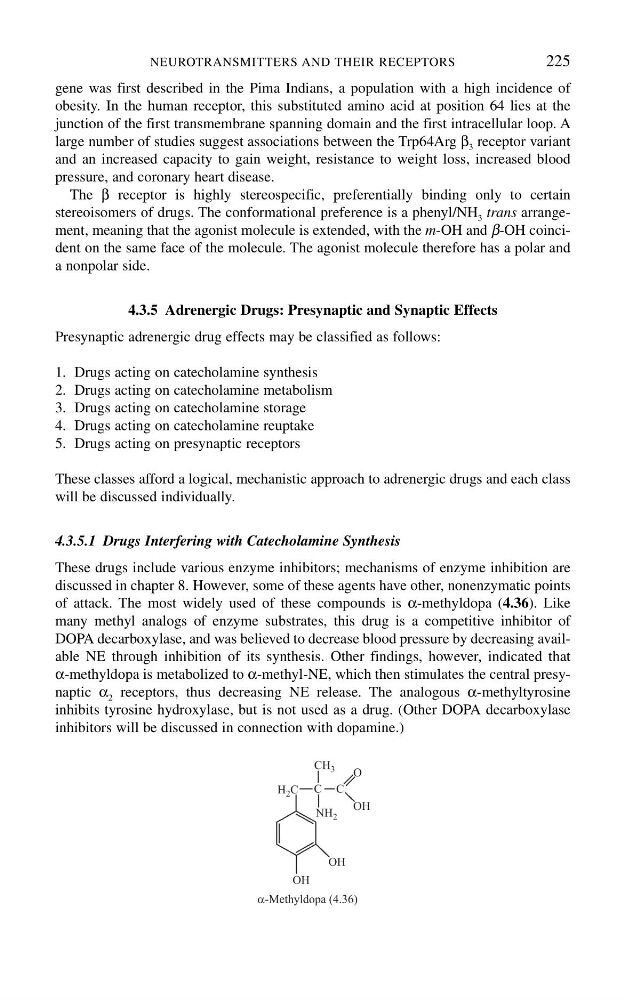
of attack. The most widely used of these compounds is α-methyldopa (4.36). Like
many methyl analogs of enzyme substrates, this drug is a competitive inhibitor of
DOPA decarboxylase, and was believed to decrease blood pressure by decreasing available NE through inhibition of its synthesis. Other findings, however, indicated that
α-methyldopa is metabolized to α-methyl-NE, which then stimulates the central presynaptic α 2 receptors, thus decreasing NE release. The analogous α-methyltyrosine
inhibits tyrosine hydroxylase, but is not used as a drug. (Other DOPA decarboxylase
inhibitors will be discussed in connection with dopamine.)
NEUROTRANSMITTERS AND THEIR RECEPTORS
225
obesity. In the human receptor, this substituted amino acid at position 64 lies at the
junction of the first transmembrane spanning domain and the first intracellular loop. A
large number of studies suggest associations between the Trp64Arg β 3 receptor variant
and an increased capacity to gain weight, resistance to weight loss, increased blood
pressure, and coronary heart disease.
The β receptor is highly stereospecific, preferentially binding only to certain
stereoisomers of drugs. The conformational preference is a phenyl/NH 3 trans arrangement, meaning that the agonist molecule is extended, with the m-OH and β-OH coincident on the same face of the molecule. The agonist molecule therefore has a polar and
a nonpolar side.
4.3.5 Adrenergic Drugs: Presynaptic and Synaptic Effects
Presynaptic adrenergic drug effects may be classified as follows:
1. Drugs acting on catecholamine synthesis
2. Drugs acting on catecholamine metabolism
3. Drugs acting on catecholamine storage
4. Drugs acting on catecholamine reuptake
5. Drugs acting on presynaptic receptors
These classes afford a logical, mechanistic approach to adrenergic drugs and each class
will be discussed individually.
4.3.5.1 Drugs Interfering with Catecholamine Synthesis
These drugs include various enzyme inhibitors; mechanisms of enzyme inhibition are
discussed in chapter 8. However, some of these agents have other, nonenzymatic points
of attack. The most widely used of these compounds is α-methyldopa (4.36). Like
many methyl analogs of enzyme substrates, this drug is a competitive inhibitor of
DOPA decarboxylase, and was believed to decrease blood pressure by decreasing available NE through inhibition of its synthesis. Other findings, however, indicated that
α-methyldopa is metabolized to α-methyl-NE, which then stimulates the central presynaptic α 2 receptors, thus decreasing NE release. The analogous α-methyltyrosine
inhibits tyrosine hydroxylase, but is not used as a drug. (Other DOPA decarboxylase
inhibitors will be discussed in connection with dopamine.)
NEUROTRANSMITTERS AND THEIR RECEPTORS
225