

The other enzyme in catecholamine catabolism is catecholamine O-methyltransferase
(COMT), a cytoplasmic enzyme that uses S-adenosyl-methionine to methylate the
3–OH of catecholamines and render them inactive. The methylated compounds are not
taken up into the synapse.
The principal mechanism for the deactivation of released catecholamines is, however,
not enzymatic destruction but reuptake into the nerve ending. The presynaptic membrane
contains an amine pump—a saturable, high-affinity, Na
+
-dependent active-transport
system that requires energy for its function. The recycled neurotransmitter is capable of
being released again, as experiments with radiolabelled [
3 H]NE have shown, and can be
incorporated into chromaffin granules as well. Many drugs interfere with neurotransmitter reuptake and metabolism, as discussed in subsequent sections.
4.3.3 Adrenergic Receptors: The α Receptor Family
The adrenergic receptors have been studied extensively and thoroughly by pharmacological methods. There are two major groups of receptors, designated as α and β, which are
in turn subdivided into α 1 , α 2 , β 1 , β 2 , and β 3 receptors on the basis of their apparent drug
sensitivity. The existence of receptor multiplicity was first suggested by Sir Henry Dale
in the mid-1920s, but was formalized and proven by Ahlquist in 1948. Multiple receptors
such as these were termed isoreceptors, in analogy to isoenzymes (or isozymes).
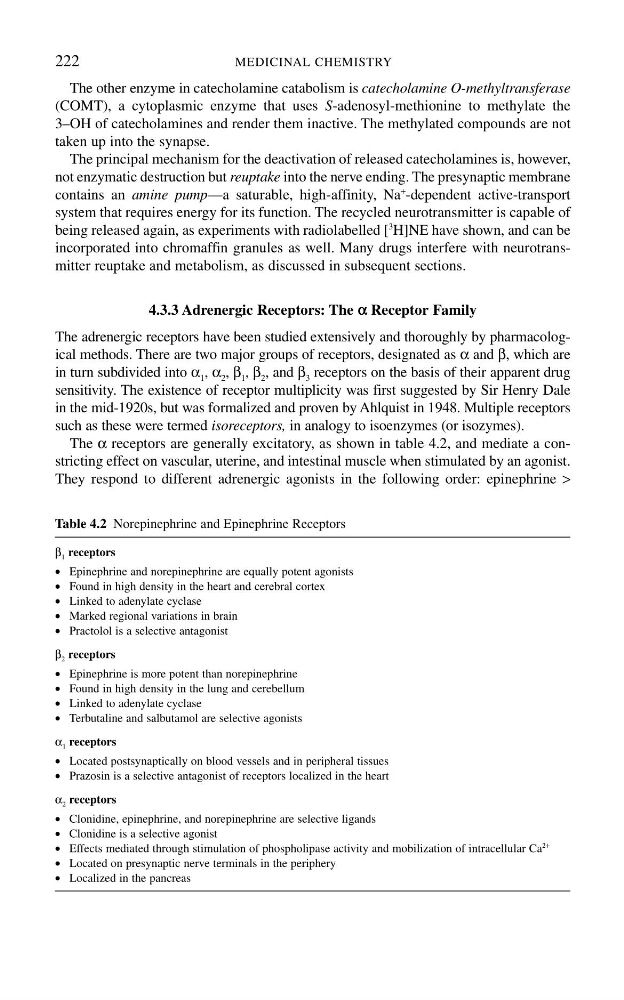
The α receptors are generally excitatory, as shown in table 4.2, and mediate a constricting effect on vascular, uterine, and intestinal muscle when stimulated by an agonist.
They respond to different adrenergic agonists in the following order: epinephrine >
222
MEDICINAL CHEMISTRY
Table 4.2 Norepinephrine and Epinephrine Receptors
β 1 receptors
• Epinephrine and norepinephrine are equally potent agonists
• Found in high density in the heart and cerebral cortex
• Linked to adenylate cyclase
• Marked regional variations in brain
• Practolol is a selective antagonist
β 2 receptors
• Epinephrine is more potent than norepinephrine
• Found in high density in the lung and cerebellum
• Linked to adenylate cyclase
• Terbutaline and salbutamol are selective agonists
α 1 receptors
• Located postsynaptically on blood vessels and in peripheral tissues
• Prazosin is a selective antagonist of receptors localized in the heart
α 2 receptors
• Clonidine, epinephrine, and norepinephrine are selective ligands
• Clonidine is a selective agonist
• Effects mediated through stimulation of phospholipase activity and mobilization of intracellular Ca
2+
• Located on presynaptic nerve terminals in the periphery
• Localized in the pancreas
(COMT), a cytoplasmic enzyme that uses S-adenosyl-methionine to methylate the
3–OH of catecholamines and render them inactive. The methylated compounds are not
taken up into the synapse.
The principal mechanism for the deactivation of released catecholamines is, however,
not enzymatic destruction but reuptake into the nerve ending. The presynaptic membrane
contains an amine pump—a saturable, high-affinity, Na
+
-dependent active-transport
system that requires energy for its function. The recycled neurotransmitter is capable of
being released again, as experiments with radiolabelled [
3 H]NE have shown, and can be
incorporated into chromaffin granules as well. Many drugs interfere with neurotransmitter reuptake and metabolism, as discussed in subsequent sections.
4.3.3 Adrenergic Receptors: The α Receptor Family
The adrenergic receptors have been studied extensively and thoroughly by pharmacological methods. There are two major groups of receptors, designated as α and β, which are
in turn subdivided into α 1 , α 2 , β 1 , β 2 , and β 3 receptors on the basis of their apparent drug
sensitivity. The existence of receptor multiplicity was first suggested by Sir Henry Dale
in the mid-1920s, but was formalized and proven by Ahlquist in 1948. Multiple receptors
such as these were termed isoreceptors, in analogy to isoenzymes (or isozymes).
The α receptors are generally excitatory, as shown in table 4.2, and mediate a constricting effect on vascular, uterine, and intestinal muscle when stimulated by an agonist.
They respond to different adrenergic agonists in the following order: epinephrine >
222
MEDICINAL CHEMISTRY
Table 4.2 Norepinephrine and Epinephrine Receptors
β 1 receptors
• Epinephrine and norepinephrine are equally potent agonists
• Found in high density in the heart and cerebral cortex
• Linked to adenylate cyclase
• Marked regional variations in brain
• Practolol is a selective antagonist
β 2 receptors
• Epinephrine is more potent than norepinephrine
• Found in high density in the lung and cerebellum
• Linked to adenylate cyclase
• Terbutaline and salbutamol are selective agonists
α 1 receptors
• Located postsynaptically on blood vessels and in peripheral tissues
• Prazosin is a selective antagonist of receptors localized in the heart
α 2 receptors
• Clonidine, epinephrine, and norepinephrine are selective ligands
• Clonidine is a selective agonist
• Effects mediated through stimulation of phospholipase activity and mobilization of intracellular Ca
2+
• Located on presynaptic nerve terminals in the periphery
• Localized in the pancreas