

Phase 3 — the drug is studied in a large number of people (hundreds to thousands)
who have the disease under study, typically using a multi-center, double-blind,
placebo–controlled, randomized clinical trial (RCT) protocol.
Phase 4 — once the drug has been approved for market, vigilant post-marketing surveillance is done to ascertain the possible appearance of previously undetected toxicities or problems.
The drug development process is long, as is shown in figure 3.10. During the drug
development phases, toxicity is one of the most important hurdles to the success of a
drug molecule. Toxicity can affect the person who is taking the medication (causing
skin rashes, liver problems, bone marrow failure, etc.) or, in the case of women,
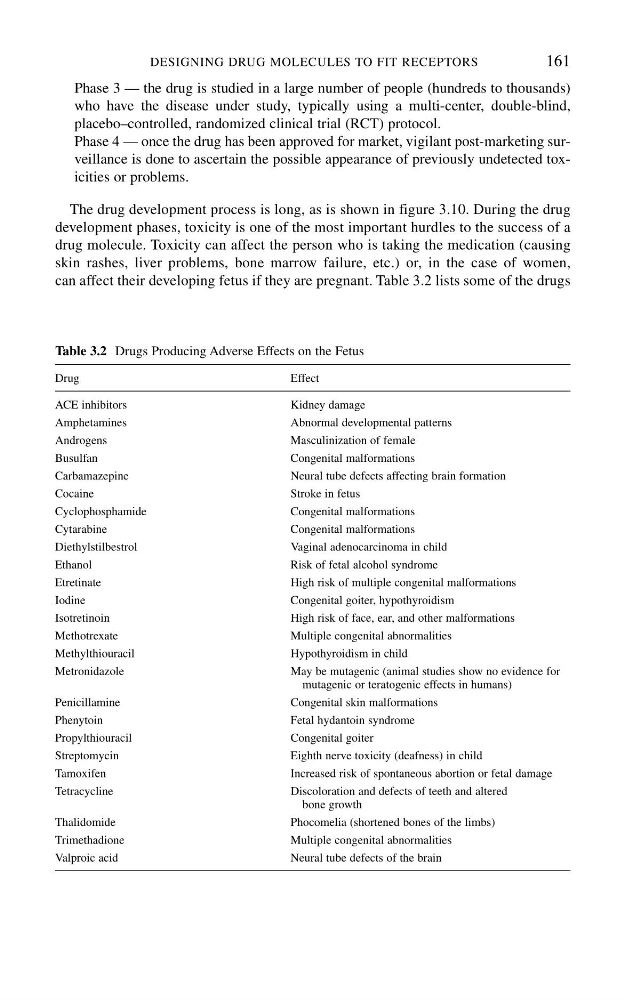
can affect their developing fetus if they are pregnant. Table 3.2 lists some of the drugs
DESIGNING DRUG MOLECULES TO FIT RECEPTORS
161
Table 3.2 Drugs Producing Adverse Effects on the Fetus
Drug
Effect
ACE inhibitors
Kidney damage
Amphetamines
Abnormal developmental patterns
Androgens
Masculinization of female
Busulfan
Congenital malformations
Carbamazepine
Neural tube defects affecting brain formation
Cocaine
Stroke in fetus
Cyclophosphamide
Congenital malformations
Cytarabine
Congenital malformations
Diethylstilbestrol
Vaginal adenocarcinoma in child
Ethanol
Risk of fetal alcohol syndrome
Etretinate
High risk of multiple congenital malformations
Iodine
Congenital goiter, hypothyroidism
Isotretinoin
High risk of face, ear, and other malformations
Methotrexate
Multiple congenital abnormalities
Methylthiouracil
Hypothyroidism in child
Metronidazole
May be mutagenic (animal studies show no evidence for
mutagenic or teratogenic effects in humans)
Penicillamine
Congenital skin malformations
Phenytoin
Fetal hydantoin syndrome
Propylthiouracil
Congenital goiter
Streptomycin
Eighth nerve toxicity (deafness) in child
Tamoxifen
Increased risk of spontaneous abortion or fetal damage
Tetracycline
Discoloration and defects of teeth and altered
bone growth
Thalidomide
Phocomelia (shortened bones of the limbs)
Trimethadione
Multiple congenital abnormalities
Valproic acid
Neural tube defects of the brain
who have the disease under study, typically using a multi-center, double-blind,
placebo–controlled, randomized clinical trial (RCT) protocol.
Phase 4 — once the drug has been approved for market, vigilant post-marketing surveillance is done to ascertain the possible appearance of previously undetected toxicities or problems.
The drug development process is long, as is shown in figure 3.10. During the drug
development phases, toxicity is one of the most important hurdles to the success of a
drug molecule. Toxicity can affect the person who is taking the medication (causing
skin rashes, liver problems, bone marrow failure, etc.) or, in the case of women,
can affect their developing fetus if they are pregnant. Table 3.2 lists some of the drugs
DESIGNING DRUG MOLECULES TO FIT RECEPTORS
161
Table 3.2 Drugs Producing Adverse Effects on the Fetus
Drug
Effect
ACE inhibitors
Kidney damage
Amphetamines
Abnormal developmental patterns
Androgens
Masculinization of female
Busulfan
Congenital malformations
Carbamazepine
Neural tube defects affecting brain formation
Cocaine
Stroke in fetus
Cyclophosphamide
Congenital malformations
Cytarabine
Congenital malformations
Diethylstilbestrol
Vaginal adenocarcinoma in child
Ethanol
Risk of fetal alcohol syndrome
Etretinate
High risk of multiple congenital malformations
Iodine
Congenital goiter, hypothyroidism
Isotretinoin
High risk of face, ear, and other malformations
Methotrexate
Multiple congenital abnormalities
Methylthiouracil
Hypothyroidism in child
Metronidazole
May be mutagenic (animal studies show no evidence for
mutagenic or teratogenic effects in humans)
Penicillamine
Congenital skin malformations
Phenytoin
Fetal hydantoin syndrome
Propylthiouracil
Congenital goiter
Streptomycin
Eighth nerve toxicity (deafness) in child
Tamoxifen
Increased risk of spontaneous abortion or fetal damage
Tetracycline
Discoloration and defects of teeth and altered
bone growth
Thalidomide
Phocomelia (shortened bones of the limbs)
Trimethadione
Multiple congenital abnormalities
Valproic acid
Neural tube defects of the brain