

3. Mask side effects or toxicity
4. Improve the flavor of a drug
An ester, for example, can be used to “mask” a carboxylate. Within the body, the ester
is hydrolyzed, releasing the drug in its bioactive carboxylate form.
3.5.3.1 Regulation of Drug Stability
The regulation of drug stability can take two directions: a prodrug can increase the in
vivo stability of an active compound and prolong its action, or it can automatically limit
its duration and prevent potential toxicity.
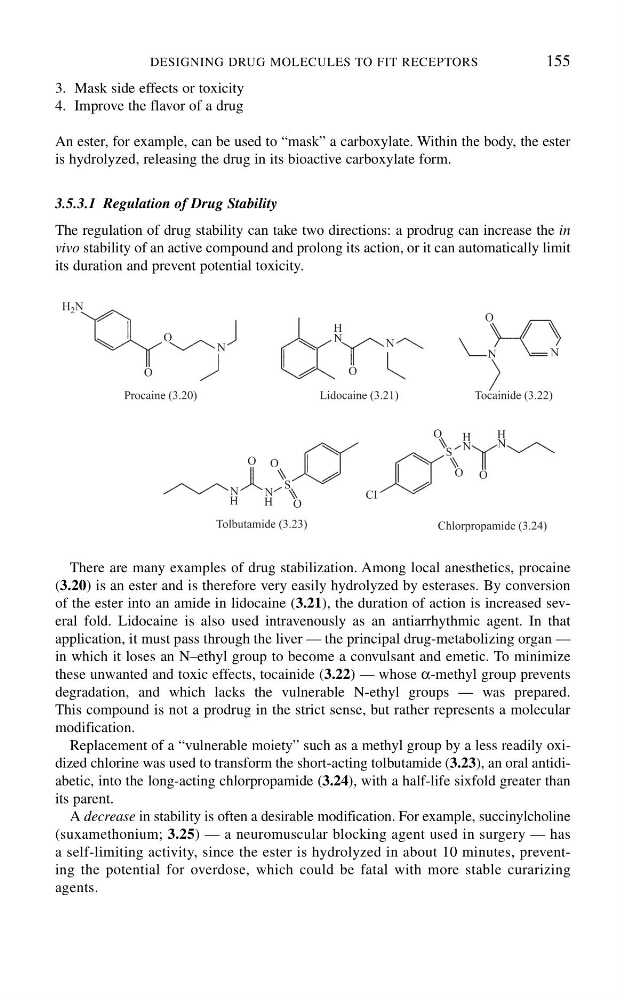
There are many examples of drug stabilization. Among local anesthetics, procaine
(3.20) is an ester and is therefore very easily hydrolyzed by esterases. By conversion
of the ester into an amide in lidocaine (3.21), the duration of action is increased several fold. Lidocaine is also used intravenously as an antiarrhythmic agent. In that
application, it must pass through the liver — the principal drug-metabolizing organ —
in which it loses an N–ethyl group to become a convulsant and emetic. To minimize
these unwanted and toxic effects, tocainide (3.22) — whose α-methyl group prevents
degradation, and which lacks the vulnerable N-ethyl groups — was prepared.
This compound is not a prodrug in the strict sense, but rather represents a molecular
modification.
Replacement of a “vulnerable moiety” such as a methyl group by a less readily oxidized chlorine was used to transform the short-acting tolbutamide (3.23), an oral antidiabetic, into the long-acting chlorpropamide (3.24), with a half-life sixfold greater than
its parent.
A decrease in stability is often a desirable modification. For example, succinylcholine
(suxamethonium; 3.25) — a neuromuscular blocking agent used in surgery — has
a self-limiting activity, since the ester is hydrolyzed in about 10 minutes, preventing the potential for overdose, which could be fatal with more stable curarizing
agents.
DESIGNING DRUG MOLECULES TO FIT RECEPTORS
155
4. Improve the flavor of a drug
An ester, for example, can be used to “mask” a carboxylate. Within the body, the ester
is hydrolyzed, releasing the drug in its bioactive carboxylate form.
3.5.3.1 Regulation of Drug Stability
The regulation of drug stability can take two directions: a prodrug can increase the in
vivo stability of an active compound and prolong its action, or it can automatically limit
its duration and prevent potential toxicity.
There are many examples of drug stabilization. Among local anesthetics, procaine
(3.20) is an ester and is therefore very easily hydrolyzed by esterases. By conversion
of the ester into an amide in lidocaine (3.21), the duration of action is increased several fold. Lidocaine is also used intravenously as an antiarrhythmic agent. In that
application, it must pass through the liver — the principal drug-metabolizing organ —
in which it loses an N–ethyl group to become a convulsant and emetic. To minimize
these unwanted and toxic effects, tocainide (3.22) — whose α-methyl group prevents
degradation, and which lacks the vulnerable N-ethyl groups — was prepared.
This compound is not a prodrug in the strict sense, but rather represents a molecular
modification.
Replacement of a “vulnerable moiety” such as a methyl group by a less readily oxidized chlorine was used to transform the short-acting tolbutamide (3.23), an oral antidiabetic, into the long-acting chlorpropamide (3.24), with a half-life sixfold greater than
its parent.
A decrease in stability is often a desirable modification. For example, succinylcholine
(suxamethonium; 3.25) — a neuromuscular blocking agent used in surgery — has
a self-limiting activity, since the ester is hydrolyzed in about 10 minutes, preventing the potential for overdose, which could be fatal with more stable curarizing
agents.
DESIGNING DRUG MOLECULES TO FIT RECEPTORS
155