

activity, then this decision may be relatively straightforward. Nevertheless, the optimization
of a lead compound is a lengthy and expensive undertaking, fraught with a frighteningly
high rate of failure.
Even in the 21st century, drug design is more of a hope than an achievement. It means
the application of previously recognized correlations of biological activity with physicochemical characteristics in the broadest sense, in the hope that the pharmacological success of a not yet synthesized compound can be predicted. Few drugs in use today were
discovered entirely in this way. One of the principal difficulties in this approach is that
the available — and very sophisticated—methods for predicting drug action cannot
foretell toxicity and side effects, nor do they help in anticipating the transport characteristics or metabolic fate of the drug in vivo.
Although some practicing biologists and pharmacologists still regard efforts at drug
design with some condescension and ill-concealed impatience, a slow but promising
development gives renewed hope that progress in this area will not be less rapid than in
the application of biology and physical chemistry to human and animal pathology. The
explosive development of computer-aided drug design and bioinformatics (see chapter 1)
promises to lead to the era of true rational drug design.
DESIGNING DRUG MOLECULES TO FIT RECEPTORS
133
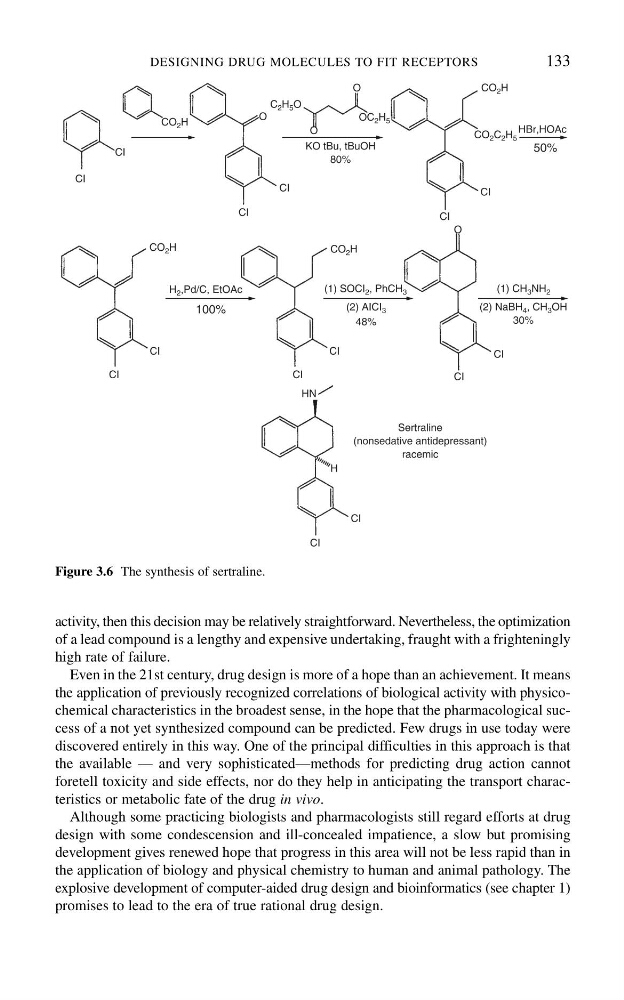
Figure 3.6 The synthesis of sertraline.
of a lead compound is a lengthy and expensive undertaking, fraught with a frighteningly
high rate of failure.
Even in the 21st century, drug design is more of a hope than an achievement. It means
the application of previously recognized correlations of biological activity with physicochemical characteristics in the broadest sense, in the hope that the pharmacological success of a not yet synthesized compound can be predicted. Few drugs in use today were
discovered entirely in this way. One of the principal difficulties in this approach is that
the available — and very sophisticated—methods for predicting drug action cannot
foretell toxicity and side effects, nor do they help in anticipating the transport characteristics or metabolic fate of the drug in vivo.
Although some practicing biologists and pharmacologists still regard efforts at drug
design with some condescension and ill-concealed impatience, a slow but promising
development gives renewed hope that progress in this area will not be less rapid than in
the application of biology and physical chemistry to human and animal pathology. The
explosive development of computer-aided drug design and bioinformatics (see chapter 1)
promises to lead to the era of true rational drug design.
DESIGNING DRUG MOLECULES TO FIT RECEPTORS
133
Figure 3.6 The synthesis of sertraline.