

interactions between two co-administered drugs, and are a common clinical problem.
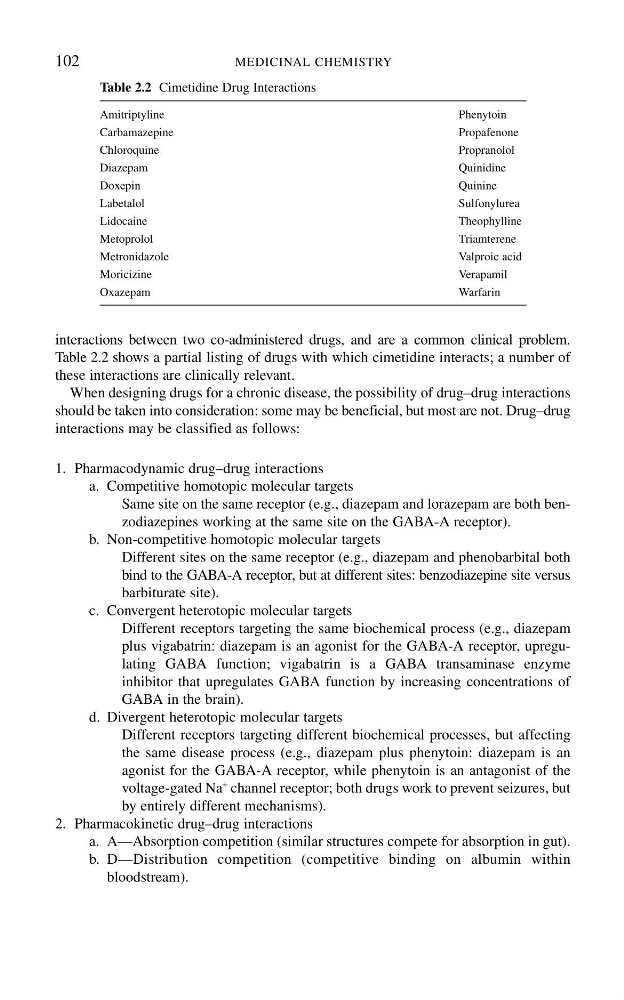
Table 2.2 shows a partial listing of drugs with which cimetidine interacts; a number of
these interactions are clinically relevant.
When designing drugs for a chronic disease, the possibility of drug–drug interactions
should be taken into consideration: some may be beneficial, but most are not. Drug–drug
interactions may be classified as follows:
1. Pharmacodynamic drug–drug interactions
a. Competitive homotopic molecular targets
Same site on the same receptor (e.g., diazepam and lorazepam are both benzodiazepines working at the same site on the GABA-A receptor).
b. Non-competitive homotopic molecular targets
Different sites on the same receptor (e.g., diazepam and phenobarbital both
bind to the GABA-A receptor, but at different sites: benzodiazepine site versus
barbiturate site).
c. Convergent heterotopic molecular targets
Different receptors targeting the same biochemical process (e.g., diazepam
plus vigabatrin: diazepam is an agonist for the GABA-A receptor, upregulating GABA function; vigabatrin is a GABA transaminase enzyme
inhibitor that upregulates GABA function by increasing concentrations of
GABA in the brain).
d. Divergent heterotopic molecular targets
Different receptors targeting different biochemical processes, but affecting
the same disease process (e.g., diazepam plus phenytoin: diazepam is an
agonist for the GABA-A receptor, while phenytoin is an antagonist of the
voltage-gated Na
+ channel receptor; both drugs work to prevent seizures, but
by entirely different mechanisms).
2. Pharmacokinetic drug–drug interactions
a. A—Absorption competition (similar structures compete for absorption in gut).
b. D—Distribution competition (competitive binding on albumin within
bloodstream).
102
MEDICINAL CHEMISTRY
Table 2.2 Cimetidine Drug Interactions
Amitriptyline
Phenytoin
Carbamazepine
Propafenone
Chloroquine
Propranolol
Diazepam
Quinidine
Doxepin
Quinine
Labetalol
Sulfonylurea
Lidocaine
Theophylline
Metoprolol
Triamterene
Metronidazole
Valproic acid
Moricizine
Verapamil
Oxazepam
Warfarin
Table 2.2 shows a partial listing of drugs with which cimetidine interacts; a number of
these interactions are clinically relevant.
When designing drugs for a chronic disease, the possibility of drug–drug interactions
should be taken into consideration: some may be beneficial, but most are not. Drug–drug
interactions may be classified as follows:
1. Pharmacodynamic drug–drug interactions
a. Competitive homotopic molecular targets
Same site on the same receptor (e.g., diazepam and lorazepam are both benzodiazepines working at the same site on the GABA-A receptor).
b. Non-competitive homotopic molecular targets
Different sites on the same receptor (e.g., diazepam and phenobarbital both
bind to the GABA-A receptor, but at different sites: benzodiazepine site versus
barbiturate site).
c. Convergent heterotopic molecular targets
Different receptors targeting the same biochemical process (e.g., diazepam
plus vigabatrin: diazepam is an agonist for the GABA-A receptor, upregulating GABA function; vigabatrin is a GABA transaminase enzyme
inhibitor that upregulates GABA function by increasing concentrations of
GABA in the brain).
d. Divergent heterotopic molecular targets
Different receptors targeting different biochemical processes, but affecting
the same disease process (e.g., diazepam plus phenytoin: diazepam is an
agonist for the GABA-A receptor, while phenytoin is an antagonist of the
voltage-gated Na
+ channel receptor; both drugs work to prevent seizures, but
by entirely different mechanisms).
2. Pharmacokinetic drug–drug interactions
a. A—Absorption competition (similar structures compete for absorption in gut).
b. D—Distribution competition (competitive binding on albumin within
bloodstream).
102
MEDICINAL CHEMISTRY
Table 2.2 Cimetidine Drug Interactions
Amitriptyline
Phenytoin
Carbamazepine
Propafenone
Chloroquine
Propranolol
Diazepam
Quinidine
Doxepin
Quinine
Labetalol
Sulfonylurea
Lidocaine
Theophylline
Metoprolol
Triamterene
Metronidazole
Valproic acid
Moricizine
Verapamil
Oxazepam
Warfarin