

C
H 3 C CH 2
H
CH 3
CH 3
1 2
3
Systematic name: 2-Methylbutane
4
C
H 3
C CH 3
H
CH 3
Systematic name: 2-Methylpropane
Common name: Isobutane
1
2 3
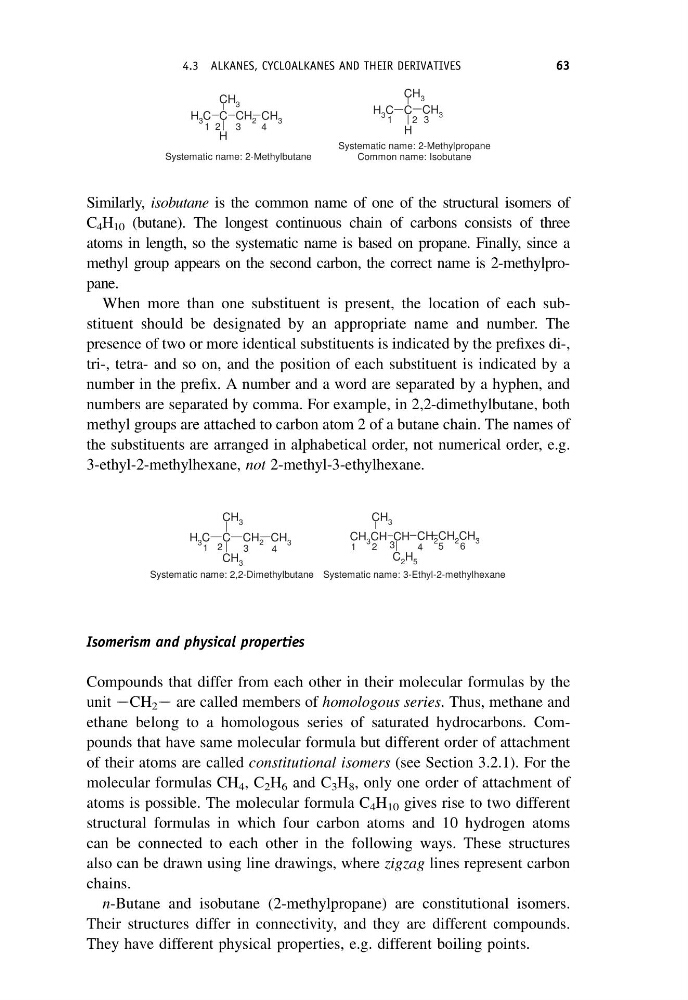
Similarly, isobutane is the common name of one of the structural isomers of
C 4 H 10 (butane). The longest continuous chain of carbons consists of three
atoms in length, so the systematic name is based on propane. Finally, since a
methyl group appears on the second carbon, the correct name is 2-methylpropane.
When more than one substituent is present, the location of each substituent should be designated by an appropriate name and number. The
presence of two or more identical substituents is indicated by the prefixes di-,
tri-, tetra- and so on, and the position of each substituent is indicated by a
number in the prefix. A number and a word are separated by a hyphen, and
numbers are separated by comma. For example, in 2,2-dimethylbutane, both
methyl groups are attached to carbon atom 2 of a butane chain. The names of
the substituents are arranged in alphabetical order, not numerical order, e.g.
3-ethyl-2-methylhexane, not 2-methyl-3-ethylhexane.
C
CH 3
CH 2
C
H 3
CH 3
CH 3
1
Systematic name: 2,2-Dimethylbutane
2
3
4
CH 2 CH 3
CH
CH 3 CH
CH 2
CH 3
C 2 H 5
Systematic name: 3-Ethyl-2-methylhexane
1
4
5
6
2 3
Isomerism and physical properties
Compounds that differ from each other in their molecular formulas by the
unit À ÀCH 2 À À are called members of homologous series. Thus, methane and
ethane belong to a homologous series of saturated hydrocarbons. Compounds that have same molecular formula but different order of attachment
of their atoms are called constitutional isomers (see Section 3.2.1). For the
molecular formulas CH 4 , C 2 H 6 and C 3 H 8 , only one order of attachment of
atoms is possible. The molecular formula C 4 H 10 gives rise to two different
structural formulas in which four carbon atoms and 10 hydrogen atoms
can be connected to each other in the following ways. These structures
also can be drawn using line drawings, where zigzag lines represent carbon
chains.
n-Butane and isobutane (2-methylpropane) are constitutional isomers.
Their structures differ in connectivity, and they are different compounds.
They have different physical properties, e.g. different boiling points.
4.3 ALKANES, CYCLOALKANES AND THEIR DERIVATIVES
63
H 3 C CH 2
H
CH 3
CH 3
1 2
3
Systematic name: 2-Methylbutane
4
C
H 3
C CH 3
H
CH 3
Systematic name: 2-Methylpropane
Common name: Isobutane
1
2 3
Similarly, isobutane is the common name of one of the structural isomers of
C 4 H 10 (butane). The longest continuous chain of carbons consists of three
atoms in length, so the systematic name is based on propane. Finally, since a
methyl group appears on the second carbon, the correct name is 2-methylpropane.
When more than one substituent is present, the location of each substituent should be designated by an appropriate name and number. The
presence of two or more identical substituents is indicated by the prefixes di-,
tri-, tetra- and so on, and the position of each substituent is indicated by a
number in the prefix. A number and a word are separated by a hyphen, and
numbers are separated by comma. For example, in 2,2-dimethylbutane, both
methyl groups are attached to carbon atom 2 of a butane chain. The names of
the substituents are arranged in alphabetical order, not numerical order, e.g.
3-ethyl-2-methylhexane, not 2-methyl-3-ethylhexane.
C
CH 3
CH 2
C
H 3
CH 3
CH 3
1
Systematic name: 2,2-Dimethylbutane
2
3
4
CH 2 CH 3
CH
CH 3 CH
CH 2
CH 3
C 2 H 5
Systematic name: 3-Ethyl-2-methylhexane
1
4
5
6
2 3
Isomerism and physical properties
Compounds that differ from each other in their molecular formulas by the
unit À ÀCH 2 À À are called members of homologous series. Thus, methane and
ethane belong to a homologous series of saturated hydrocarbons. Compounds that have same molecular formula but different order of attachment
of their atoms are called constitutional isomers (see Section 3.2.1). For the
molecular formulas CH 4 , C 2 H 6 and C 3 H 8 , only one order of attachment of
atoms is possible. The molecular formula C 4 H 10 gives rise to two different
structural formulas in which four carbon atoms and 10 hydrogen atoms
can be connected to each other in the following ways. These structures
also can be drawn using line drawings, where zigzag lines represent carbon
chains.
n-Butane and isobutane (2-methylpropane) are constitutional isomers.
Their structures differ in connectivity, and they are different compounds.
They have different physical properties, e.g. different boiling points.
4.3 ALKANES, CYCLOALKANES AND THEIR DERIVATIVES
63