

4.1 Organic functional groups: definition and
structural features
All organic compounds are grouped into classes based on characteristic
features called functional groups. A functional group is an atom or a group
of atoms within a molecule that serves as a site of chemical reactivity.
Carbon combines with other atoms such as H, N, O, S and halogens to form
functional groups. A reaction is the process by which one compound is
transformed into a new compound. Thus, functional groups are important in
chemical reactions. It is important that you are able to recognize these
functional groups because they dictate the physical, chemical and other
properties of organic molecules, including various drug molecules. The
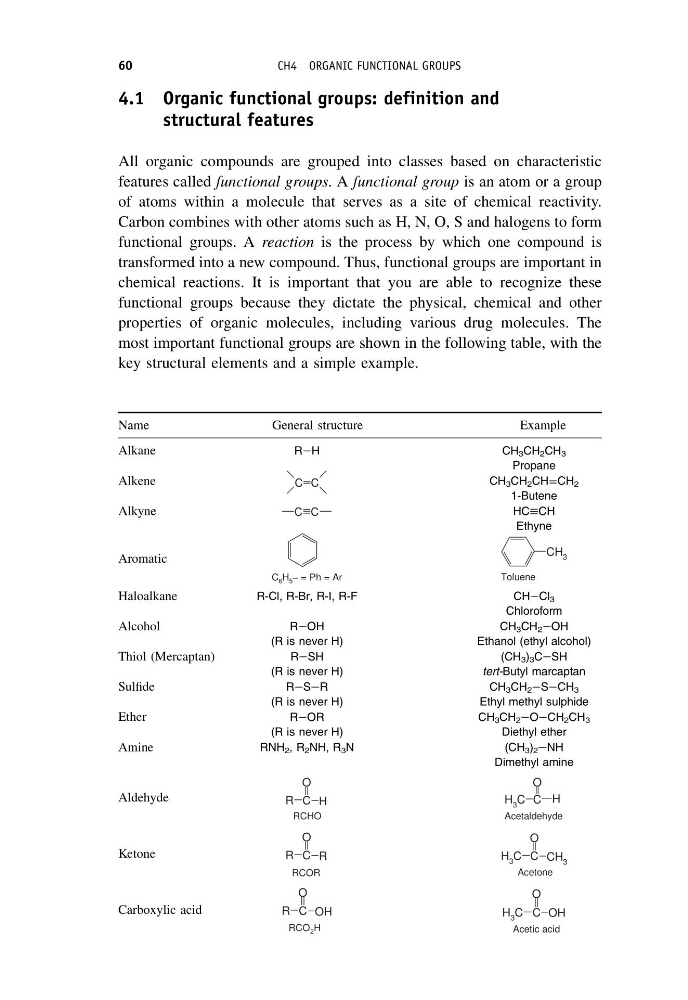
most important functional groups are shown in the following table, with the
key structural elements and a simple example.
Name
General structure
Example
Alkane
RÀ ÀH
C H 3 CH 2 CH 3
Propane
Alkene
C C
CH 3 CH 2 CHÀ À
À ÀCH2
1-Butene
Alkyne
C C
HC À À
À À
À À CH
Ethyne
Aromatic
C 6 H 5 − = Ph = Ar
CH 3
Toluene
Haloalkane
R-Cl, R-Br, R-I, R-F
CHÀ ÀCl 3
Chloroform
Alcohol
RÀ ÀOH
CH 3 CH 2 À ÀOH
(R is never H)
Ethanol (ethyl alcohol)
Thiol (Mercaptan)
RÀ ÀSH
(CH 3 ) 3 CÀ ÀSH
(R is never H)
tert-Butyl marcaptan
Sulfide
RÀ ÀSÀ ÀR
C H 3 CH 2 À ÀSÀ ÀCH 3
(R is never H)
Ethyl methyl sulphide
Ether
RÀ ÀOR
CH 3 CH 2 À ÀOÀ ÀCH 2 CH 3
(R is never H)
Diethyl ether
Amine
RNH 2 , R 2 NH, R 3 N
(CH 3 ) 2 À ÀNH
Dimethyl amine
Aldehyde
R C
O
H
RCHO
C
H 3 C
O
H
Acetaldehyde
Ketone
R C
O
R
RCOR
C
H 3 C
O
CH 3
Acetone
Carboxylic acid
R C
O
OH
RCO 2 H
C
H 3
C
O
OH
Acetic acid
60
CH4 ORGANIC FUNCTIONAL GROUPS
structural features
All organic compounds are grouped into classes based on characteristic
features called functional groups. A functional group is an atom or a group
of atoms within a molecule that serves as a site of chemical reactivity.
Carbon combines with other atoms such as H, N, O, S and halogens to form
functional groups. A reaction is the process by which one compound is
transformed into a new compound. Thus, functional groups are important in
chemical reactions. It is important that you are able to recognize these
functional groups because they dictate the physical, chemical and other
properties of organic molecules, including various drug molecules. The
most important functional groups are shown in the following table, with the
key structural elements and a simple example.
Name
General structure
Example
Alkane
RÀ ÀH
C H 3 CH 2 CH 3
Propane
Alkene
C C
CH 3 CH 2 CHÀ À
À ÀCH2
1-Butene
Alkyne
C C
HC À À
À À
À À CH
Ethyne
Aromatic
C 6 H 5 − = Ph = Ar
CH 3
Toluene
Haloalkane
R-Cl, R-Br, R-I, R-F
CHÀ ÀCl 3
Chloroform
Alcohol
RÀ ÀOH
CH 3 CH 2 À ÀOH
(R is never H)
Ethanol (ethyl alcohol)
Thiol (Mercaptan)
RÀ ÀSH
(CH 3 ) 3 CÀ ÀSH
(R is never H)
tert-Butyl marcaptan
Sulfide
RÀ ÀSÀ ÀR
C H 3 CH 2 À ÀSÀ ÀCH 3
(R is never H)
Ethyl methyl sulphide
Ether
RÀ ÀOR
CH 3 CH 2 À ÀOÀ ÀCH 2 CH 3
(R is never H)
Diethyl ether
Amine
RNH 2 , R 2 NH, R 3 N
(CH 3 ) 2 À ÀNH
Dimethyl amine
Aldehyde
R C
O
H
RCHO
C
H 3 C
O
H
Acetaldehyde
Ketone
R C
O
R
RCOR
C
H 3 C
O
CH 3
Acetone
Carboxylic acid
R C
O
OH
RCO 2 H
C
H 3
C
O
OH
Acetic acid
60
CH4 ORGANIC FUNCTIONAL GROUPS