

H
H
H
H
H
H
H
H
H
H
C
H 3
H
H
H
H
CH 3
Butane
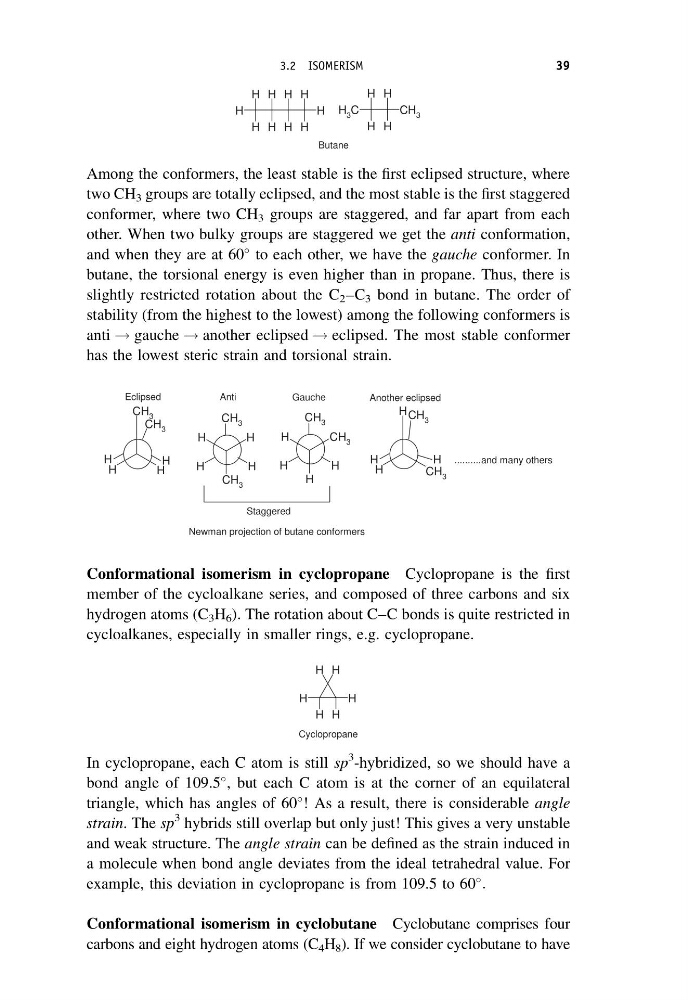
Among the conformers, the least stable is the first eclipsed structure, where
two CH 3 groups are totally eclipsed, and the most stable is the first staggered
conformer, where two CH 3 groups are staggered, and far apart from each
other. When two bulky groups are staggered we get the anti conformation,
and when they are at 60
to each other, we have the gauche conformer. In
butane, the torsional energy is even higher than in propane. Thus, there is
slightly restricted rotation about the C 2 –C 3 bond in butane. The order of
stability (from the highest to the lowest) among the following conformers is
anti ! gauche ! another eclipsed ! eclipsed. The most stable conformer
has the lowest steric strain and torsional strain.
CH 3
H
H
H
H
CH 3
CH 3
H
H
CH 3
H
H
H
CH 3
H
CH 3
H
H
H
CH 3
H
H
H
CH 3
Eclipsed
Anti
Newman projection of butane conformers
Gauche
Another eclipsed
Staggered
..........and many others
Conformational isomerism in cyclopropane Cyclopropane is the first
member of the cycloalkane series, and composed of three carbons and six
hydrogen atoms (C 3 H 6 ). The rotation about C–C bonds is quite restricted in
cycloalkanes, especially in smaller rings, e.g. cyclopropane.
H H
H H
H
H
Cyclopropane
In cyclopropane, each C atom is still sp
3
-hybridized, so we should have a
bond angle of 109.5
, but each C atom is at the corner of an equilateral
triangle, which has angles of 60
! As a result, there is considerable angle
strain. The sp
3 hybrids still overlap but only just! This gives a very unstable
and weak structure. The angle strain can be defined as the strain induced in
a molecule when bond angle deviates from the ideal tetrahedral value. For
example, this deviation in cyclopropane is from 109.5 to 60
.
Conformational isomerism in cyclobutane Cyclobutane comprises four
carbons and eight hydrogen atoms (C 4 H 8 ). If we consider cyclobutane to have
3.2 ISOMERISM
39
H
H
H
H
H
H
H
H
H
C
H 3
H
H
H
H
CH 3
Butane
Among the conformers, the least stable is the first eclipsed structure, where
two CH 3 groups are totally eclipsed, and the most stable is the first staggered
conformer, where two CH 3 groups are staggered, and far apart from each
other. When two bulky groups are staggered we get the anti conformation,
and when they are at 60
to each other, we have the gauche conformer. In
butane, the torsional energy is even higher than in propane. Thus, there is
slightly restricted rotation about the C 2 –C 3 bond in butane. The order of
stability (from the highest to the lowest) among the following conformers is
anti ! gauche ! another eclipsed ! eclipsed. The most stable conformer
has the lowest steric strain and torsional strain.
CH 3
H
H
H
H
CH 3
CH 3
H
H
CH 3
H
H
H
CH 3
H
CH 3
H
H
H
CH 3
H
H
H
CH 3
Eclipsed
Anti
Newman projection of butane conformers
Gauche
Another eclipsed
Staggered
..........and many others
Conformational isomerism in cyclopropane Cyclopropane is the first
member of the cycloalkane series, and composed of three carbons and six
hydrogen atoms (C 3 H 6 ). The rotation about C–C bonds is quite restricted in
cycloalkanes, especially in smaller rings, e.g. cyclopropane.
H H
H H
H
H
Cyclopropane
In cyclopropane, each C atom is still sp
3
-hybridized, so we should have a
bond angle of 109.5
, but each C atom is at the corner of an equilateral
triangle, which has angles of 60
! As a result, there is considerable angle
strain. The sp
3 hybrids still overlap but only just! This gives a very unstable
and weak structure. The angle strain can be defined as the strain induced in
a molecule when bond angle deviates from the ideal tetrahedral value. For
example, this deviation in cyclopropane is from 109.5 to 60
.
Conformational isomerism in cyclobutane Cyclobutane comprises four
carbons and eight hydrogen atoms (C 4 H 8 ). If we consider cyclobutane to have
3.2 ISOMERISM
39