

are possible for n-butane are reflected in its boiling point, which is higher
than the boiling point of isobutane.
Isobutane
b.p. -10.2
n-Butane
b.p. - 0.6
2.5.3 Hydrogen bonding
Hydrogen bonding is the attractive force between the hydrogen attached to
an electronegative atom of one molecule and an electronegative atom of the
same (intramolecular) or a different molecule (intermolecular). It is an
unusually strong force of attraction between highly polar molecules in
which hydrogen is covalently bonded to nitrogen, oxygen or fluorine.
Therefore, a hydrogen bond is a special type of interaction between
atoms. A hydrogen bond is formed whenever a polar covalent bond
involving a hydrogen atom is in close proximity to an electronegative
atom such as O or N. The attractive forces of hydrogen bonding are usually
indicated by a dashed line rather than the solid line used for a covalent bond.
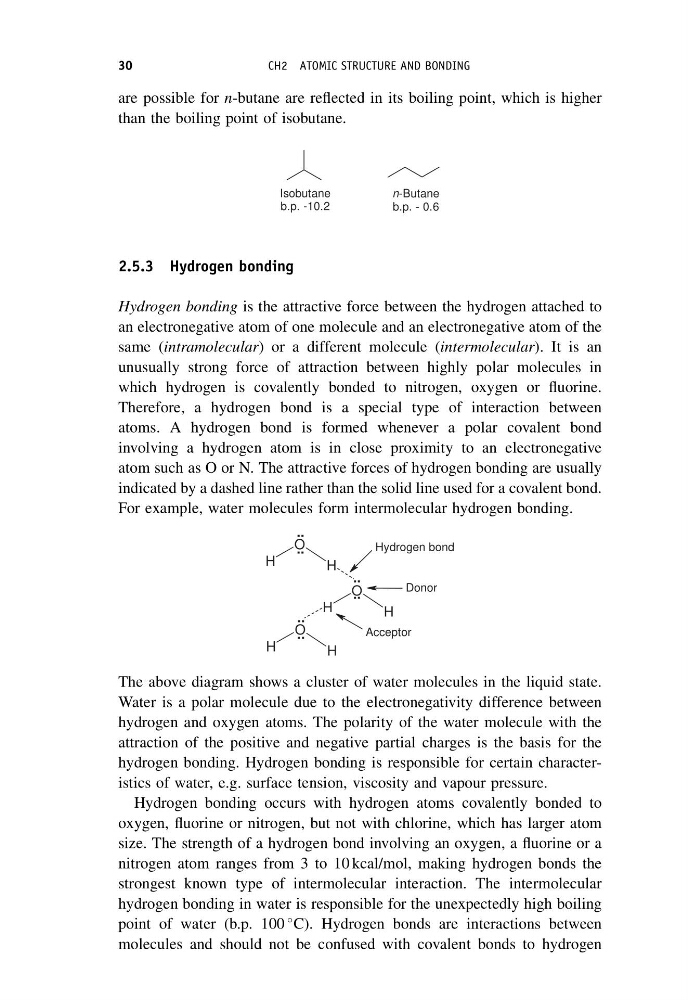
For example, water molecules form intermolecular hydrogen bonding.
H
O
H
H
O
H
H
O
H
..
..
..
..
..
..
Hydrogen bond
Donor
Acceptor
The above diagram shows a cluster of water molecules in the liquid state.
Water is a polar molecule due to the electronegativity difference between
hydrogen and oxygen atoms. The polarity of the water molecule with the
attraction of the positive and negative partial charges is the basis for the
hydrogen bonding. Hydrogen bonding is responsible for certain characteristics of water, e.g. surface tension, viscosity and vapour pressure.
Hydrogen bonding occurs with hydrogen atoms covalently bonded to
oxygen, fluorine or nitrogen, but not with chlorine, which has larger atom
size. The strength of a hydrogen bond involving an oxygen, a fluorine or a
nitrogen atom ranges from 3 to 10 kcal/mol, making hydrogen bonds the
strongest known type of intermolecular interaction. The intermolecular
hydrogen bonding in water is responsible for the unexpectedly high boiling
point of water (b.p. 100
C). Hydrogen bonds are interactions between
molecules and should not be confused with covalent bonds to hydrogen
30
CH2 ATOMIC STRUCTURE AND BONDING
than the boiling point of isobutane.
Isobutane
b.p. -10.2
n-Butane
b.p. - 0.6
2.5.3 Hydrogen bonding
Hydrogen bonding is the attractive force between the hydrogen attached to
an electronegative atom of one molecule and an electronegative atom of the
same (intramolecular) or a different molecule (intermolecular). It is an
unusually strong force of attraction between highly polar molecules in
which hydrogen is covalently bonded to nitrogen, oxygen or fluorine.
Therefore, a hydrogen bond is a special type of interaction between
atoms. A hydrogen bond is formed whenever a polar covalent bond
involving a hydrogen atom is in close proximity to an electronegative
atom such as O or N. The attractive forces of hydrogen bonding are usually
indicated by a dashed line rather than the solid line used for a covalent bond.
For example, water molecules form intermolecular hydrogen bonding.
H
O
H
H
O
H
H
O
H
..
..
..
..
..
..
Hydrogen bond
Donor
Acceptor
The above diagram shows a cluster of water molecules in the liquid state.
Water is a polar molecule due to the electronegativity difference between
hydrogen and oxygen atoms. The polarity of the water molecule with the
attraction of the positive and negative partial charges is the basis for the
hydrogen bonding. Hydrogen bonding is responsible for certain characteristics of water, e.g. surface tension, viscosity and vapour pressure.
Hydrogen bonding occurs with hydrogen atoms covalently bonded to
oxygen, fluorine or nitrogen, but not with chlorine, which has larger atom
size. The strength of a hydrogen bond involving an oxygen, a fluorine or a
nitrogen atom ranges from 3 to 10 kcal/mol, making hydrogen bonds the
strongest known type of intermolecular interaction. The intermolecular
hydrogen bonding in water is responsible for the unexpectedly high boiling
point of water (b.p. 100
C). Hydrogen bonds are interactions between
molecules and should not be confused with covalent bonds to hydrogen
30
CH2 ATOMIC STRUCTURE AND BONDING