

In general, if the electronegativity difference is equal to or less than 0.5 the
bond is nonpolar covalent, and if the electronegativity difference between
bonded atoms is 0.5–1.9 the bond is polar covalent. If the difference in
electronegativities between the two atoms is 2.0 or greater, the bond is ionic.
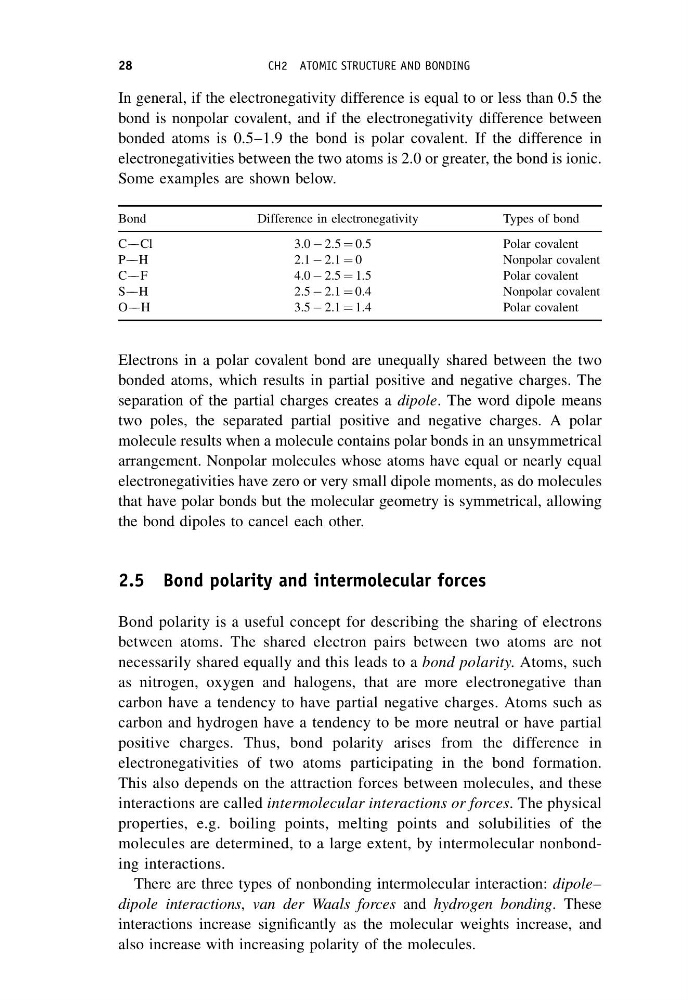
Some examples are shown below.
Electrons in a polar covalent bond are unequally shared between the two
bonded atoms, which results in partial positive and negative charges. The
separation of the partial charges creates a dipole. The word dipole means
two poles, the separated partial positive and negative charges. A polar
molecule results when a molecule contains polar bonds in an unsymmetrical
arrangement. Nonpolar molecules whose atoms have equal or nearly equal
electronegativities have zero or very small dipole moments, as do molecules
that have polar bonds but the molecular geometry is symmetrical, allowing
the bond dipoles to cancel each other.
2.5 Bond polarity and intermolecular forces
Bond polarity is a useful concept for describing the sharing of electrons
between atoms. The shared electron pairs between two atoms are not
necessarily shared equally and this leads to a bond polarity. Atoms, such
as nitrogen, oxygen and halogens, that are more electronegative than
carbon have a tendency to have partial negative charges. Atoms such as
carbon and hydrogen have a tendency to be more neutral or have partial
positive charges. Thus, bond polarity arises from the difference in
electronegativities of two atoms participating in the bond formation.
This also depends on the attraction forces between molecules, and these
interactions are called intermolecular interactions or forces. The physical
properties, e.g. boiling points, melting points and solubilities of the
molecules are determined, to a large extent, by intermolecular nonbonding interactions.
There are three types of nonbonding intermolecular interaction: dipole–
dipole interactions, van der Waals forces and hydrogen bonding. These
interactions increase significantly as the molecular weights increase, and
also increase with increasing polarity of the molecules.
Bond
Difference in electronegativity
Types of bond
CÀ ÀCl
3.0 À 2.5 ¼ 0.5
Polar covalent
PÀ ÀH
2.1 À 2.1 ¼ 0
Nonpolar covalent
CÀ ÀF
4.0 À 2.5 ¼ 1.5
Polar covalent
SÀ ÀH
2.5 À 2.1 ¼ 0.4
Nonpolar covalent
OÀ ÀH
3.5 À 2.1 ¼ 1.4
Polar covalent
28
CH2 ATOMIC STRUCTURE AND BONDING
bond is nonpolar covalent, and if the electronegativity difference between
bonded atoms is 0.5–1.9 the bond is polar covalent. If the difference in
electronegativities between the two atoms is 2.0 or greater, the bond is ionic.
Some examples are shown below.
Electrons in a polar covalent bond are unequally shared between the two
bonded atoms, which results in partial positive and negative charges. The
separation of the partial charges creates a dipole. The word dipole means
two poles, the separated partial positive and negative charges. A polar
molecule results when a molecule contains polar bonds in an unsymmetrical
arrangement. Nonpolar molecules whose atoms have equal or nearly equal
electronegativities have zero or very small dipole moments, as do molecules
that have polar bonds but the molecular geometry is symmetrical, allowing
the bond dipoles to cancel each other.
2.5 Bond polarity and intermolecular forces
Bond polarity is a useful concept for describing the sharing of electrons
between atoms. The shared electron pairs between two atoms are not
necessarily shared equally and this leads to a bond polarity. Atoms, such
as nitrogen, oxygen and halogens, that are more electronegative than
carbon have a tendency to have partial negative charges. Atoms such as
carbon and hydrogen have a tendency to be more neutral or have partial
positive charges. Thus, bond polarity arises from the difference in
electronegativities of two atoms participating in the bond formation.
This also depends on the attraction forces between molecules, and these
interactions are called intermolecular interactions or forces. The physical
properties, e.g. boiling points, melting points and solubilities of the
molecules are determined, to a large extent, by intermolecular nonbonding interactions.
There are three types of nonbonding intermolecular interaction: dipole–
dipole interactions, van der Waals forces and hydrogen bonding. These
interactions increase significantly as the molecular weights increase, and
also increase with increasing polarity of the molecules.
Bond
Difference in electronegativity
Types of bond
CÀ ÀCl
3.0 À 2.5 ¼ 0.5
Polar covalent
PÀ ÀH
2.1 À 2.1 ¼ 0
Nonpolar covalent
CÀ ÀF
4.0 À 2.5 ¼ 1.5
Polar covalent
SÀ ÀH
2.5 À 2.1 ¼ 0.4
Nonpolar covalent
OÀ ÀH
3.5 À 2.1 ¼ 1.4
Polar covalent
28
CH2 ATOMIC STRUCTURE AND BONDING