

are often present in unripe fruits, but disappear during ripening. It is
believed that tannins may provide plants with protection against microbial
attacks. Tannins are of two broad structural types: condensed proanthocyanidins in which the fundamental structural unit is the phenolic flavan-3-ol
(catechin) nucleus, and galloyl and hexahydroxydiphenoyl esters and their
derivatives.
Tannins are amorphous substances, which produce colloidal acidic aqueous solutions with astringent taste. With iron salts (FeCl 3 ) they form dark
blue or greenish black water-soluble compounds. Tannins form insoluble
and indigestible compounds with proteins, and this is the basis of their
extensive use in the leather industry (tanning process), and for the treatment
of diarrhoea, bleeding gums and skin injuries.
Classification
Tannins can be classified into two major classes: hydrolysable tannins and
condensed tannins. On treatment with acids or enzymes, while hydrolysable
tannins are split into simpler molecules, condensed tannins produce complex water-insoluble products.
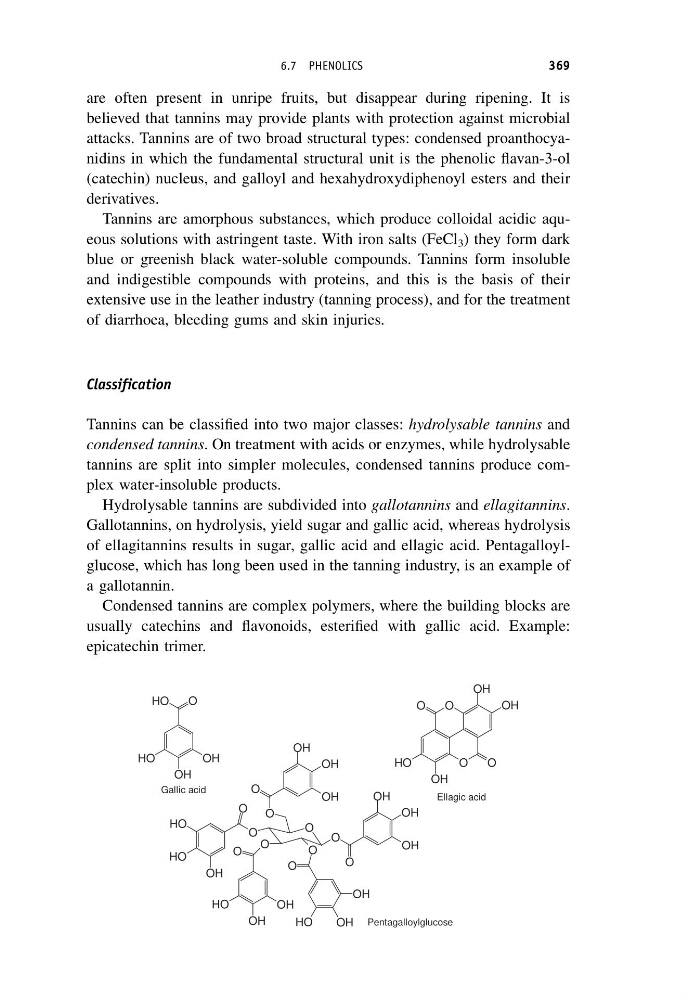
Hydrolysable tannins are subdivided into gallotannins and ellagitannins.
Gallotannins, on hydrolysis, yield sugar and gallic acid, whereas hydrolysis
of ellagitannins results in sugar, gallic acid and ellagic acid. Pentagalloylglucose, which has long been used in the tanning industry, is an example of
a gallotannin.
Condensed tannins are complex polymers, where the building blocks are
usually catechins and flavonoids, esterified with gallic acid. Example:
epicatechin trimer.
O
O
H
OH
OH
O
H
O
O
O
O
O
H
OH
OH
OH
O
O
O
O
O
O
O
OH
OH
O
H
O
O
H
OH
OH
O
OH
OH
OH
O
O
H
O
H
OH
O
OH
OH
OH
Gallic acid
Ellagic acid
Pentagalloylglucose
6.7 PHENOLICS
369
believed that tannins may provide plants with protection against microbial
attacks. Tannins are of two broad structural types: condensed proanthocyanidins in which the fundamental structural unit is the phenolic flavan-3-ol
(catechin) nucleus, and galloyl and hexahydroxydiphenoyl esters and their
derivatives.
Tannins are amorphous substances, which produce colloidal acidic aqueous solutions with astringent taste. With iron salts (FeCl 3 ) they form dark
blue or greenish black water-soluble compounds. Tannins form insoluble
and indigestible compounds with proteins, and this is the basis of their
extensive use in the leather industry (tanning process), and for the treatment
of diarrhoea, bleeding gums and skin injuries.
Classification
Tannins can be classified into two major classes: hydrolysable tannins and
condensed tannins. On treatment with acids or enzymes, while hydrolysable
tannins are split into simpler molecules, condensed tannins produce complex water-insoluble products.
Hydrolysable tannins are subdivided into gallotannins and ellagitannins.
Gallotannins, on hydrolysis, yield sugar and gallic acid, whereas hydrolysis
of ellagitannins results in sugar, gallic acid and ellagic acid. Pentagalloylglucose, which has long been used in the tanning industry, is an example of
a gallotannin.
Condensed tannins are complex polymers, where the building blocks are
usually catechins and flavonoids, esterified with gallic acid. Example:
epicatechin trimer.
O
O
H
OH
OH
O
H
O
O
O
O
O
H
OH
OH
OH
O
O
O
O
O
O
O
OH
OH
O
H
O
O
H
OH
OH
O
OH
OH
OH
O
O
H
O
H
OH
O
OH
OH
OH
Gallic acid
Ellagic acid
Pentagalloylglucose
6.7 PHENOLICS
369