

However, broadly steroids can be classified only in to two main classes: sex or
reproductive hormones and adrenocorticoid or adrenocortical hormones.
6.6.5 Biosynthesis of steroids
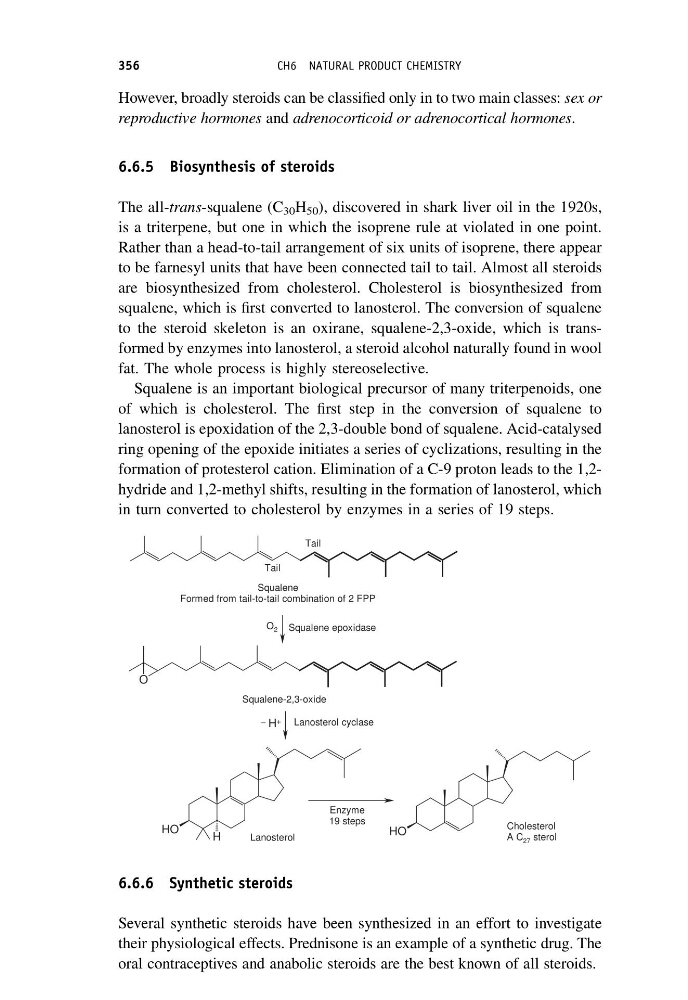
The all-trans-squalene (C 30 H 50 ), discovered in shark liver oil in the 1920s,
is a triterpene, but one in which the isoprene rule at violated in one point.
Rather than a head-to-tail arrangement of six units of isoprene, there appear
to be farnesyl units that have been connected tail to tail. Almost all steroids
are biosynthesized from cholesterol. Cholesterol is biosynthesized from
squalene, which is first converted to lanosterol. The conversion of squalene
to the steroid skeleton is an oxirane, squalene-2,3-oxide, which is transformed by enzymes into lanosterol, a steroid alcohol naturally found in wool
fat. The whole process is highly stereoselective.
Squalene is an important biological precursor of many triterpenoids, one
of which is cholesterol. The first step in the conversion of squalene to
lanosterol is epoxidation of the 2,3-double bond of squalene. Acid-catalysed
ring opening of the epoxide initiates a series of cyclizations, resulting in the
formation of protesterol cation. Elimination of a C-9 proton leads to the 1,2hydride and 1,2-methyl shifts, resulting in the formation of lanosterol, which
in turn converted to cholesterol by enzymes in a series of 19 steps.
O
O
H
O
H
H
Squalene-2,3-oxide
Lanosterol cyclase
Squalene epoxidase
O 2
_ H +
Lanosterol
Enzyme
19 steps
Squalene
Formed from tail-to-tail combination of 2 FPP
Tail
Tail
Cholesterol
A C 27 sterol
6.6.6 Synthetic steroids
Several synthetic steroids have been synthesized in an effort to investigate
their physiological effects. Prednisone is an example of a synthetic drug. The
oral contraceptives and anabolic steroids are the best known of all steroids.
356
CH6 NATURAL PRODUCT CHEMISTRY
reproductive hormones and adrenocorticoid or adrenocortical hormones.
6.6.5 Biosynthesis of steroids
The all-trans-squalene (C 30 H 50 ), discovered in shark liver oil in the 1920s,
is a triterpene, but one in which the isoprene rule at violated in one point.
Rather than a head-to-tail arrangement of six units of isoprene, there appear
to be farnesyl units that have been connected tail to tail. Almost all steroids
are biosynthesized from cholesterol. Cholesterol is biosynthesized from
squalene, which is first converted to lanosterol. The conversion of squalene
to the steroid skeleton is an oxirane, squalene-2,3-oxide, which is transformed by enzymes into lanosterol, a steroid alcohol naturally found in wool
fat. The whole process is highly stereoselective.
Squalene is an important biological precursor of many triterpenoids, one
of which is cholesterol. The first step in the conversion of squalene to
lanosterol is epoxidation of the 2,3-double bond of squalene. Acid-catalysed
ring opening of the epoxide initiates a series of cyclizations, resulting in the
formation of protesterol cation. Elimination of a C-9 proton leads to the 1,2hydride and 1,2-methyl shifts, resulting in the formation of lanosterol, which
in turn converted to cholesterol by enzymes in a series of 19 steps.
O
O
H
O
H
H
Squalene-2,3-oxide
Lanosterol cyclase
Squalene epoxidase
O 2
_ H +
Lanosterol
Enzyme
19 steps
Squalene
Formed from tail-to-tail combination of 2 FPP
Tail
Tail
Cholesterol
A C 27 sterol
6.6.6 Synthetic steroids
Several synthetic steroids have been synthesized in an effort to investigate
their physiological effects. Prednisone is an example of a synthetic drug. The
oral contraceptives and anabolic steroids are the best known of all steroids.
356
CH6 NATURAL PRODUCT CHEMISTRY