

6.5.5 Diterpenes
The diterpenoids constitute a large group of 20-carbon-containing compounds derived from 2E,6E,10E-geranylgeranyl pyrophosphate (GGPP) or
its allylic geranyl linaloyl isomer through condensation of IPP with 2E,6EFPP. They are found in higher plants, fungi, insects and marine organisms.
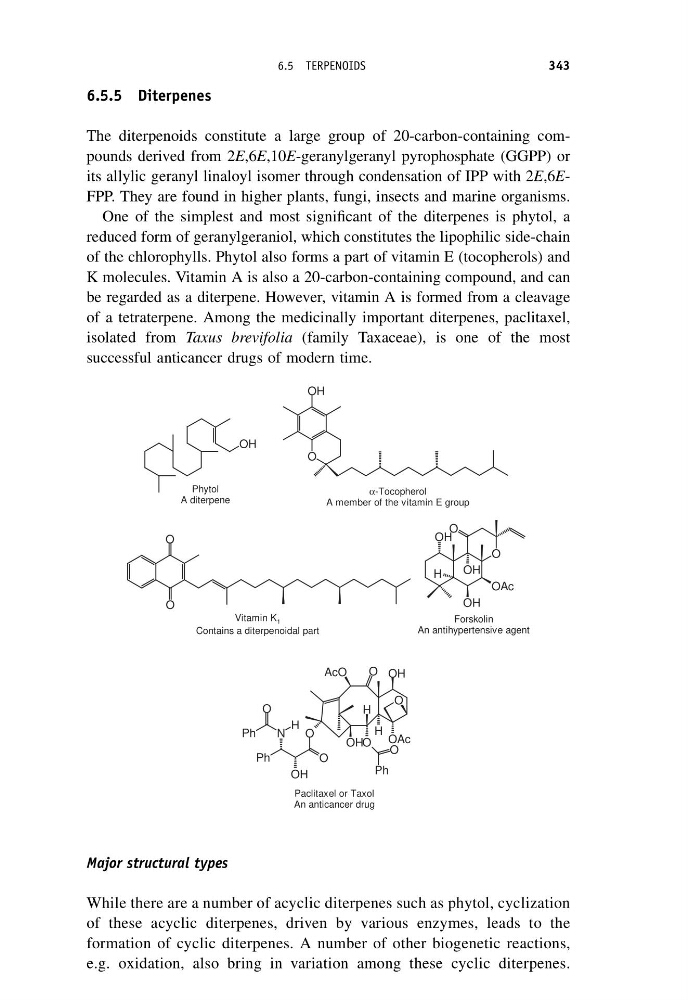
One of the simplest and most significant of the diterpenes is phytol, a
reduced form of geranylgeraniol, which constitutes the lipophilic side-chain
of the chlorophylls. Phytol also forms a part of vitamin E (tocopherols) and
K molecules. Vitamin A is also a 20-carbon-containing compound, and can
be regarded as a diterpene. However, vitamin A is formed from a cleavage
of a tetraterpene. Among the medicinally important diterpenes, paclitaxel,
isolated from Taxus brevifolia (family Taxaceae), is one of the most
successful anticancer drugs of modern time.
OH
Phytol
A diterpene
OH
O
α-Tocopherol
A member of the vitamin E group
O
O
Vitamin K 1
Contains a diterpenoidal part
O
OH
OAc
O
OH
OH
H
Forskolin
An antihypertensive agent
O OH
O
OAc
H
O
H
O
OH
AcO
O
O
OH
N
O
H
Ph
Ph
Ph
Paclitaxel or Taxol
An anticancer drug
Major structural types
While there are a number of acyclic diterpenes such as phytol, cyclization
of these acyclic diterpenes, driven by various enzymes, leads to the
formation of cyclic diterpenes. A number of other biogenetic reactions,
e.g. oxidation, also bring in variation among these cyclic diterpenes.
6.5 TERPENOIDS
343
The diterpenoids constitute a large group of 20-carbon-containing compounds derived from 2E,6E,10E-geranylgeranyl pyrophosphate (GGPP) or
its allylic geranyl linaloyl isomer through condensation of IPP with 2E,6EFPP. They are found in higher plants, fungi, insects and marine organisms.
One of the simplest and most significant of the diterpenes is phytol, a
reduced form of geranylgeraniol, which constitutes the lipophilic side-chain
of the chlorophylls. Phytol also forms a part of vitamin E (tocopherols) and
K molecules. Vitamin A is also a 20-carbon-containing compound, and can
be regarded as a diterpene. However, vitamin A is formed from a cleavage
of a tetraterpene. Among the medicinally important diterpenes, paclitaxel,
isolated from Taxus brevifolia (family Taxaceae), is one of the most
successful anticancer drugs of modern time.
OH
Phytol
A diterpene
OH
O
α-Tocopherol
A member of the vitamin E group
O
O
Vitamin K 1
Contains a diterpenoidal part
O
OH
OAc
O
OH
OH
H
Forskolin
An antihypertensive agent
O OH
O
OAc
H
O
H
O
OH
AcO
O
O
OH
N
O
H
Ph
Ph
Ph
Paclitaxel or Taxol
An anticancer drug
Major structural types
While there are a number of acyclic diterpenes such as phytol, cyclization
of these acyclic diterpenes, driven by various enzymes, leads to the
formation of cyclic diterpenes. A number of other biogenetic reactions,
e.g. oxidation, also bring in variation among these cyclic diterpenes.
6.5 TERPENOIDS
343