

O
H
O O
H
OH
O
H
O O
H
OP
O
H
O O
H
OPP
OPP
OPP
3R (+)-Mevalonic acid
ATP
ADP
3R (+)-Mevalonic acid 5-phosphate
ATP
ADP
3R (+)-Mevalonic acid 5-diphosphate
ATP
ADP
−CO 2 , −HO-P
Isopentenyl diphosphate
Or isopentenyl pyrophosphate
P = phosphate group
Isopentenyl isomerase
Dimethylallylpyrophosphate
OPP
OPP
OPP
OH
Isopentenyl pyrophosphate
Dimethylallyl
transferase
Dimethylallyl pyrophosphate
+
Geranyl pyrophosphate
Geraniol
Hydrolysis
6.5.3 Monoterpenes
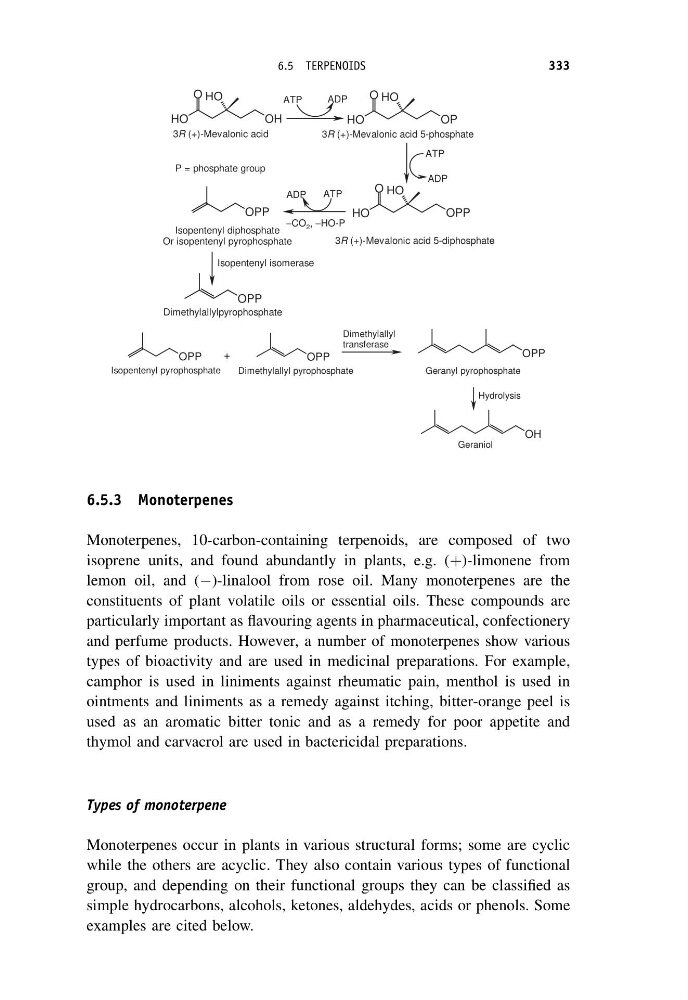
Monoterpenes, 10-carbon-containing terpenoids, are composed of two
isoprene units, and found abundantly in plants, e.g. (þ)-limonene from
lemon oil, and (À)-linalool from rose oil. Many monoterpenes are the
constituents of plant volatile oils or essential oils. These compounds are
particularly important as flavouring agents in pharmaceutical, confectionery
and perfume products. However, a number of monoterpenes show various
types of bioactivity and are used in medicinal preparations. For example,
camphor is used in liniments against rheumatic pain, menthol is used in
ointments and liniments as a remedy against itching, bitter-orange peel is
used as an aromatic bitter tonic and as a remedy for poor appetite and
thymol and carvacrol are used in bactericidal preparations.
Types of monoterpene
Monoterpenes occur in plants in various structural forms; some are cyclic
while the others are acyclic. They also contain various types of functional
group, and depending on their functional groups they can be classified as
simple hydrocarbons, alcohols, ketones, aldehydes, acids or phenols. Some
examples are cited below.
6.5 TERPENOIDS
333
H
O O
H
OH
O
H
O O
H
OP
O
H
O O
H
OPP
OPP
OPP
3R (+)-Mevalonic acid
ATP
ADP
3R (+)-Mevalonic acid 5-phosphate
ATP
ADP
3R (+)-Mevalonic acid 5-diphosphate
ATP
ADP
−CO 2 , −HO-P
Isopentenyl diphosphate
Or isopentenyl pyrophosphate
P = phosphate group
Isopentenyl isomerase
Dimethylallylpyrophosphate
OPP
OPP
OPP
OH
Isopentenyl pyrophosphate
Dimethylallyl
transferase
Dimethylallyl pyrophosphate
+
Geranyl pyrophosphate
Geraniol
Hydrolysis
6.5.3 Monoterpenes
Monoterpenes, 10-carbon-containing terpenoids, are composed of two
isoprene units, and found abundantly in plants, e.g. (þ)-limonene from
lemon oil, and (À)-linalool from rose oil. Many monoterpenes are the
constituents of plant volatile oils or essential oils. These compounds are
particularly important as flavouring agents in pharmaceutical, confectionery
and perfume products. However, a number of monoterpenes show various
types of bioactivity and are used in medicinal preparations. For example,
camphor is used in liniments against rheumatic pain, menthol is used in
ointments and liniments as a remedy against itching, bitter-orange peel is
used as an aromatic bitter tonic and as a remedy for poor appetite and
thymol and carvacrol are used in bactericidal preparations.
Types of monoterpene
Monoterpenes occur in plants in various structural forms; some are cyclic
while the others are acyclic. They also contain various types of functional
group, and depending on their functional groups they can be classified as
simple hydrocarbons, alcohols, ketones, aldehydes, acids or phenols. Some
examples are cited below.
6.5 TERPENOIDS
333