

glycogen for long term storage. It can release glucose units if cellular glucose
levels are low. Glycogen ‘mops up’ excess glucose in cells. Like amylopectin,
glycogen contains a complex branching structure with both 1,4
0 and 1,6
0 links,
but it is larger than amylopectin (up to 100 000 glucose units) and much more
branched. It has one end glucose unit (where glucose can be added or released)
for every 12 units and a branch in every six glucose units.
Cellulose
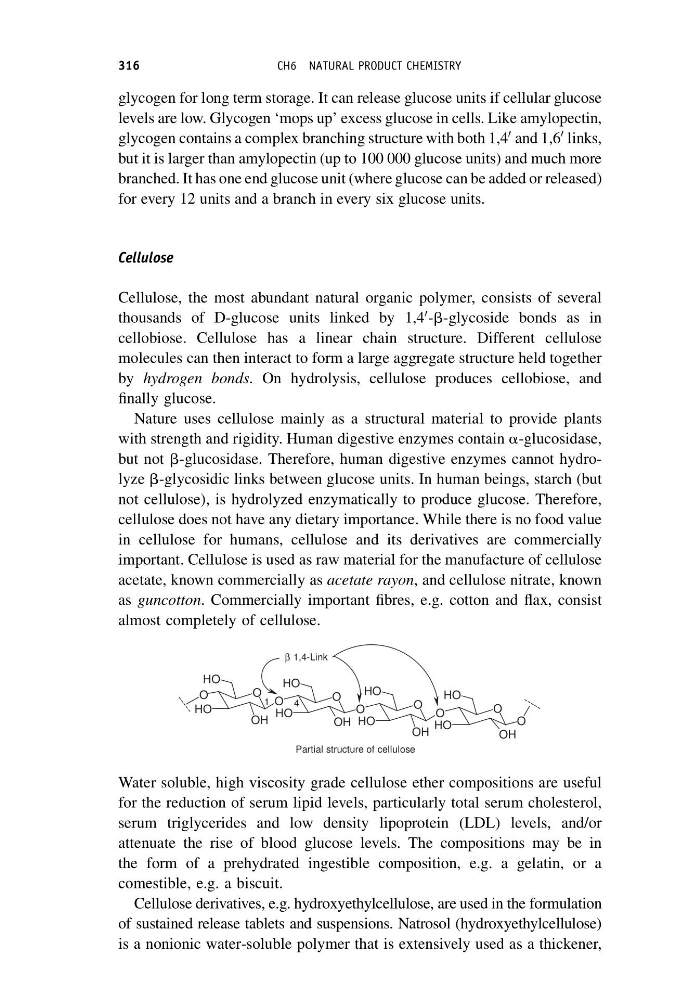
Cellulose, the most abundant natural organic polymer, consists of several
thousands of D-glucose units linked by 1,4
0 -b-glycoside bonds as in
cellobiose. Cellulose has a linear chain structure. Different cellulose
molecules can then interact to form a large aggregate structure held together
by hydrogen bonds. On hydrolysis, cellulose produces cellobiose, and
finally glucose.
Nature uses cellulose mainly as a structural material to provide plants
with strength and rigidity. Human digestive enzymes contain a-glucosidase,
but not b-glucosidase. Therefore, human digestive enzymes cannot hydrolyze b-glycosidic links between glucose units. In human beings, starch (but
not cellulose), is hydrolyzed enzymatically to produce glucose. Therefore,
cellulose does not have any dietary importance. While there is no food value
in cellulose for humans, cellulose and its derivatives are commercially
important. Cellulose is used as raw material for the manufacture of cellulose
acetate, known commercially as acetate rayon, and cellulose nitrate, known
as guncotton. Commercially important fibres, e.g. cotton and flax, consist
almost completely of cellulose.
O
O
H
O
O
H
OH
O
O
O
H
O
OH
O
O
H
O
O
H
OH
O
O
H
O
O
H
OH
O
H
β 1,4-Link
4
1
Partial structure of cellulose
Water soluble, high viscosity grade cellulose ether compositions are useful
for the reduction of serum lipid levels, particularly total serum cholesterol,
serum triglycerides and low density lipoprotein (LDL) levels, and/or
attenuate the rise of blood glucose levels. The compositions may be in
the form of a prehydrated ingestible composition, e.g. a gelatin, or a
comestible, e.g. a biscuit.
Cellulose derivatives, e.g. hydroxyethylcellulose, are used in the formulation
of sustained release tablets and suspensions. Natrosol (hydroxyethylcellulose)
is a nonionic water-soluble polymer that is extensively used as a thickener,
316
CH6 NATURAL PRODUCT CHEMISTRY
levels are low. Glycogen ‘mops up’ excess glucose in cells. Like amylopectin,
glycogen contains a complex branching structure with both 1,4
0 and 1,6
0 links,
but it is larger than amylopectin (up to 100 000 glucose units) and much more
branched. It has one end glucose unit (where glucose can be added or released)
for every 12 units and a branch in every six glucose units.
Cellulose
Cellulose, the most abundant natural organic polymer, consists of several
thousands of D-glucose units linked by 1,4
0 -b-glycoside bonds as in
cellobiose. Cellulose has a linear chain structure. Different cellulose
molecules can then interact to form a large aggregate structure held together
by hydrogen bonds. On hydrolysis, cellulose produces cellobiose, and
finally glucose.
Nature uses cellulose mainly as a structural material to provide plants
with strength and rigidity. Human digestive enzymes contain a-glucosidase,
but not b-glucosidase. Therefore, human digestive enzymes cannot hydrolyze b-glycosidic links between glucose units. In human beings, starch (but
not cellulose), is hydrolyzed enzymatically to produce glucose. Therefore,
cellulose does not have any dietary importance. While there is no food value
in cellulose for humans, cellulose and its derivatives are commercially
important. Cellulose is used as raw material for the manufacture of cellulose
acetate, known commercially as acetate rayon, and cellulose nitrate, known
as guncotton. Commercially important fibres, e.g. cotton and flax, consist
almost completely of cellulose.
O
O
H
O
O
H
OH
O
O
O
H
O
OH
O
O
H
O
O
H
OH
O
O
H
O
O
H
OH
O
H
β 1,4-Link
4
1
Partial structure of cellulose
Water soluble, high viscosity grade cellulose ether compositions are useful
for the reduction of serum lipid levels, particularly total serum cholesterol,
serum triglycerides and low density lipoprotein (LDL) levels, and/or
attenuate the rise of blood glucose levels. The compositions may be in
the form of a prehydrated ingestible composition, e.g. a gelatin, or a
comestible, e.g. a biscuit.
Cellulose derivatives, e.g. hydroxyethylcellulose, are used in the formulation
of sustained release tablets and suspensions. Natrosol (hydroxyethylcellulose)
is a nonionic water-soluble polymer that is extensively used as a thickener,
316
CH6 NATURAL PRODUCT CHEMISTRY