

6.1.2 Natural products in medicine
The use of natural products, especially plants, for healing is as ancient and
universal as medicine itself. The therapeutic use of plants certainly goes
back to the Sumerian and the Akkadian civilizations in about the third
millenium BC. Hippocrates (ca. 460–377 BC), one of the ancient authors
who described medicinal natural products of plant and animal origins, listed
approximately 400 different plant species for medicinal purposes. Natural
products have been an integral part of the ancient traditional medicine
systems, e.g. Chinese, Ayurvedic and Egyptian. Even now, continuous
traditions of natural product therapy exist throughout the third world,
especially in the orient, where numerous minerals, animal substances and
plants are still in common use. According to the World Health Organisation
(WHO), some 3.4 billion people in the developing world depend on plantbased traditional medicines. This represents about 88 per cent of the world’s
inhabitants, who rely mainly on traditional medicine for their primary health
care. In China alone, 7295 plant species are utilized as medicinal agents.
Nature has been a potential source of therapeutic agents for thousands of
years. An impressive number of modern drugs have been derived from natural
sources. Over the last century, a number of top selling drugs have been developed
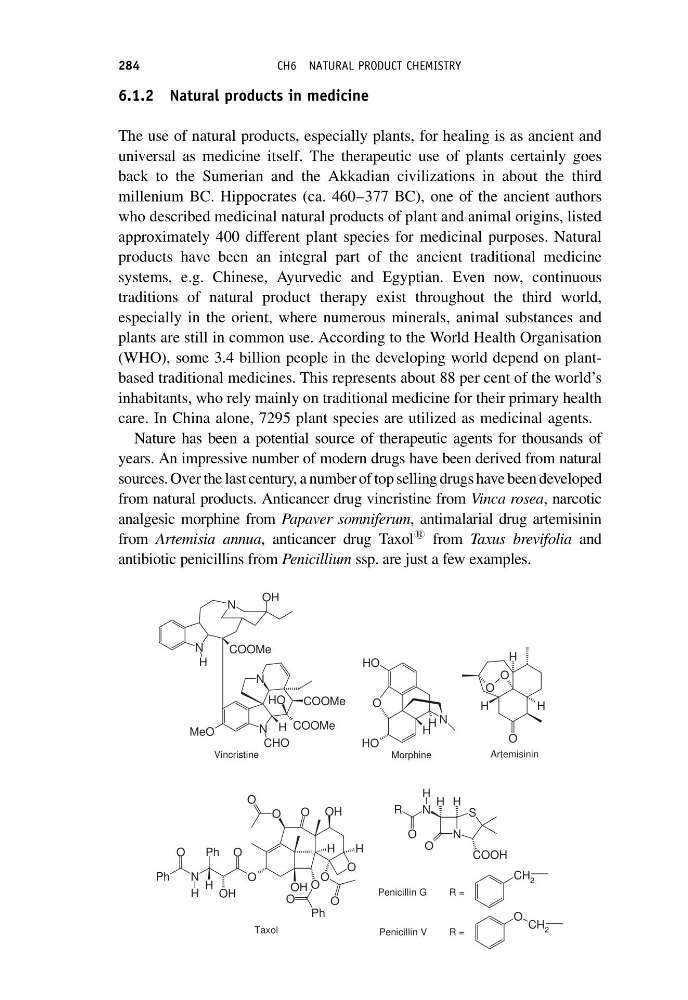
from natural products. Anticancer drug vincristine from Vinca rosea, narcotic
analgesic morphine from Papaver somniferum, antimalarial drug artemisinin
from Artemisia annua, anticancer drug Taxol
1 from Taxus brevifolia and
antibiotic penicillins from Penicillium ssp. are just a few examples.
O
H
H
O
O
H
O
O
H
O
H
H
N
H
N
H
N
COOMe
OH
N
N
CHO
H COOMe
O
H
COOMe
MeO
Artemisinin
Morphine
Vincristine
O
O
O
OH
OH
H
O
H
O
O
N
O
O
H
OH
H
O
O
O
Ph
Ph
Ph
N
S
O
COOH
H
N
H
O
R
H
CH 2
O CH 2
Taxol
Penicillin G
R =
Penicillin V
R =
284
CH6 NATURAL PRODUCT CHEMISTRY
The use of natural products, especially plants, for healing is as ancient and
universal as medicine itself. The therapeutic use of plants certainly goes
back to the Sumerian and the Akkadian civilizations in about the third
millenium BC. Hippocrates (ca. 460–377 BC), one of the ancient authors
who described medicinal natural products of plant and animal origins, listed
approximately 400 different plant species for medicinal purposes. Natural
products have been an integral part of the ancient traditional medicine
systems, e.g. Chinese, Ayurvedic and Egyptian. Even now, continuous
traditions of natural product therapy exist throughout the third world,
especially in the orient, where numerous minerals, animal substances and
plants are still in common use. According to the World Health Organisation
(WHO), some 3.4 billion people in the developing world depend on plantbased traditional medicines. This represents about 88 per cent of the world’s
inhabitants, who rely mainly on traditional medicine for their primary health
care. In China alone, 7295 plant species are utilized as medicinal agents.
Nature has been a potential source of therapeutic agents for thousands of
years. An impressive number of modern drugs have been derived from natural
sources. Over the last century, a number of top selling drugs have been developed
from natural products. Anticancer drug vincristine from Vinca rosea, narcotic
analgesic morphine from Papaver somniferum, antimalarial drug artemisinin
from Artemisia annua, anticancer drug Taxol
1 from Taxus brevifolia and
antibiotic penicillins from Penicillium ssp. are just a few examples.
O
H
H
O
O
H
O
O
H
O
H
H
N
H
N
H
N
COOMe
OH
N
N
CHO
H COOMe
O
H
COOMe
MeO
Artemisinin
Morphine
Vincristine
O
O
O
OH
OH
H
O
H
O
O
N
O
O
H
OH
H
O
O
O
Ph
Ph
Ph
N
S
O
COOH
H
N
H
O
R
H
CH 2
O CH 2
Taxol
Penicillin G
R =
Penicillin V
R =
284
CH6 NATURAL PRODUCT CHEMISTRY