

5.7.22 Reduction of esters
Preparation of primary alcohols
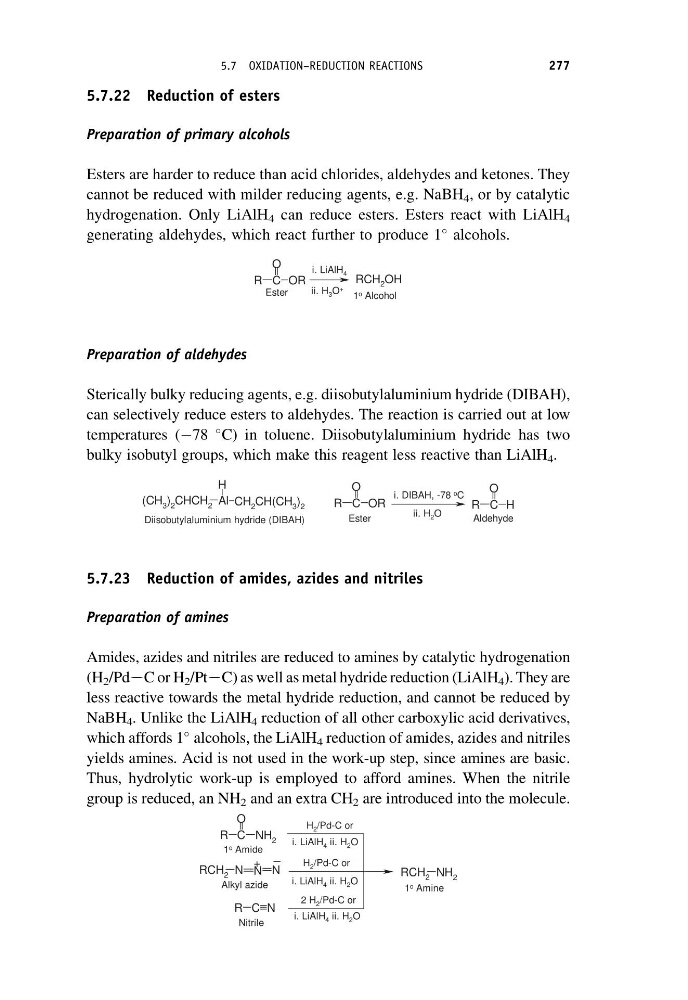
Esters are harder to reduce than acid chlorides, aldehydes and ketones. They
cannot be reduced with milder reducing agents, e.g. NaBH 4 , or by catalytic
hydrogenation. Only LiAlH 4 can reduce esters. Esters react with LiAlH 4
generating aldehydes, which react further to produce 1
alcohols.
R C
O
OR
ii. H 3 O +
i. LiAlH 4
1 o Alcohol
RCH 2 OH
Ester
Preparation of aldehydes
Sterically bulky reducing agents, e.g. diisobutylaluminium hydride (DIBAH),
can selectively reduce esters to aldehydes. The reaction is carried out at low
temperatures (À78
C) in toluene. Diisobutylaluminium hydride has two
bulky isobutyl groups, which make this reagent less reactive than LiAlH 4 .
R C
O
OR
(CH 3 ) 2 CHCH 2 Al CH 2 CH(CH 3 ) 2
H
R C
O
H
ii. H 2 O
i. DIBAH, -78 o C
Aldehyde
Diisobutylaluminium hydride (DIBAH)
Ester
5.7.23 Reduction of amides, azides and nitriles
Preparation of amines
Amides, azides and nitriles are reduced to amines by catalytic hydrogenation
(H 2 /PdÀ ÀC or H 2 /PtÀ ÀC) as well as metal hydride reduction (LiAlH 4 ). They are
less reactive towards the metal hydride reduction, and cannot be reduced by
NaBH 4 . Unlike the LiAlH 4 reduction of all other carboxylic acid derivatives,
which affords 1
alcohols, the LiAlH 4 reduction of amides, azides and nitriles
yields amines. Acid is not used in the work-up step, since amines are basic.
Thus, hydrolytic work-up is employed to afford amines. When the nitrile
group is reduced, an NH 2 and an extra CH 2 are introduced into the molecule.
R C NH 2
O
R C N
RCH 2 N N N
RCH 2 NH 2
1 o Amide
1 o Amine
Nitrile
H 2 /Pd-C or
H 2 /Pd-C or
+
_
i. LiAlH 4 ii. H 2 O
2 H 2 /Pd-C or
Alkyl azide
i. LiAlH 4 ii. H 2 O
i. LiAlH 4 ii. H 2 O
5.7 OXIDATION–REDUCTION REACTIONS
277
Preparation of primary alcohols
Esters are harder to reduce than acid chlorides, aldehydes and ketones. They
cannot be reduced with milder reducing agents, e.g. NaBH 4 , or by catalytic
hydrogenation. Only LiAlH 4 can reduce esters. Esters react with LiAlH 4
generating aldehydes, which react further to produce 1
alcohols.
R C
O
OR
ii. H 3 O +
i. LiAlH 4
1 o Alcohol
RCH 2 OH
Ester
Preparation of aldehydes
Sterically bulky reducing agents, e.g. diisobutylaluminium hydride (DIBAH),
can selectively reduce esters to aldehydes. The reaction is carried out at low
temperatures (À78
C) in toluene. Diisobutylaluminium hydride has two
bulky isobutyl groups, which make this reagent less reactive than LiAlH 4 .
R C
O
OR
(CH 3 ) 2 CHCH 2 Al CH 2 CH(CH 3 ) 2
H
R C
O
H
ii. H 2 O
i. DIBAH, -78 o C
Aldehyde
Diisobutylaluminium hydride (DIBAH)
Ester
5.7.23 Reduction of amides, azides and nitriles
Preparation of amines
Amides, azides and nitriles are reduced to amines by catalytic hydrogenation
(H 2 /PdÀ ÀC or H 2 /PtÀ ÀC) as well as metal hydride reduction (LiAlH 4 ). They are
less reactive towards the metal hydride reduction, and cannot be reduced by
NaBH 4 . Unlike the LiAlH 4 reduction of all other carboxylic acid derivatives,
which affords 1
alcohols, the LiAlH 4 reduction of amides, azides and nitriles
yields amines. Acid is not used in the work-up step, since amines are basic.
Thus, hydrolytic work-up is employed to afford amines. When the nitrile
group is reduced, an NH 2 and an extra CH 2 are introduced into the molecule.
R C NH 2
O
R C N
RCH 2 N N N
RCH 2 NH 2
1 o Amide
1 o Amine
Nitrile
H 2 /Pd-C or
H 2 /Pd-C or
+
_
i. LiAlH 4 ii. H 2 O
2 H 2 /Pd-C or
Alkyl azide
i. LiAlH 4 ii. H 2 O
i. LiAlH 4 ii. H 2 O
5.7 OXIDATION–REDUCTION REACTIONS
277