

processes are involved in the transfer of this stored genetic information.
Replication. This process creates the identical copies of DNA, so that
information can be preserved and handed down to offspring.
Transcription. This process reads the stored genetic information and
brings it out of the nucleus to ribosomes, where protein synthesis occurs.
Translation. In this process, the genetic messages are decoded and used to
build proteins.
Replication of DNA
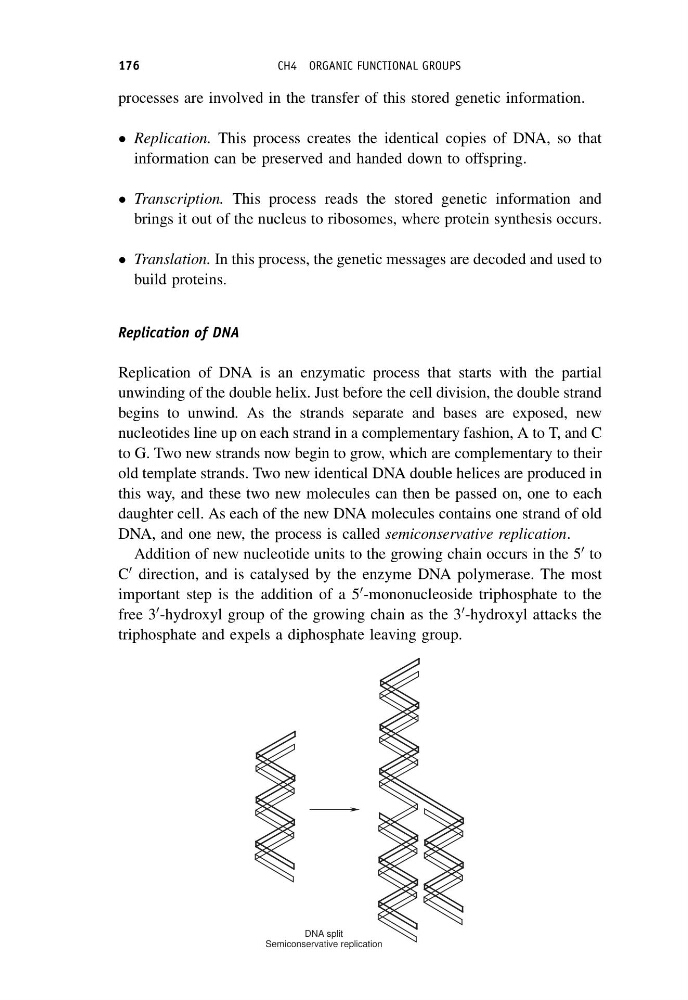
Replication of DNA is an enzymatic process that starts with the partial
unwinding of the double helix. Just before the cell division, the double strand
begins to unwind. As the strands separate and bases are exposed, new
nucleotides line up on each strand in a complementary fashion, A to T, and C
to G. Two new strands now begin to grow, which are complementary to their
old template strands. Two new identical DNA double helices are produced in
this way, and these two new molecules can then be passed on, one to each
daughter cell. As each of the new DNA molecules contains one strand of old
DNA, and one new, the process is called semiconservative replication.
Addition of new nucleotide units to the growing chain occurs in the 5
0 to
C
0 direction, and is catalysed by the enzyme DNA polymerase. The most
important step is the addition of a 5
0 -mononucleoside triphosphate to the
free 3
0 -hydroxyl group of the growing chain as the 3
0 -hydroxyl attacks the
triphosphate and expels a diphosphate leaving group.
DNA split
Semiconservative replication
176
CH4 ORGANIC FUNCTIONAL GROUPS
Replication. This process creates the identical copies of DNA, so that
information can be preserved and handed down to offspring.
Transcription. This process reads the stored genetic information and
brings it out of the nucleus to ribosomes, where protein synthesis occurs.
Translation. In this process, the genetic messages are decoded and used to
build proteins.
Replication of DNA
Replication of DNA is an enzymatic process that starts with the partial
unwinding of the double helix. Just before the cell division, the double strand
begins to unwind. As the strands separate and bases are exposed, new
nucleotides line up on each strand in a complementary fashion, A to T, and C
to G. Two new strands now begin to grow, which are complementary to their
old template strands. Two new identical DNA double helices are produced in
this way, and these two new molecules can then be passed on, one to each
daughter cell. As each of the new DNA molecules contains one strand of old
DNA, and one new, the process is called semiconservative replication.
Addition of new nucleotide units to the growing chain occurs in the 5
0 to
C
0 direction, and is catalysed by the enzyme DNA polymerase. The most
important step is the addition of a 5
0 -mononucleoside triphosphate to the
free 3
0 -hydroxyl group of the growing chain as the 3
0 -hydroxyl attacks the
triphosphate and expels a diphosphate leaving group.
DNA split
Semiconservative replication
176
CH4 ORGANIC FUNCTIONAL GROUPS