

(a) The total mole percentage of purines is approximately equal to that of
the pyrimidines; i.e., (%G + %A)/(%C + %T) ffi 1.
(b) The mole percentage of adenine is nearly equal to that of thymine, i.e
%A/%T ffi 1, and same is true for guanine and cytosine, i.e. %G/%C ffi 1.
To provide explanations for some of these earlier findings, the secondary
structure of DNA was first proposed by James Watson and Francis Crick in
1953, and was verified shortly thereafter through X-ray crystallographic
analysis by Wilkins. According to the Watson–Crick model, DNA consists
of two polynucleotide strands coiled around each other in a double helix like
the handrails on a spiral staircase. The two strands run in opposite directions
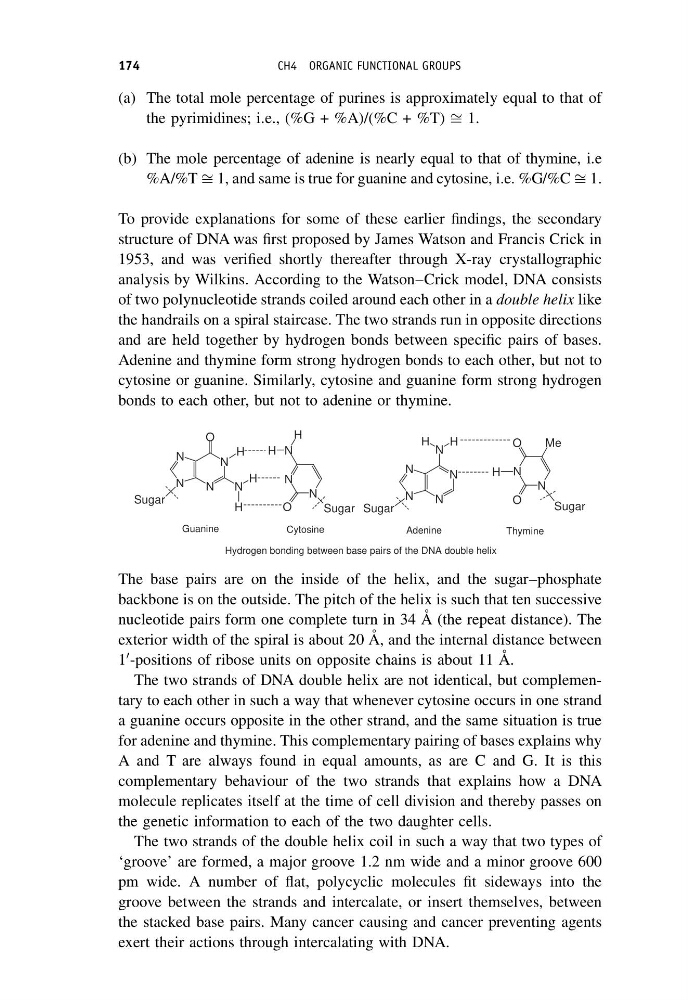
and are held together by hydrogen bonds between specific pairs of bases.
Adenine and thymine form strong hydrogen bonds to each other, but not to
cytosine or guanine. Similarly, cytosine and guanine form strong hydrogen
bonds to each other, but not to adenine or thymine.
N
N
N
N
O
Sugar
H
N
H
H
N
N
O
N
H
H
Sugar
N
N
N
N
Sugar
N
H
H
N
N
O
Sugar
O
Me
H
Guanine
Cytosine
Hydrogen bonding between base pairs of the DNA double helix
Adenine
Thymine
The base pairs are on the inside of the helix, and the sugar–phosphate
backbone is on the outside. The pitch of the helix is such that ten successive
nucleotide pairs form one complete turn in 34 A ˚ (the repeat distance). The
exterior width of the spiral is about 20 A ˚ , and the internal distance between
1
0 -positions of ribose units on opposite chains is about 11 A ˚ .
The two strands of DNA double helix are not identical, but complementary to each other in such a way that whenever cytosine occurs in one strand
a guanine occurs opposite in the other strand, and the same situation is true
for adenine and thymine. This complementary pairing of bases explains why
A and T are always found in equal amounts, as are C and G. It is this
complementary behaviour of the two strands that explains how a DNA
molecule replicates itself at the time of cell division and thereby passes on
the genetic information to each of the two daughter cells.
The two strands of the double helix coil in such a way that two types of
‘groove’ are formed, a major groove 1.2 nm wide and a minor groove 600
pm wide. A number of flat, polycyclic molecules fit sideways into the
groove between the strands and intercalate, or insert themselves, between
the stacked base pairs. Many cancer causing and cancer preventing agents
exert their actions through intercalating with DNA.
174
CH4 ORGANIC FUNCTIONAL GROUPS
the pyrimidines; i.e., (%G + %A)/(%C + %T) ffi 1.
(b) The mole percentage of adenine is nearly equal to that of thymine, i.e
%A/%T ffi 1, and same is true for guanine and cytosine, i.e. %G/%C ffi 1.
To provide explanations for some of these earlier findings, the secondary
structure of DNA was first proposed by James Watson and Francis Crick in
1953, and was verified shortly thereafter through X-ray crystallographic
analysis by Wilkins. According to the Watson–Crick model, DNA consists
of two polynucleotide strands coiled around each other in a double helix like
the handrails on a spiral staircase. The two strands run in opposite directions
and are held together by hydrogen bonds between specific pairs of bases.
Adenine and thymine form strong hydrogen bonds to each other, but not to
cytosine or guanine. Similarly, cytosine and guanine form strong hydrogen
bonds to each other, but not to adenine or thymine.
N
N
N
N
O
Sugar
H
N
H
H
N
N
O
N
H
H
Sugar
N
N
N
N
Sugar
N
H
H
N
N
O
Sugar
O
Me
H
Guanine
Cytosine
Hydrogen bonding between base pairs of the DNA double helix
Adenine
Thymine
The base pairs are on the inside of the helix, and the sugar–phosphate
backbone is on the outside. The pitch of the helix is such that ten successive
nucleotide pairs form one complete turn in 34 A ˚ (the repeat distance). The
exterior width of the spiral is about 20 A ˚ , and the internal distance between
1
0 -positions of ribose units on opposite chains is about 11 A ˚ .
The two strands of DNA double helix are not identical, but complementary to each other in such a way that whenever cytosine occurs in one strand
a guanine occurs opposite in the other strand, and the same situation is true
for adenine and thymine. This complementary pairing of bases explains why
A and T are always found in equal amounts, as are C and G. It is this
complementary behaviour of the two strands that explains how a DNA
molecule replicates itself at the time of cell division and thereby passes on
the genetic information to each of the two daughter cells.
The two strands of the double helix coil in such a way that two types of
‘groove’ are formed, a major groove 1.2 nm wide and a minor groove 600
pm wide. A number of flat, polycyclic molecules fit sideways into the
groove between the strands and intercalate, or insert themselves, between
the stacked base pairs. Many cancer causing and cancer preventing agents
exert their actions through intercalating with DNA.
174
CH4 ORGANIC FUNCTIONAL GROUPS