

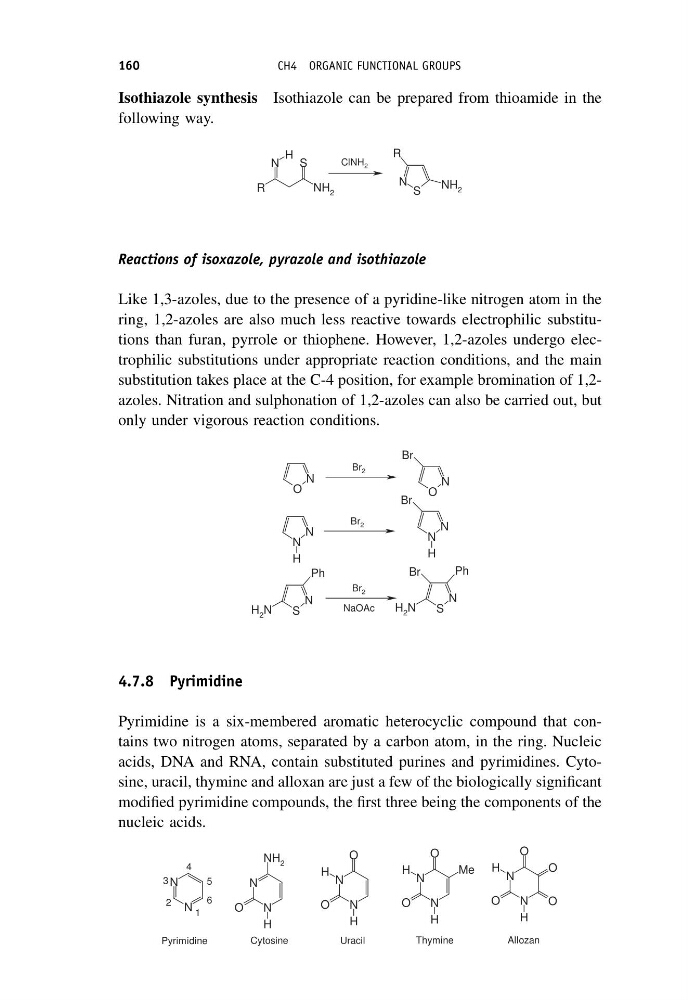
Isothiazole synthesis Isothiazole can be prepared from thioamide in the
following way.
R
N
S
NH 2
H
N
S
R
NH 2
ClNH 2
Reactions of isoxazole, pyrazole and isothiazole
Like 1,3-azoles, due to the presence of a pyridine-like nitrogen atom in the
ring, 1,2-azoles are also much less reactive towards electrophilic substitutions than furan, pyrrole or thiophene. However, 1,2-azoles undergo electrophilic substitutions under appropriate reaction conditions, and the main
substitution takes place at the C-4 position, for example bromination of 1,2azoles. Nitration and sulphonation of 1,2-azoles can also be carried out, but
only under vigorous reaction conditions.
O
N
N
N
H
S
N
N
H 2
Ph
O
N
Br
N
N
Br
H
S
N
N
H 2
Ph
Br
Br 2
Br 2
Br 2
NaOAc
4.7.8 Pyrimidine
Pyrimidine is a six-membered aromatic heterocyclic compound that contains two nitrogen atoms, separated by a carbon atom, in the ring. Nucleic
acids, DNA and RNA, contain substituted purines and pyrimidines. Cytosine, uracil, thymine and alloxan are just a few of the biologically significant
modified pyrimidine compounds, the first three being the components of the
nucleic acids.
N
N
N
N
O
H
O
H
N
N
Me
O
H
O
H
N
N
NH 2
O
H
N
N
H
H
O
O
O
O
1
2
3
5
4
6
Pyrimidine
Cytosine
Uracil
Thymine
Allozan
160
CH4 ORGANIC FUNCTIONAL GROUPS
following way.
R
N
S
NH 2
H
N
S
R
NH 2
ClNH 2
Reactions of isoxazole, pyrazole and isothiazole
Like 1,3-azoles, due to the presence of a pyridine-like nitrogen atom in the
ring, 1,2-azoles are also much less reactive towards electrophilic substitutions than furan, pyrrole or thiophene. However, 1,2-azoles undergo electrophilic substitutions under appropriate reaction conditions, and the main
substitution takes place at the C-4 position, for example bromination of 1,2azoles. Nitration and sulphonation of 1,2-azoles can also be carried out, but
only under vigorous reaction conditions.
O
N
N
N
H
S
N
N
H 2
Ph
O
N
Br
N
N
Br
H
S
N
N
H 2
Ph
Br
Br 2
Br 2
Br 2
NaOAc
4.7.8 Pyrimidine
Pyrimidine is a six-membered aromatic heterocyclic compound that contains two nitrogen atoms, separated by a carbon atom, in the ring. Nucleic
acids, DNA and RNA, contain substituted purines and pyrimidines. Cytosine, uracil, thymine and alloxan are just a few of the biologically significant
modified pyrimidine compounds, the first three being the components of the
nucleic acids.
N
N
N
N
O
H
O
H
N
N
Me
O
H
O
H
N
N
NH 2
O
H
N
N
H
H
O
O
O
O
1
2
3
5
4
6
Pyrimidine
Cytosine
Uracil
Thymine
Allozan
160
CH4 ORGANIC FUNCTIONAL GROUPS