

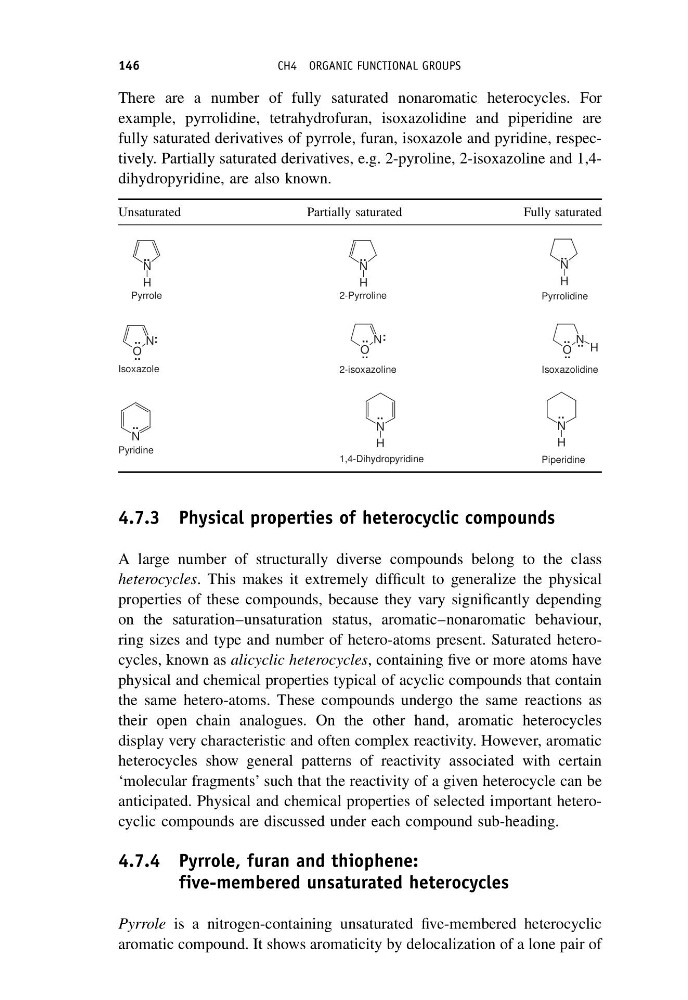
There are a number of fully saturated nonaromatic heterocycles. For
example, pyrrolidine, tetrahydrofuran, isoxazolidine and piperidine are
fully saturated derivatives of pyrrole, furan, isoxazole and pyridine, respectively. Partially saturated derivatives, e.g. 2-pyroline, 2-isoxazoline and 1,4dihydropyridine, are also known.
Unsaturated
Partially saturated
Fully saturated
N
H
..
Pyrrole
N
H
..
2-Pyrroline
N
H
..
Pyrrolidine
O
N
..
..
Isoxazole
:
O
N
..
.. :
2-isoxazoline
O
N H
..
.. ..
Isoxazolidine
N
..
Pyridine
N
H
1,4-Dihydropyridine
..
N
H
Piperidine
..
4.7.3 Physical properties of heterocyclic compounds
A large number of structurally diverse compounds belong to the class
heterocycles. This makes it extremely difficult to generalize the physical
properties of these compounds, because they vary significantly depending
on the saturation–unsaturation status, aromatic–nonaromatic behaviour,
ring sizes and type and number of hetero-atoms present. Saturated heterocycles, known as alicyclic heterocycles, containing five or more atoms have
physical and chemical properties typical of acyclic compounds that contain
the same hetero-atoms. These compounds undergo the same reactions as
their open chain analogues. On the other hand, aromatic heterocycles
display very characteristic and often complex reactivity. However, aromatic
heterocycles show general patterns of reactivity associated with certain
‘molecular fragments’ such that the reactivity of a given heterocycle can be
anticipated. Physical and chemical properties of selected important heterocyclic compounds are discussed under each compound sub-heading.
4.7.4 Pyrrole, furan and thiophene:
five-membered unsaturated heterocycles
Pyrrole is a nitrogen-containing unsaturated five-membered heterocyclic
aromatic compound. It shows aromaticity by delocalization of a lone pair of
146
CH4 ORGANIC FUNCTIONAL GROUPS
example, pyrrolidine, tetrahydrofuran, isoxazolidine and piperidine are
fully saturated derivatives of pyrrole, furan, isoxazole and pyridine, respectively. Partially saturated derivatives, e.g. 2-pyroline, 2-isoxazoline and 1,4dihydropyridine, are also known.
Unsaturated
Partially saturated
Fully saturated
N
H
..
Pyrrole
N
H
..
2-Pyrroline
N
H
..
Pyrrolidine
O
N
..
..
Isoxazole
:
O
N
..
.. :
2-isoxazoline
O
N H
..
.. ..
Isoxazolidine
N
..
Pyridine
N
H
1,4-Dihydropyridine
..
N
H
Piperidine
..
4.7.3 Physical properties of heterocyclic compounds
A large number of structurally diverse compounds belong to the class
heterocycles. This makes it extremely difficult to generalize the physical
properties of these compounds, because they vary significantly depending
on the saturation–unsaturation status, aromatic–nonaromatic behaviour,
ring sizes and type and number of hetero-atoms present. Saturated heterocycles, known as alicyclic heterocycles, containing five or more atoms have
physical and chemical properties typical of acyclic compounds that contain
the same hetero-atoms. These compounds undergo the same reactions as
their open chain analogues. On the other hand, aromatic heterocycles
display very characteristic and often complex reactivity. However, aromatic
heterocycles show general patterns of reactivity associated with certain
‘molecular fragments’ such that the reactivity of a given heterocycle can be
anticipated. Physical and chemical properties of selected important heterocyclic compounds are discussed under each compound sub-heading.
4.7.4 Pyrrole, furan and thiophene:
five-membered unsaturated heterocycles
Pyrrole is a nitrogen-containing unsaturated five-membered heterocyclic
aromatic compound. It shows aromaticity by delocalization of a lone pair of
146
CH4 ORGANIC FUNCTIONAL GROUPS