

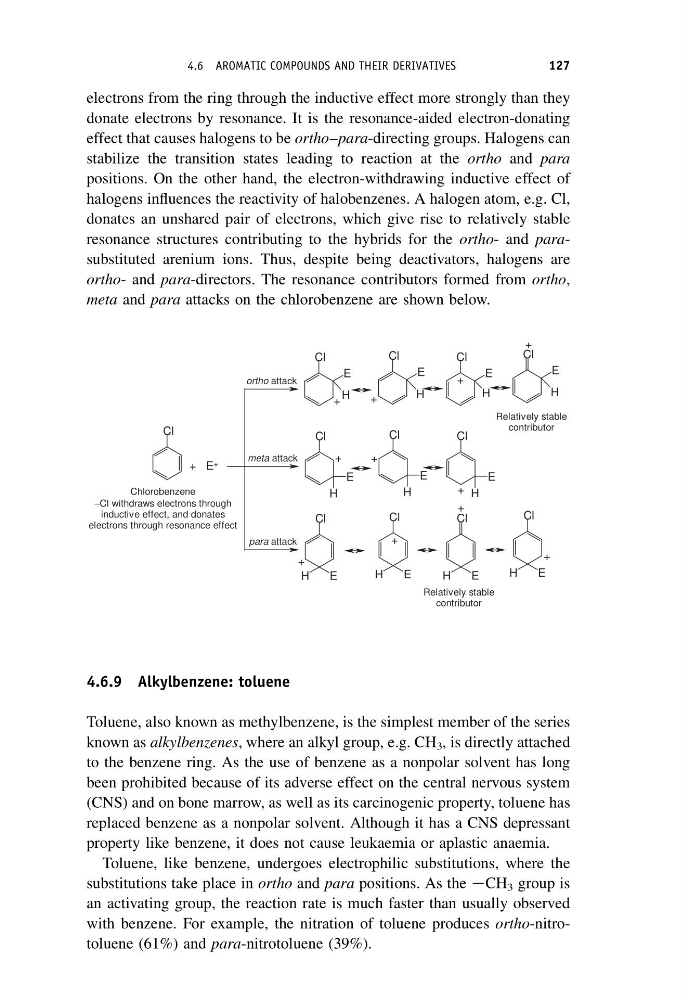
electrons from the ring through the inductive effect more strongly than they
donate electrons by resonance. It is the resonance-aided electron-donating
effect that causes halogens to be ortho–para-directing groups. Halogens can
stabilize the transition states leading to reaction at the ortho and para
positions. On the other hand, the electron-withdrawing inductive effect of
halogens influences the reactivity of halobenzenes. A halogen atom, e.g. Cl,
donates an unshared pair of electrons, which give rise to relatively stable
resonance structures contributing to the hybrids for the ortho- and parasubstituted arenium ions. Thus, despite being deactivators, halogens are
ortho- and para-directors. The resonance contributors formed from ortho,
meta and para attacks on the chlorobenzene are shown below.
Cl
E
H
Cl
E
H
Cl
E
H
Cl
E
H
Cl
Cl
E
H
Cl
E
H
Cl
E
H
Cl
H
E
Cl
H
E
Cl
E
H
H
E
Cl
+ E +
Chlorobenzene
−Cl withdraws electrons through
inductive effect, and donates
electrons through resonance effect
ortho attack
meta attack
para attack
+
+
+
+
+
+
+
+
+
+
+
Relatively stable
contributor
Relatively stable
contributor
4.6.9 Alkylbenzene: toluene
Toluene, also known as methylbenzene, is the simplest member of the series
known as alkylbenzenes, where an alkyl group, e.g. CH 3 , is directly attached
to the benzene ring. As the use of benzene as a nonpolar solvent has long
been prohibited because of its adverse effect on the central nervous system
(CNS) and on bone marrow, as well as its carcinogenic property, toluene has
replaced benzene as a nonpolar solvent. Although it has a CNS depressant
property like benzene, it does not cause leukaemia or aplastic anaemia.
Toluene, like benzene, undergoes electrophilic substitutions, where the
substitutions take place in ortho and para positions. As the À ÀCH 3 group is
an activating group, the reaction rate is much faster than usually observed
with benzene. For example, the nitration of toluene produces ortho-nitrotoluene (61%) and para-nitrotoluene (39%).
4.6 AROMATIC COMPOUNDS AND THEIR DERIVATIVES
127
donate electrons by resonance. It is the resonance-aided electron-donating
effect that causes halogens to be ortho–para-directing groups. Halogens can
stabilize the transition states leading to reaction at the ortho and para
positions. On the other hand, the electron-withdrawing inductive effect of
halogens influences the reactivity of halobenzenes. A halogen atom, e.g. Cl,
donates an unshared pair of electrons, which give rise to relatively stable
resonance structures contributing to the hybrids for the ortho- and parasubstituted arenium ions. Thus, despite being deactivators, halogens are
ortho- and para-directors. The resonance contributors formed from ortho,
meta and para attacks on the chlorobenzene are shown below.
Cl
E
H
Cl
E
H
Cl
E
H
Cl
E
H
Cl
Cl
E
H
Cl
E
H
Cl
E
H
Cl
H
E
Cl
H
E
Cl
E
H
H
E
Cl
+ E +
Chlorobenzene
−Cl withdraws electrons through
inductive effect, and donates
electrons through resonance effect
ortho attack
meta attack
para attack
+
+
+
+
+
+
+
+
+
+
+
Relatively stable
contributor
Relatively stable
contributor
4.6.9 Alkylbenzene: toluene
Toluene, also known as methylbenzene, is the simplest member of the series
known as alkylbenzenes, where an alkyl group, e.g. CH 3 , is directly attached
to the benzene ring. As the use of benzene as a nonpolar solvent has long
been prohibited because of its adverse effect on the central nervous system
(CNS) and on bone marrow, as well as its carcinogenic property, toluene has
replaced benzene as a nonpolar solvent. Although it has a CNS depressant
property like benzene, it does not cause leukaemia or aplastic anaemia.
Toluene, like benzene, undergoes electrophilic substitutions, where the
substitutions take place in ortho and para positions. As the À ÀCH 3 group is
an activating group, the reaction rate is much faster than usually observed
with benzene. For example, the nitration of toluene produces ortho-nitrotoluene (61%) and para-nitrotoluene (39%).
4.6 AROMATIC COMPOUNDS AND THEIR DERIVATIVES
127